
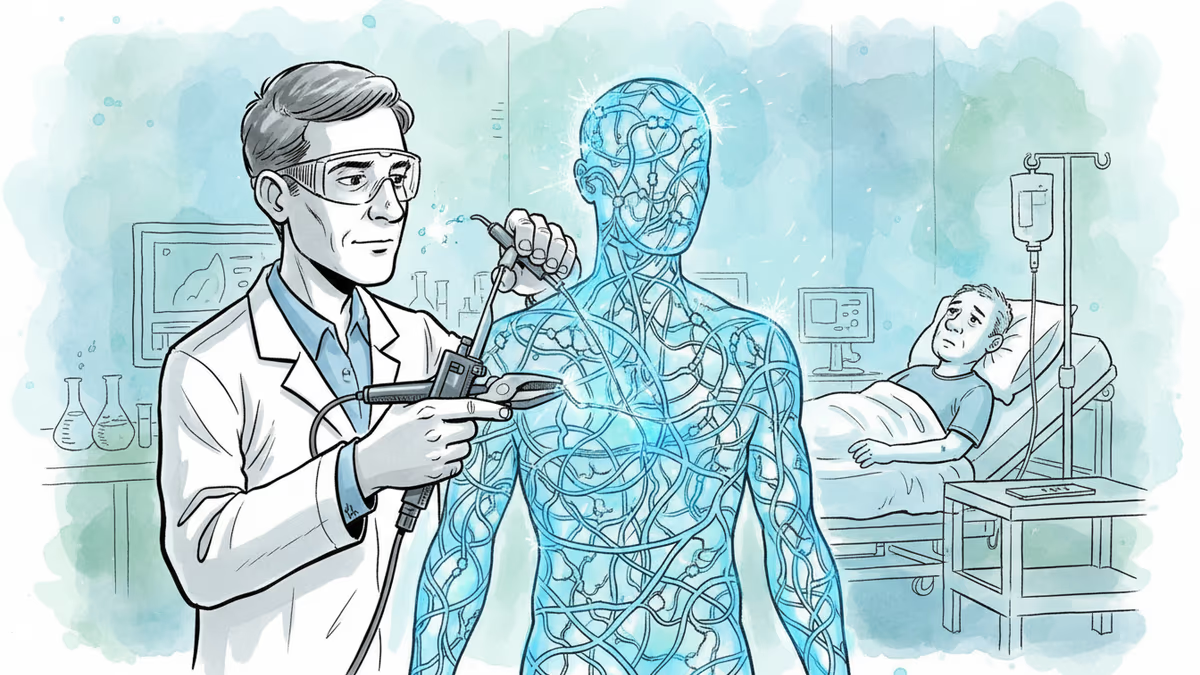
The Immune System's 'Undo Button'—Can Cancer Therapy Reset Autoimmune Disease?
CAR T cell therapy, proven in blood cancers, is now in hundreds of clinical trials for MS, lupus, and other autoimmune conditions. What the science shows—and what it doesn't yet.
She Called the Clinic Every Two Months Until They Said Yes
At 49, Jan Janisch-Hanzlik was a nurse who could no longer do her nursing job. Multiple sclerosis had taken that. Then it took her confidence carrying her grandchildren—too many falls. She moved to a larger house to accommodate a wheelchair she feared was inevitable. The best available medication wasn't working. So when she heard about a clinical trial at the University of Nebraska Medical Center, near her home in Blair, she phoned the clinic every other month until they were ready to enroll her as their first patient.
The treatment she was waiting for wasn't developed for her disease. It was developed for cancer.
From the Oncology Ward to the Autoimmune Clinic
CAR T cell therapy works by extracting a patient's own immune cells—specifically T cells—reprogramming them in a laboratory to recognize and destroy a specific target, then infusing them back into the body. In blood cancers like certain leukemias and lymphomas, this approach has produced results that were unthinkable a decade ago: patients with no remaining options achieving long-term remission.
Autoimmune diseases present a mirror-image problem. Instead of the immune system failing to attack something dangerous, it attacks the body itself. In multiple sclerosis, immune cells erode the protective sheath around nerves. In lupus, they assault the kidneys and skin. In vasculitis, the blood vessel walls. The logic now being tested in hundreds of clinical trials is straightforward: if you can engineer T cells to hunt down and eliminate the specific immune cells causing this friendly-fire damage, the immune system might reset—returning to something closer to its state before the disease took hold.
Trials are currently underway for MS, lupus, Graves' disease, vasculitis, and several other conditions. Early results from some centers, including a research group at the University of Erlangen in Germany, have reported months to years of symptom-free remission in patients with severe autoimmune disease following a single treatment course.
The Gap Between Promise and Practice

The excitement is understandable. But the distance between a compelling clinical trial and a widely available treatment is long, and the obstacles are specific.
First, cost. A single course of CAR T therapy currently runs between $350,000 and $500,000 in cancer applications—and that's after years of manufacturing refinement. The production process requires extracting a patient's cells, shipping them to a specialized facility, genetically engineering them, quality-testing the batch, and returning them for infusion. It cannot be mass-produced like a pill.
Second, safety. CAR T therapy carries the risk of cytokine release syndrome—a severe inflammatory response that can be life-threatening and requires intensive monitoring. In cancer patients who may have months to live without treatment, this risk calculus is straightforward. In autoimmune patients who may live for decades with their condition, it's more complex.
Third, evidence. The cancer data for CAR T spans years and thousands of patients. The autoimmune data is still early, with smaller cohorts and shorter follow-up periods. Regulatory agencies in the US and Europe have not yet approved CAR T for any autoimmune indication. The clinical trials now running are generating the data that will—or won't—make that case.
Who Wins, Who Waits, Who Pays
The stakeholder map here is unusually complicated.
Patients like Janisch-Hanzlik, for whom existing treatments have failed, have the most direct stake. For them, a clinical trial is often the only remaining option—which explains the two-month phone calls.
Biotech and pharma companies see a market that dwarfs oncology. Autoimmune diseases affect an estimated 50 million Americans and hundreds of millions globally. The existing treatment market exceeds $150 billion annually, built largely on drugs that manage symptoms rather than address root causes. Novartis, Kite Pharma, and a growing field of smaller biotechs are investing heavily in autoimmune CAR T programs.
Insurers and health systems face a structural tension. A one-time treatment that produces durable remission could, in theory, cost less over a patient's lifetime than decades of expensive biologics. But the upfront price is extraordinary, and the durability of remission in autoimmune patients is still unproven at scale. The reimbursement frameworks that exist for CAR T in oncology were hard-won and remain contested; building equivalent frameworks for autoimmune indications will require that fight again.
Regulators are watching carefully. The FDA and EMA have well-established pathways for oncology CAR T. Autoimmune diseases are a broader, more heterogeneous population. Determining which patients are appropriate candidates—and what the acceptable risk threshold is for a non-terminal condition—is a genuinely difficult regulatory question, not just a bureaucratic one.
This content is AI-generated based on source articles. While we strive for accuracy, errors may occur. We recommend verifying with the original source.
Related Articles
R3 Bio wants to grow human bodies without brains as biological backups. The science is speculative. The ethics are explosive. And the legal framework doesn't exist yet.
Colossal Biosciences raised hundreds of millions to resurrect woolly mammoths and dire wolves. What they're actually doing is more complicated—and more interesting.
California startup R3 Bio quietly pitched investors on 'brainless human clones' as backup bodies—beyond its public story of nonsentient organ sacks for drug testing. A deep dive into biotech's most ethically charged frontier.
Max Hodak's Science Corp raises $230M for rice-grain sized chip that restores vision to blind patients. Could beat Neuralink as first BCI company to commercialize
R3 Bio wants to grow human bodies without brains as biological backups. The science is speculative. The ethics are explosive. And the legal framework doesn't exist yet.
Colossal Biosciences raised hundreds of millions to resurrect woolly mammoths and dire wolves. What they're actually doing is more complicated—and more interesting.
California startup R3 Bio quietly pitched investors on 'brainless human clones' as backup bodies—beyond its public story of nonsentient organ sacks for drug testing. A deep dive into biotech's most ethically charged frontier.
Max Hodak's Science Corp raises $230M for rice-grain sized chip that restores vision to blind patients. Could beat Neuralink as first BCI company to commercialize
Thoughts
Share your thoughts on this article
Sign in to join the conversation