
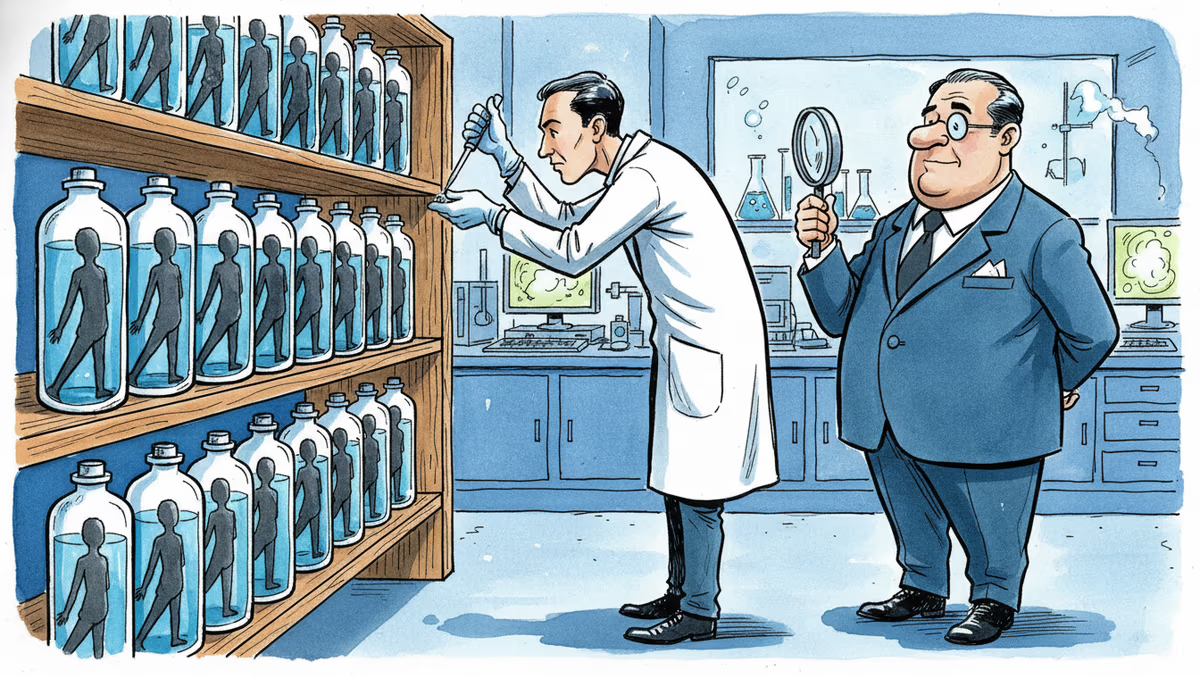
The Startup Pitching Brainless Human Clones as Spare Bodies
R3 Bio wants to grow human bodies without brains as biological backups. The science is speculative. The ethics are explosive. And the legal framework doesn't exist yet.
What If Your Body Had a Warranty—And a Replacement on Standby?
A small American startup called R3 Bio has been quietly pitching a vision that sits at the intersection of regenerative medicine and science fiction: grow a human body without a brain, keep it as a biological backup, and harvest its organs—or swap into it entirely—when your original body fails. The pitch, first reported by MIT Technology Review in March 2026, has been circulating in private investor and research circles for months before breaking into public view.
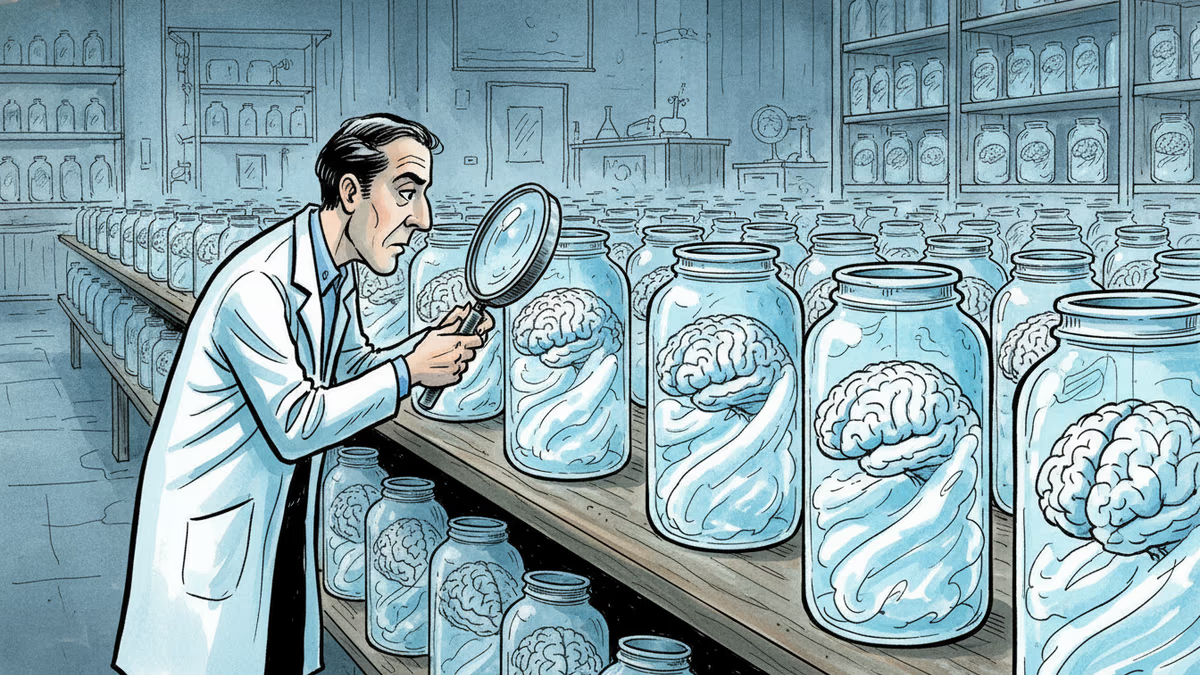
The concept has a name that is deliberately clinical: the brainless clone. The premise is that moral status derives from consciousness, and consciousness requires a brain. Remove the brain—or prevent it from developing—and what remains is, in R3 Bio's framing, a biological resource rather than a person. A living spare-parts depot, genetically identical to its owner, with zero risk of immune rejection.
The Case For: Solving Transplant Medicine's Hardest Problem
The global organ transplant waiting list is not an abstraction. In the United States alone, more than 100,000 people are waiting for a kidney at any given moment. Roughly 20 people die each day waiting for an organ that never arrives. For those who do receive a transplant, a lifetime of immunosuppressant drugs follows—drugs that carry their own serious risks, including elevated cancer rates and chronic infections.
A genetically identical donor body would eliminate rejection entirely. No immunosuppressants. No waiting list. No dependency on a stranger's death to save your life. Proponents in the transhumanist community argue this is simply the logical endpoint of a medical tradition that has always sought to extend and improve human life—from blood transfusions to pacemakers to stem-cell therapies, named among MIT Technology Review's 10 Breakthrough Technologies of 2025.
R3 Bio's approach connects to a broader wave of research. Scientists are already growing organoids—miniature lab-grown versions of hearts, livers, and kidneys—that have demonstrated basic function in animal models. A full body is orders of magnitude more complex, but the directional logic is the same: use a patient's own cells to build biological replacements.
The Case Against: Where Does a Body Without a Brain Belong?
Bioethicists push back hard, and not just on emotional grounds.

The first problem is scientific. There is no established threshold for what degree of brain absence guarantees the absence of consciousness or sentience. The brainstem alone can regulate basic physiological responses. Defining "brainless" precisely enough to satisfy both biology and ethics is an unsolved problem. Anencephalic infants—born without a cerebral cortex—have historically been at the center of fraught debates about organ donation, and no consensus emerged.
The second problem is procedural. Growing a human body to viability requires starting from a human embryo. That embryo must be created, manipulated, and deliberately stunted in its neurological development. Every major regulatory framework governing human embryo research—including the longstanding 14-day rule that has only recently been extended in some jurisdictions—was built around the assumption that embryos would not be developed into bodies at all, let alone bodies engineered to lack cognition.
The third problem is the failure rate. Any experimental process of this complexity would produce many unsuccessful attempts before achieving a viable result. What is the moral status of those intermediate entities?
Who Wins, Who Loses, and Who Hasn't Decided Yet
The stakeholder map here is unusually complex.
Xenotransplantation companies—firms like eGenesis and United Therapeutics that have invested hundreds of millions of dollars engineering pig organs for human transplant—face an existential competitive threat if human-clone technology ever reaches viability. A genetically matched human body makes a pig kidney irrelevant.
Regulators are in uncharted territory. The FDA's frameworks for biologics, the IRB rules governing human subjects research, and the National Organ Transplant Act were all written without imagining this category of entity. Legal ambiguity is not the same as legal permission, but the absence of explicit prohibition creates a window that well-funded actors may attempt to exploit in permissive jurisdictions.
Religious institutions across traditions—not only Catholic bioethics bodies but also significant voices in Jewish, Islamic, and Buddhist thought—have staked out positions that human life, however defined, cannot be instrumentalized as a parts supply. The specific question of brain absence does not resolve this for most of these traditions.
Wealthy individuals and longevity investors represent the obvious demand side. The longevity industry has attracted billions in venture capital over the past decade, with figures like Bryan Johnson spending aggressively on life-extension protocols. A guaranteed biological backup body is the most literal possible expression of that impulse.
The Regulatory Void Is the Real Story
What makes R3 Bio's pitch significant right now is less about whether the science works—it largely doesn't yet—and more about the absence of any legal architecture to evaluate it. The history of biomedical ethics suggests that frameworks tend to arrive after the technology, not before. Brain-death criteria were formalized because transplant surgery made them necessary. IVF regulation was built after Louise Brown was born in 1978.
The question R3 Bio forces into the open is whether societies can do better this time—whether the ethical and legal conversation can happen before a wealthy client in an unregulated jurisdiction commissions the first attempt.
This content is AI-generated based on source articles. While we strive for accuracy, errors may occur. We recommend verifying with the original source.
Related Articles
CAR T cell therapy, proven in blood cancers, is now in hundreds of clinical trials for MS, lupus, and other autoimmune conditions. What the science shows—and what it doesn't yet.
Colossal Biosciences raised hundreds of millions to resurrect woolly mammoths and dire wolves. What they're actually doing is more complicated—and more interesting.
California startup R3 Bio quietly pitched investors on 'brainless human clones' as backup bodies—beyond its public story of nonsentient organ sacks for drug testing. A deep dive into biotech's most ethically charged frontier.
Around 5,000–6,000 people worldwide have signed up to have their bodies or brains cryonically preserved after death. Scientists say revival is vanishingly unlikely. So what exactly are they waiting for?
CAR T cell therapy, proven in blood cancers, is now in hundreds of clinical trials for MS, lupus, and other autoimmune conditions. What the science shows—and what it doesn't yet.
Colossal Biosciences raised hundreds of millions to resurrect woolly mammoths and dire wolves. What they're actually doing is more complicated—and more interesting.
California startup R3 Bio quietly pitched investors on 'brainless human clones' as backup bodies—beyond its public story of nonsentient organ sacks for drug testing. A deep dive into biotech's most ethically charged frontier.
Around 5,000–6,000 people worldwide have signed up to have their bodies or brains cryonically preserved after death. Scientists say revival is vanishingly unlikely. So what exactly are they waiting for?
Thoughts
Share your thoughts on this article
Sign in to join the conversation