
Frozen at −146°C, Waiting for a Future That May Never Come
Around 5,000–6,000 people worldwide have signed up to have their bodies or brains cryonically preserved after death. Scientists say revival is vanishingly unlikely. So what exactly are they waiting for?
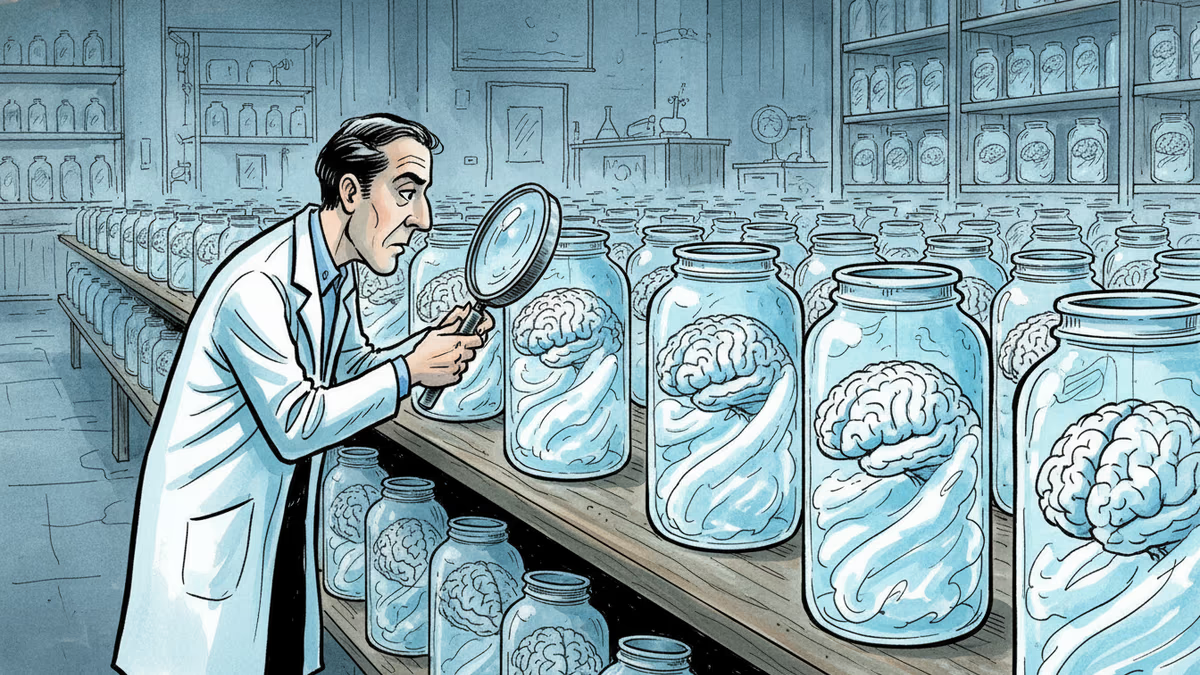
A brain sits in a facility in Scottsdale, Arizona, coated in a thin layer of frost, stored at −146°C. It has been there for over a decade. Its owner, gerontologist L. Stephen Coles, died of pancreatic cancer in 2014. He left instructions for it to be preserved. Just in case.
Just in case science catches up. Just in case death turns out to be a problem with a solution.
The Brain Is Fine. The Problem Is Everything Else.
Recently, renowned cryobiologist Greg Fahy completed an analysis of tissue samples from Coles's brain. His verdict: "astonishingly well preserved." No cracking, no catastrophic cellular damage. The freezing process, it seems, did its job.
But preserved is not the same as revivable. Every scientist who works in or around cryonics says the same thing: the probability of actually reanimating someone like Coles is vanishingly small. Fahy knows this. Nick Llewellyn, director of R&D at Alcor—the facility storing Coles's brain—knows this too. He describes the odds as "pretty low." He's signed up anyway. "I want to see what the future looks like," he says.
This tension—clear-eyed about the odds, committed to the bet—is at the heart of what makes cryonics so strange and so fascinating.
From a TV Repairman to a $220,000 Industry
The story starts in 1967. James Hiram Bedford, a retired psychology professor dying of kidney cancer, became the first person ever cryonically preserved. The procedure was performed by affiliates of the Cryonics Society of California, led by a charismatic TV repairman with no scientific or medical credentials. Bedford's body was perfused with cryoprotective chemicals and frozen.
He's still in storage at Alcor today. 58 years and counting.

The industry has grown—modestly—since then. Today, roughly 5,000 to 6,000 people worldwide have signed up for cryopreservation. Emil Kendziorra, CEO of Tomorrow.Bio, told MIT Technology Review that his company alone signs up between 20 and 50 new members every month.
The price of this particular gamble? Alcor charges $80,000 to store a brain and $220,000 for whole-body preservation. Many members, including Kendziorra himself, fund it through a life insurance policy—making immortality, in a sense, a financial product.
Who Signs Up, and Why
The motivations are more varied than you might expect. Some, like Coles and Bedford, were dying of diseases that medicine couldn't yet cure. Cancer death rates in the US have fallen significantly since the early 1990s. The implicit wager: freeze now, wake up when the cure exists.
Others are driven by something more fundamental. Last year, Kendziorra spoke at Vitalist Bay, a gathering of people who believe death is, literally, "humanity's core problem." The crowd was enthusiastic about cryonics not as a medical fallback but as a philosophical stance—a refusal to accept mortality as inevitable.
A 2021 survey of 1,478 US internet users found that just over a third of male respondents expressed a desire to live indefinitely. Men were both more aware of cryonics and more optimistic about its outcomes than women.
Still, a small but vocal minority in the same survey called the concept dystopian. Some said it should be outright illegal.
The Question Science Can't Answer
Cryobiologist Shannon Tessier at Massachusetts General Hospital studies cryopreservation professionally. She thinks the science is genuinely interesting. She still wouldn't sign up—even if revival were technically possible.
"It turns into a philosophical question," she says. "Do I want to be revived hundreds of years later when my family is gone and life is completely different? There are so many complicated philosophical, societal, legal complications that need to be thought through."
This is the fork in the road that cryonics forces you to confront. Llewellyn sees the uncertainty as a reason to go for it. Tessier sees it as a reason to pause. Both are responding rationally to the same set of facts.
The deeper issue is one that neither science nor law has resolved: if you freeze a person's brain, preserve the structure of their neurons, and then—somehow, centuries later—reconstruct them, is that the same person? Continuity of consciousness is not a problem cryobiology can solve on its own.
Authors
Related Articles
R3 Bio wants to grow human bodies without brains as biological backups. The science is speculative. The ethics are explosive. And the legal framework doesn't exist yet.
California startup R3 Bio quietly pitched investors on 'brainless human clones' as backup bodies—beyond its public story of nonsentient organ sacks for drug testing. A deep dive into biotech's most ethically charged frontier.

Peter Attia's Epstein connection triggers swift exits from David Protein and Biograph. How do startups manage influencer risk when reputations crumble overnight?

A 2026 study in Clinical Nutrition finds that seniors aged 65+ can significantly improve metabolic health by reducing ultraprocessed food intake. Read the Ultraprocessed food metabolic health study 2026 details.
R3 Bio wants to grow human bodies without brains as biological backups. The science is speculative. The ethics are explosive. And the legal framework doesn't exist yet.
California startup R3 Bio quietly pitched investors on 'brainless human clones' as backup bodies—beyond its public story of nonsentient organ sacks for drug testing. A deep dive into biotech's most ethically charged frontier.
Peter Attia's Epstein connection triggers swift exits from David Protein and Biograph. How do startups manage influencer risk when reputations crumble overnight?
A 2026 study in Clinical Nutrition finds that seniors aged 65+ can significantly improve metabolic health by reducing ultraprocessed food intake. Read the Ultraprocessed food metabolic health study 2026 details.
Thoughts
Share your thoughts on this article
Sign in to join the conversation