
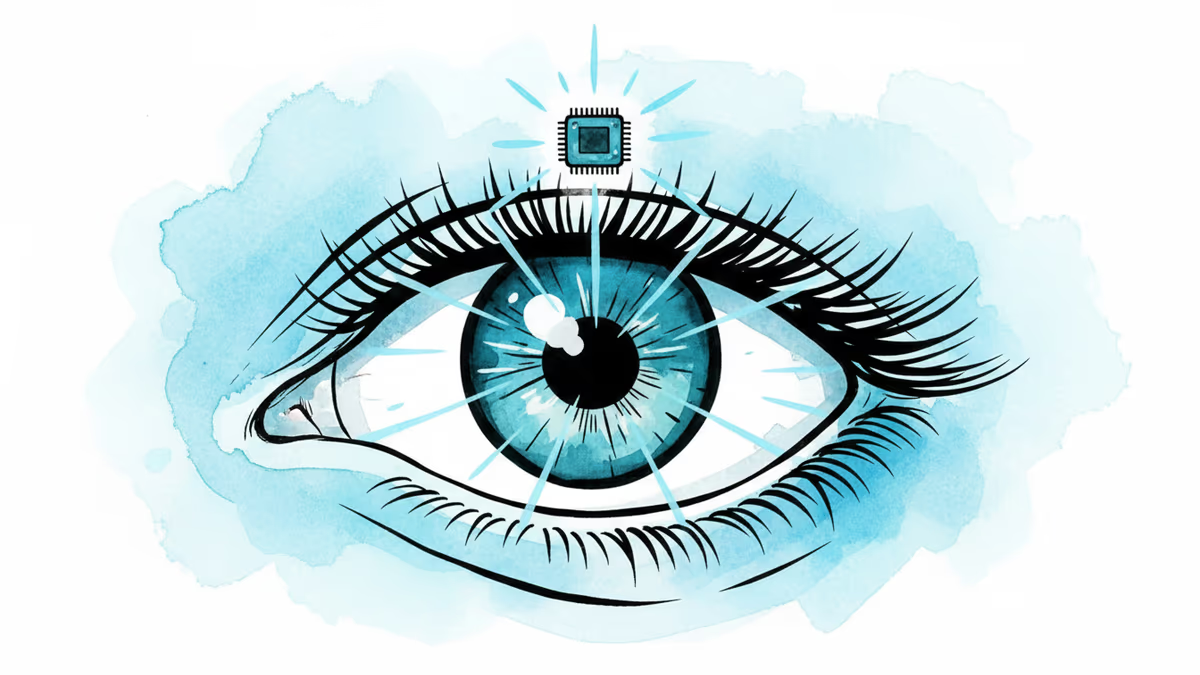
The Ex-Neuralink Co-Founder Racing to Beat Musk to Market
Max Hodak's Science Corp raises $230M for rice-grain sized chip that restores vision to blind patients. Could beat Neuralink as first BCI company to commercialize
$230 million just flowed into a chip smaller than a grain of rice. While Elon Musk grabs headlines with Neuralink demos, his former co-founder is quietly racing ahead in the brain-computer interface game.
Science Corporation, founded by ex-Neuralink president Max Hodak, announced Wednesday it closed a Series C funding round worth $230 million. The startup now carries a $1.25 billion valuation. But here's what makes this different from typical Silicon Valley hype: their device is already working in real patients.
When Blind Patients Start Reading Again
PRIMA – that's what they call their rice-grain-sized chip – gets implanted directly into the eye. Paired with camera-equipped glasses, it restores functional vision to people suffering from advanced macular degeneration. The clinical results speak louder than any pitch deck.
Across 47 patients in Europe and the U.S., 80% showed meaningful improvement in visual acuity. They could read letters, numbers, and words again. "To my knowledge, this is the first time that restoration of the ability to fluently read has ever been definitively shown in blind patients," Hodak told TechCrunch.
The technology didn't start at Science Corp – they acquired PRIMA's assets from French company Pixium Vision in 2024, then refined it. But the current clinical results? That's all Science Corp's work.
The Regulatory Race Nobody's Talking About
While Neuralink remains stuck in clinical trials, Science Corp is sprinting toward commercialization. They've submitted a CE mark application to the European Union and expect approval by mid-2026. If that timeline holds, they'd become the first BCI company with a product in market.
Germany looks likely to be their first market – the country has established pathways for early access to breakthrough medical technologies. In the U.S., FDA discussions are "ongoing," though the company remains tight-lipped on specifics.

Beyond Vision: The Bigger Play
Science Corp isn't stopping at sight restoration. They're expanding PRIMA trials to include Stargardt disease and retinitis pigmentosa – inherited conditions that cause vision loss in young adults.
But the real moonshot? Their "biohybrid neural interface" program. Picture this: engineered neurons grown from stem cells on a waffle-like device that sits on your brain's surface, forming biological connections with existing neural circuits. It's part computer, part living tissue.
Then there's Vessel – a new business line developing miniaturized organ preservation technology. Instead of rushing organs to ICU suites, imagine transporting them on commercial flights or maintaining them in patients' homes.
Why Investors Are Betting Big
The funding round drew both new and returning investors: Lightspeed Venture Partners, Khosla Ventures, Y Combinator, and notably, IQT – the investment arm that backs technologies for FBI and CIA use.
Science Corp now employs 150 people and has raised $490 million total. The new capital will fund PRIMA's commercialization while supporting their broader research portfolio.
The Quiet Revolution
While Musk livestreams patients playing chess with their thoughts, Hodak's team has been methodically building toward market approval. Different approaches, same destination – but only one can claim "first to market."
The healthcare implications are staggering. Age-related macular degeneration affects over 11 million Americans, with numbers rising as the population ages. Current treatments slow progression but can't restore lost vision.
Authors
Related Articles
CAR T cell therapy, proven in blood cancers, is now in hundreds of clinical trials for MS, lupus, and other autoimmune conditions. What the science shows—and what it doesn't yet.
R3 Bio wants to grow human bodies without brains as biological backups. The science is speculative. The ethics are explosive. And the legal framework doesn't exist yet.
Colossal Biosciences raised hundreds of millions to resurrect woolly mammoths and dire wolves. What they're actually doing is more complicated—and more interesting.
Elon Musk promised minds merged with AI. Neuralink delivered a brain-controlled cursor. The gap between the two reveals something important about how Silicon Valley sells the future.
CAR T cell therapy, proven in blood cancers, is now in hundreds of clinical trials for MS, lupus, and other autoimmune conditions. What the science shows—and what it doesn't yet.
R3 Bio wants to grow human bodies without brains as biological backups. The science is speculative. The ethics are explosive. And the legal framework doesn't exist yet.
Colossal Biosciences raised hundreds of millions to resurrect woolly mammoths and dire wolves. What they're actually doing is more complicated—and more interesting.
Elon Musk promised minds merged with AI. Neuralink delivered a brain-controlled cursor. The gap between the two reveals something important about how Silicon Valley sells the future.
Thoughts
Share your thoughts on this article
Sign in to join the conversation