
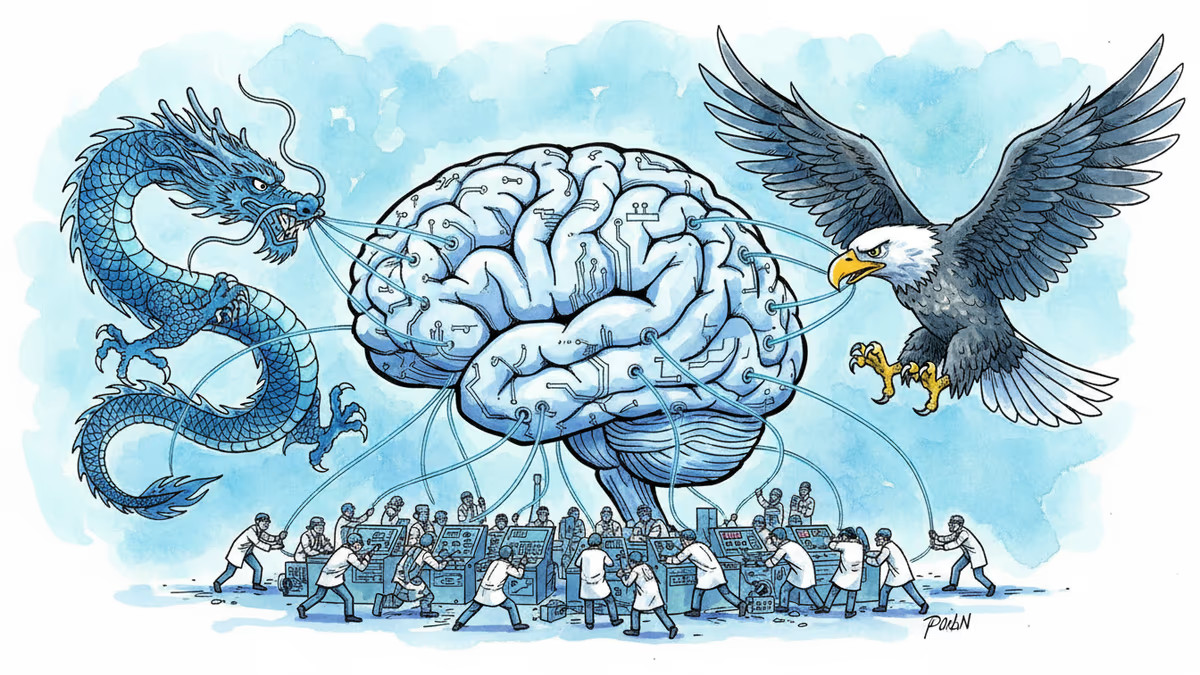
China's Brain-Computer Interface Market Hits $530M in 2025
China's BCI industry rapidly scales from research to commercialization with strong policy support, insurance coverage, and growing investment, challenging US leaders like Neuralink.
While Neuralink Claims 'Pioneer' Status, China Is Already Scaling
As Elon Musk's Neuralink touts itself as the "pioneer" of brain-computer interfaces, China's BCI industry has quietly moved beyond the lab into full commercialization mode. The numbers tell the story: China's BCI market reached $530 million in 2025, up from $450 million in 2024, with projections hitting $17 billion by 2040.
This isn't just hype. Provinces like Sichuan, Hubei, and Zhejiang have already set medical service pricing for BCI treatments, fast-tracking their inclusion in China's national medical insurance system. What took the US years of regulatory back-and-forth, China is accomplishing through coordinated policy action.
The Four-Factor Formula for BCI Success
Phoenix Peng, who has founded not one but two BCI startups—implantable device maker NeuroXess and ultrasound BCI company Gestala—breaks down China's rapid progress into four key advantages.
First is unified policy support. In August 2025, China's Ministry of Industry and seven other agencies released a national BCI roadmap targeting major technical milestones by 2027 and a complete supply chain by 2030. December saw the launch of an $1.65 billion brain science fund supporting companies from research through commercialization.
Second are vast clinical resources. Large patient populations and lower research costs accelerate trials, while China's national health insurance enables faster commercialization once devices get state approval. This contrasts sharply with the US, where even after FDA approval, each private insurer must individually decide coverage.
Third is mature manufacturing infrastructure. China's existing capabilities in semiconductors, AI, and medical hardware support rapid R&D and prototyping cycles that would take months longer elsewhere.

Finally, there's strategic investment momentum. Shanghai-based StairMed Technology raised $48 million in Series B funding in February 2025, while BrainCo quietly filed for a Hong Kong IPO after raising $287 million earlier this year.
Invasive vs. Non-Invasive: Two Paths Diverging
The BCI field is splitting along two distinct approaches. Invasive systems like Neuralink and China's NeuroXess implant electrodes directly into the brain for precise neuron-level signals, but require surgery with inherent risks.
Non-invasive alternatives like NeuroSky and BrainCo trade some precision for safety and ease of adoption. Not everyone wants brain surgery, after all.
Emerging approaches are expanding the toolkit further. Ultrasound BCIs from companies like OpenAI-backed Merge Labs and Peng's Gestala target high-prevalence conditions like chronic pain, stroke, and depression. Early clinical trials show promise: a single session reduced pain scores by 50%, with effects lasting one to two weeks.
Gestala expects to roll out its first-generation product by Q3 2026, targeting the massive market of patients who need treatment but won't consider surgical implants.
The Regulatory Reality Check
Over the next five years, industry insiders expect China's BCI regulations to align more closely with international standards, particularly FDA guidance and frameworks from organizations like IEC and ISO.
Chinese regulators are expected to tighten oversight of invasive devices and the sensitive data all BCIs generate, while potentially easing approval pathways for non-invasive technologies. Ethics requirements will likely strengthen, with broader review processes beyond just medical applications.
HongShan Capital (formerly Sequoia China) partner Yang Yunxia captures the investment reality: "Some technologies may look cutting-edge but far from practical application," while others appear commercially viable but face "high costs" or significant technical barriers.
Authors
Related Articles

Huawei's CANN is open source under a license barring software for non-Ascend chips. Inside China's second CUDA, and the two links still outside it: pre-training compute and 5nm capacity.

China is restricting AI researchers and startup founders from traveling abroad as the U.S.-China AI performance gap narrows to just 2.7%. What Beijing's talent lockdown means for the global AI race.
Elon Musk promised minds merged with AI. Neuralink delivered a brain-controlled cursor. The gap between the two reveals something important about how Silicon Valley sells the future.
China's NEO brain implant is now a legally sold medical device — the world's first commercial BCI. What this means for Neuralink, global regulators, and the future of human-machine interfaces.
Huawei's CANN is open source under a license barring software for non-Ascend chips. Inside China's second CUDA, and the two links still outside it: pre-training compute and 5nm capacity.
China is restricting AI researchers and startup founders from traveling abroad as the U.S.-China AI performance gap narrows to just 2.7%. What Beijing's talent lockdown means for the global AI race.
Elon Musk promised minds merged with AI. Neuralink delivered a brain-controlled cursor. The gap between the two reveals something important about how Silicon Valley sells the future.
China's NEO brain implant is now a legally sold medical device — the world's first commercial BCI. What this means for Neuralink, global regulators, and the future of human-machine interfaces.
Thoughts
Share your thoughts on this article
Sign in to join the conversation