
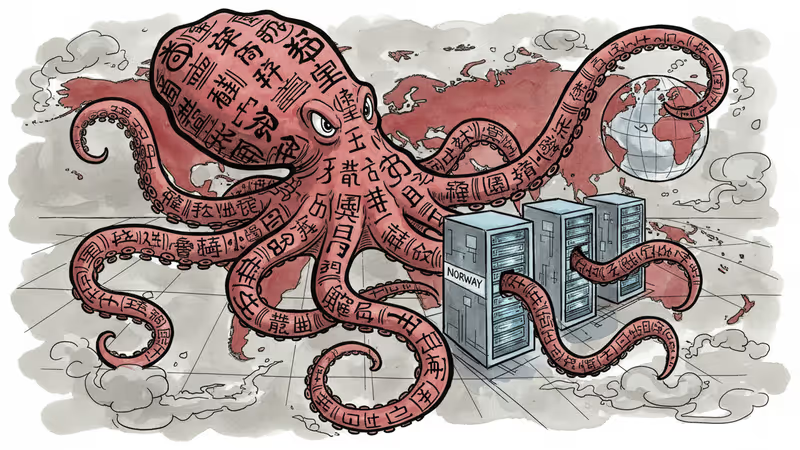
Norway Joins Growing List of Salt Typhoon Victims
Chinese hackers infiltrate Norwegian companies as Salt Typhoon campaign expands globally, raising questions about critical infrastructure security worldwide.
47 countries and counting. That's how many nations have now reported cyberattacks linked to Chinese state-sponsored groups in the past five years. Norway just became the latest to join this unwelcome club.
The Norwegian Police Security Service revealed Friday that the notorious Salt Typhoon hacking group successfully infiltrated multiple Norwegian organizations, targeting vulnerable network devices to conduct espionage operations. The announcement adds another chapter to what U.S. national security officials have called an "epoch-defining threat."
The Salt Typhoon Playbook
Salt Typhoon operates with surgical precision. Rather than launching flashy ransomware attacks that grab headlines, the group embeds itself quietly within critical infrastructure networks, sometimes for years. Their preferred targets? Telecommunications companies and network equipment that handle sensitive communications.
The Norwegian report follows a familiar pattern. The hackers exploited vulnerable network devices—the digital equivalent of picking locks on back doors that organizations forgot to secure. Once inside, they positioned themselves to intercept communications and steal sensitive data, all while remaining virtually invisible.
This isn't Salt Typhoon's first rodeo. The group has successfully penetrated telecom networks across Canada and the United States, where they allegedly intercepted communications from senior politicians. The scale of their operations suggests a level of coordination and resources that only state-sponsored actors typically possess.
Beyond Norway's Borders

What makes this latest revelation particularly concerning isn't just that Norway was breached—it's the expanding geographic footprint of Salt Typhoon's operations. The group has demonstrated an ability to adapt their tactics to different countries' cybersecurity landscapes while maintaining their core objective: long-term espionage access to critical communications infrastructure.
The timing of Norway's disclosure also matters. Coming just weeks after similar revelations from other European nations, it suggests either a coordinated campaign or that organizations worldwide are finally discovering breaches that may have existed for months or years.
For businesses operating internationally, this raises uncomfortable questions about supply chain security. If Salt Typhoon can penetrate Norwegian companies—a country known for robust cybersecurity practices—what does that mean for organizations in countries with less developed cyber defenses?
The Telecom Wake-Up Call
The repeated targeting of telecommunications providers has forced the industry to confront an uncomfortable reality: they've become the digital highways for modern espionage. When hackers control telecom infrastructure, they don't just steal data—they gain the ability to monitor communications in real-time.
This has prompted telecom companies to accelerate security investments, but the challenge is immense. Legacy network equipment, some installed decades ago, wasn't designed with today's sophisticated threat actors in mind. Upgrading this infrastructure requires not just money, but coordination across international networks and supply chains.
The pressure is mounting from multiple directions. Governments are demanding better security practices, customers are questioning whether their communications are truly private, and investors are factoring cybersecurity risks into valuations.
Authors
Related Articles
China is restricting AI researchers and startup founders from traveling abroad as the U.S.-China AI performance gap narrows to just 2.7%. What Beijing's talent lockdown means for the global AI race.
UK Visa Portal, a private immigration service mistaken for an official government site, has been exposing passport scans and selfies of over 100,000 applicants. The breach remains unpatched.
Okta CEO Todd McKinnon on why AI agents need identity management, the SaaSpocalypse threat, and why the kill switch might be the most important button in enterprise tech.
Iran and Israel are hacking civilian security cameras for military reconnaissance. How consumer surveillance devices became weapons of war.
China is restricting AI researchers and startup founders from traveling abroad as the U.S.-China AI performance gap narrows to just 2.7%. What Beijing's talent lockdown means for the global AI race.
UK Visa Portal, a private immigration service mistaken for an official government site, has been exposing passport scans and selfies of over 100,000 applicants. The breach remains unpatched.
Okta CEO Todd McKinnon on why AI agents need identity management, the SaaSpocalypse threat, and why the kill switch might be the most important button in enterprise tech.
Iran and Israel are hacking civilian security cameras for military reconnaissance. How consumer surveillance devices became weapons of war.
Thoughts
Share your thoughts on this article
Sign in to join the conversation