
How $47 Chinese Phones Built Africa's Digital Future
Behind Kenya's Silicon Savannah success lies a untold story of Chinese smartphones. From knockoffs to ecosystem builders, Chinese tech is reshaping a continent.
1 billion people got their first smartphone from China
Fall 2021, Moi Avenue, Nairobi. Journalist Andrea Pollio needed a burner phone for mobile money. What he found wasn't just electronics stores—it was the frontline of a quiet revolution.
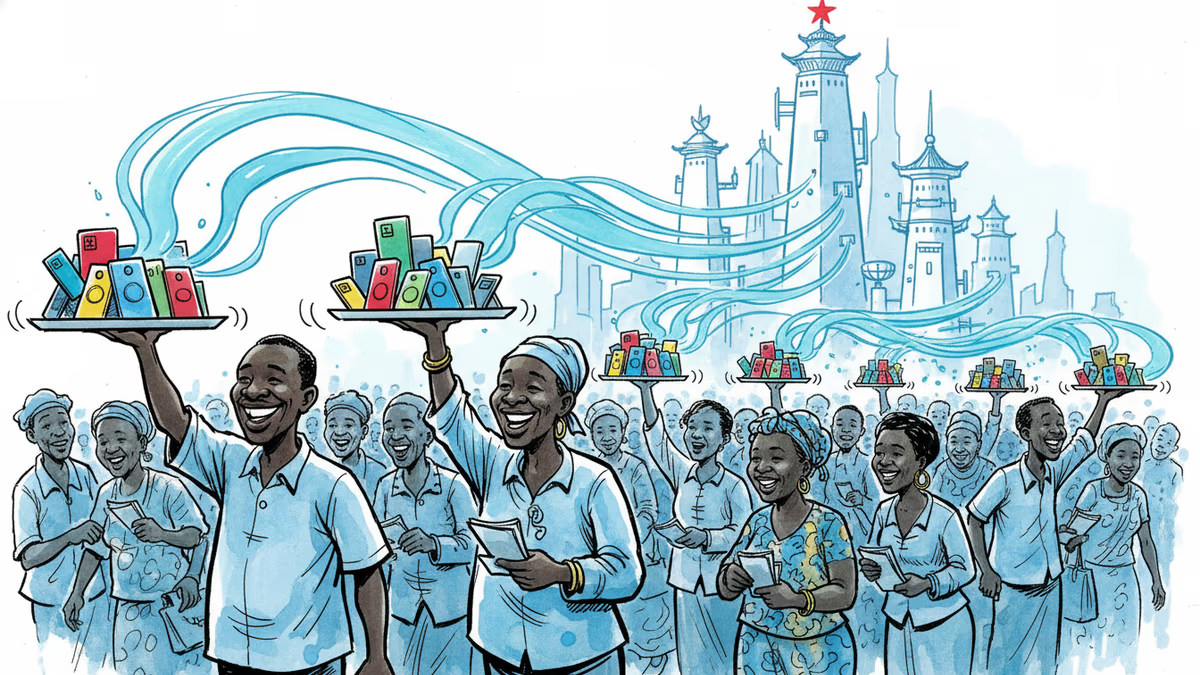
Dozens of shops lined the avenue, their windows plastered with logos: Tecno, Infinix, Itel, Realme. All Chinese brands most Americans have never heard of. Yet these "chinku" phones—as Kenyans call them—had done something Samsung and Apple couldn't: put smartphones in every pocket.
The real story behind M-Pesa's success
Kenya's M-Pesa gets credit as the world's first successful mobile money platform. But local business journalist Jerotich offers a different take: "If you want to understand the mobile money revolution, you need to look at when phones became ubiquitous."
The math is stark. In 2010, a Nokia cost $200 in Kenya—three months' wages for many. Chinese knockoffs? $47. By 2015, Chinese brands held 70% of Kenya's smartphone market.
Transsion Holdings—the company behind Tecno and Infinix—didn't just sell phones. They built an ecosystem: local payment apps, Africa-focused app stores, cloud services optimized for spotty internet. The phone was the trojan horse; the data was the prize.
China's 'other' tech strategy
While Silicon Valley chases premium markets, Chinese companies are writing a different playbook. Take Transsion: virtually unknown in the West, it's Africa's #1 smartphone brand.
Their strategy? Localization at scale. Phones with four SIM cards for countries with competing networks. AI cameras trained on darker skin tones. Swahili voice assistants. Solar charging for areas without reliable electricity.
"We don't compete with Apple," a Transsion executive told me. "We compete with no phone at all."

The data colonization question
But here's where it gets complicated. These Chinese phones aren't just hardware—they're data collection devices for 1 billion Africans entering the digital economy.
Every mobile payment, every app download, every location ping flows through Chinese-controlled infrastructure. Huawei built the 4G networks. Chinese phones dominate the endpoints. ByteDance (TikTok's parent) owns Africa's fastest-growing social platform.
Is this digital liberation or digital colonization? The answer depends on who you ask—and what happens to all that data.
Silicon Valley's missed opportunity
American tech companies largely ignored Africa, viewing it as "not ready" for smartphones. Chinese companies saw 1 billion future customers.
The results speak for themselves:
- Chinese brands: 70% market share
- Samsung: 15% (and falling)
- Apple: <2%
Google and Facebook tried to enter later with initiatives like Android Go and Free Basics. Too little, too late. The infrastructure was already Chinese-built.
What this means for the West
Africa isn't just a market—it's a testing ground. Technologies perfected on $50 phones in Lagos and Nairobi eventually reach India, Southeast Asia, and Latin America.
Chinese companies are building a parallel tech ecosystem for the Global South. Different values, different priorities, different data flows. While Silicon Valley optimizes for engagement, Chinese platforms optimize for commerce and payments.
The implications for Western tech dominance are profound. When 4 billion people get online through Chinese devices and platforms, whose internet are they really joining?
Authors
Related Articles

Huawei's CANN is open source under a license barring software for non-Ascend chips. Inside China's second CUDA, and the two links still outside it: pre-training compute and 5nm capacity.

China is restricting AI researchers and startup founders from traveling abroad as the U.S.-China AI performance gap narrows to just 2.7%. What Beijing's talent lockdown means for the global AI race.
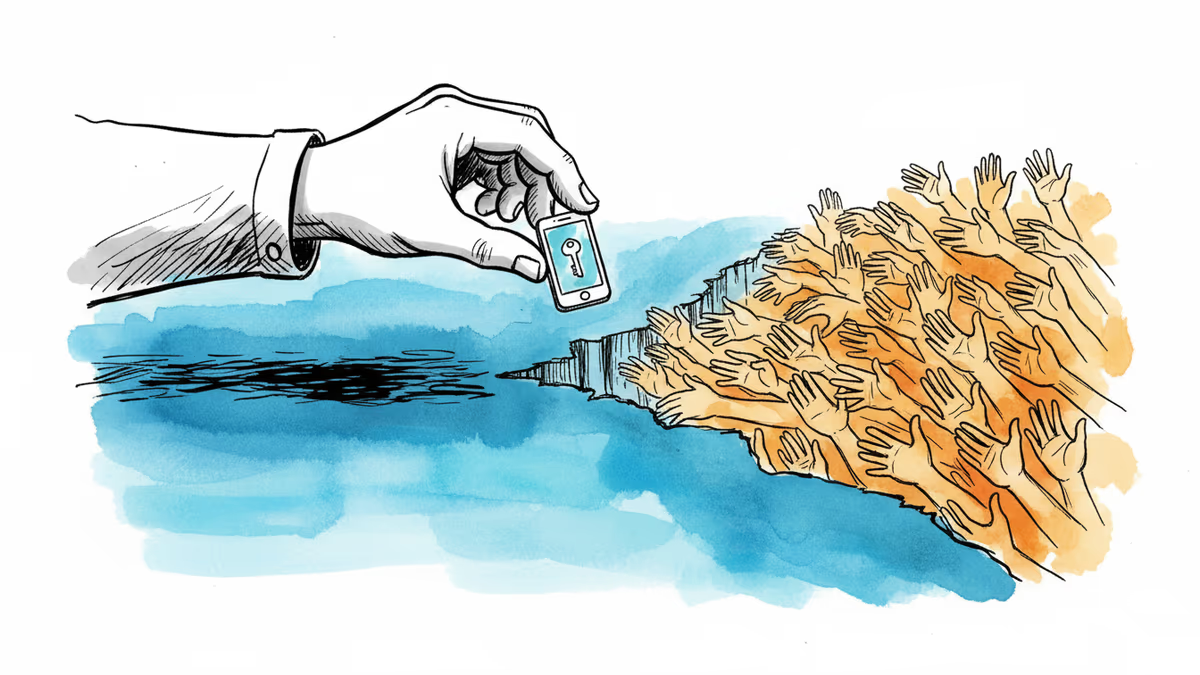
A GSMA-led coalition is pushing ultra-low-cost 4G phones into six African markets. The target price is bold. The obstacles — component costs, taxes, thin margins — are real.
Nothing launches Phone (4a) Pro in the US for $499, but without carrier partnerships, the UK company still faces an uphill battle against established players.
Huawei's CANN is open source under a license barring software for non-Ascend chips. Inside China's second CUDA, and the two links still outside it: pre-training compute and 5nm capacity.
China is restricting AI researchers and startup founders from traveling abroad as the U.S.-China AI performance gap narrows to just 2.7%. What Beijing's talent lockdown means for the global AI race.
A GSMA-led coalition is pushing ultra-low-cost 4G phones into six African markets. The target price is bold. The obstacles — component costs, taxes, thin margins — are real.
Nothing launches Phone (4a) Pro in the US for $499, but without carrier partnerships, the UK company still faces an uphill battle against established players.
Thoughts
Share your thoughts on this article
Sign in to join the conversation