

Why a 22-Year-Old CEO Raised $22M in Just Two Weeks
Terra Industries, an African defensetech startup, raised $22M extension round one month after its Series A. Young founders are reshaping the global defense industry landscape.
One month after raising $11.75 million, African defensetech startup Terra Industries just closed another $22 million in funding. The founders? Nathan Nwachuku, 22, and Maxwell Maduka, 24. Their company, launched in 2024, has now raised $34 million total.
The speed is striking, but the bigger story lies in what they're building—and why investors can't write checks fast enough.
Africa's Push for Defense Independence
Terrorism remains one of Africa's biggest threats, yet most security intelligence comes from Russia, China, or the West. Nwachuku wants to change that: "We're building Africa's first defense prime, creating autonomous defense systems to protect our critical infrastructure."
Terra has already generated over $2.5 million in commercial revenue and protects assets worth around $11 billion. Based in Nigeria, the company recently established a joint manufacturing facility in Saudi Arabia with AIC Steel—their first major expansion outside Africa.
"The priority is working with countries where terrorism and infrastructure security are major national concerns," Nwachuku said, particularly targeting sub-Saharan Africa and the Sahel region.
The Two-Week Funding Frenzy
This extension round closed in under two weeks, led by Lux Capital. Existing investors 8VC, Nova Global, and Resiliience17 Capital (founded by Flutterwave CEO Olugbenga Agboola) also participated.

Investors cited "faster-than-expected traction" with deals and partnerships. The urgency wasn't manufactured—it was real momentum creating competitive pressure among VCs.
Building defense companies isn't cheap. For context: Anduril has raised over $2.5 billion, ShieldAI around $1 billion, and drone maker Skydio about $740 million. Terra's $34 million is just the beginning.
Gen Z Founders Meet Defense Tech
Terra's rapid rise reflects a broader shift in defense technology. Young entrepreneurs are entering an industry traditionally dominated by established contractors and decades-old relationships.
The company has secured government and commercial contracts across multiple African nations (yet to be announced). Nwachuku focuses on "major economies where the need for infrastructure security is urgent and where our solutions can make meaningful impact."
These regions have lost not just billions in infrastructure, but thousands of lives over recent decades.
The Investor Perspective: Risk vs. Reward
Defense investors typically favor experienced teams with government connections. Yet here's Lux Capital betting big on founders who could be mistaken for college students.
What changed? The urgency of Africa's security challenges, combined with the limitations of traditional defense solutions. Young founders bring fresh approaches to problems that conventional wisdom hasn't solved.
Authors
Related Articles

A GSMA-led coalition is pushing ultra-low-cost 4G phones into six African markets. The target price is bold. The obstacles — component costs, taxes, thin margins — are real.

Cluely CEO admits to fabricating $7M revenue figure, exposing how startup "fake it till you make it" culture has gone too far. What this means for the ecosystem.
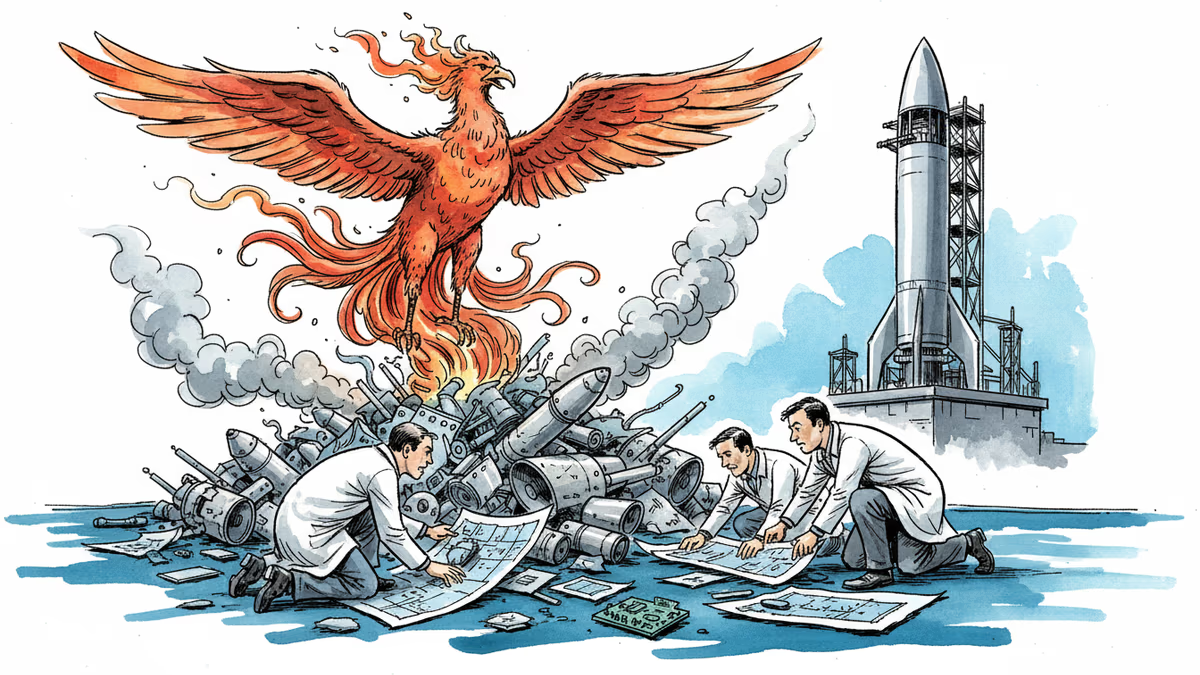
Phantom Space acquired assets from bankrupt Vector Launch, showing how failed space companies' technologies are finding new life. Is this becoming the new normal in aerospace?

Lucid Motors laid off 12% of workforce amid profitability push. The luxury EV maker's struggles reveal harsh realities facing Tesla challengers in 2026.
A GSMA-led coalition is pushing ultra-low-cost 4G phones into six African markets. The target price is bold. The obstacles — component costs, taxes, thin margins — are real.
Cluely CEO admits to fabricating $7M revenue figure, exposing how startup "fake it till you make it" culture has gone too far. What this means for the ecosystem.
Phantom Space acquired assets from bankrupt Vector Launch, showing how failed space companies' technologies are finding new life. Is this becoming the new normal in aerospace?
Lucid Motors laid off 12% of workforce amid profitability push. The luxury EV maker's struggles reveal harsh realities facing Tesla challengers in 2026.
Thoughts
Share your thoughts on this article
Sign in to join the conversation