
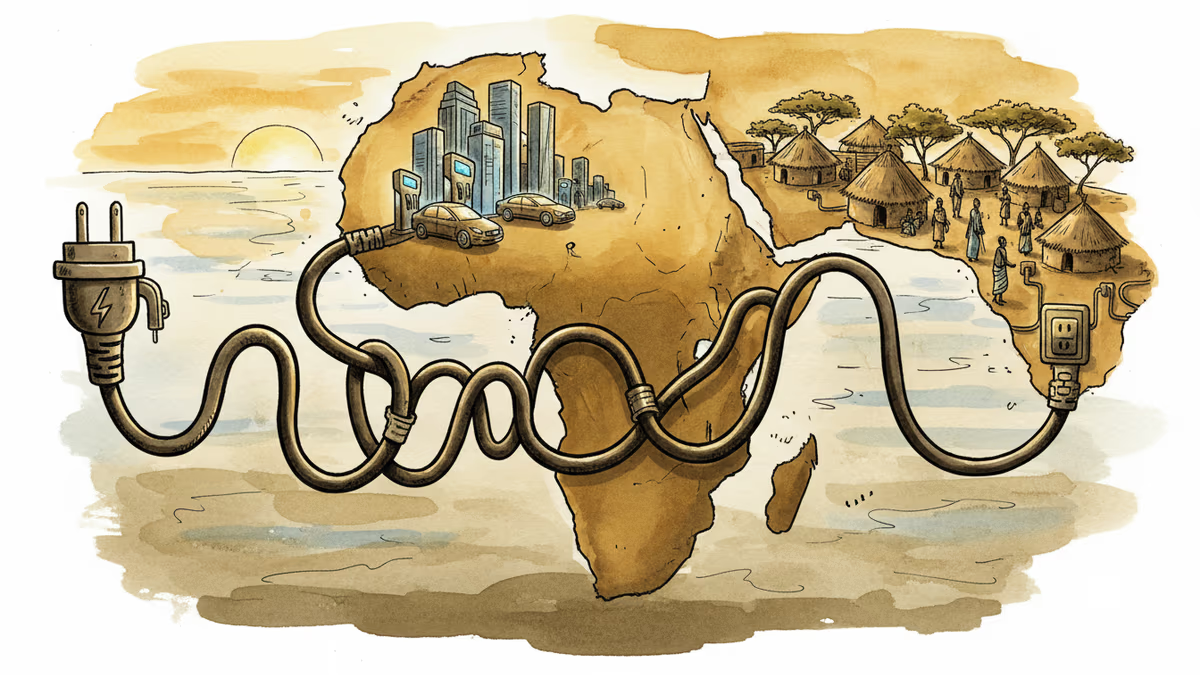
Africa Could Leapfrog the Gas Car Era Entirely
Ethiopia banned gas car imports while China builds Africa's first battery gigafactory. But can the continent overcome infrastructure gaps to become an unlikely EV leader?
$5 billion worth of concrete and steel started generating power in September 2025. Ethiopia's massive hydroelectric dam doesn't just double the country's electricity capacity—it's the foundation for the world's most aggressive EV policy. Since 2024, Ethiopia has banned all gas-powered car imports. Not even China or Norway went that far, that fast.
The economics are stark: gasoline costs a fortune there, while the new 5-gigawatt dam provides cheap, abundant clean electricity. But turning policy into reality? That's where things get complicated.
The Two-Wheeler Revolution
While Ethiopia tackles cars, Rwanda is going after motorbikes. The capital Kigali banned new registrations for commercial gas-powered motorbikes last year. Since these bike taxis make up over half the vehicles on city streets, it's a transportation transformation disguised as regulation.
The strategy makes sense globally. In 2025, EVs captured 45% of new two- and three-wheeler sales worldwide—nearly double the 25% share for cars and trucks. Smaller, cheaper vehicles are leading the electric transition.
Spiro, a Dubai-based electric motorbike company, just raised $100 million to expand across Africa. They're assembling bikes in Uganda, Kenya, Nigeria, and Rwanda, with 60,000+ bikes deployed and 1,500 battery swap stations operating. It's infrastructure built for Africa's actual transportation needs, not Western car culture.
China's African Battery Bet

The real game-changer might be happening in a factory under construction. Gotion High-Tech is building Africa's first battery gigafactory—a $5.6 billion project set to produce 20 gigawatt-hours of batteries annually starting in 2026. That's enough for hundreds of thousands of EVs each year, made on the continent.
Meanwhile, BYD, the world's largest EV company, plans 70 dealerships across South Africa by year-end. Chinese EV makers, facing oversaturation at home, see Africa as their next growth frontier.
"You have very high-quality, very affordable vehicles coming onto the market that are benefiting from the economies of scale in China," says Kelly Carlin from the Rocky Mountain Institute. "It's a game changer."
54 Countries, 54 Different Realities
But Africa isn't one market—it's 54 different ones. Morocco, Kenya, and Rwanda already assemble electric two-wheelers locally. Yet many regions still struggle with basic grid reliability, a fundamental problem when your transportation depends on consistent electricity.
A recent Nature Energy study found that EVs from scooters to minibuses could be cheaper to own than gas vehicles across Africa by 2040. The question isn't whether the economics work—it's whether the infrastructure can catch up to the opportunity.
Even in Ethiopia, many drivers still choose older gas-powered vehicles despite the import ban. Policy can create markets, but it can't instantly change consumer behavior or charging infrastructure.
Authors
Related Articles

A GSMA-led coalition is pushing ultra-low-cost 4G phones into six African markets. The target price is bold. The obstacles — component costs, taxes, thin margins — are real.
Despite EV success, electric sports cars struggle with consumer rejection, technical hurdles, and emotional disconnect from traditional performance enthusiasts
Exploring the used EV market at $15,000 budget point. BMW i3 and Chevrolet Bolt options compared with lower mileage, newer features, and better value propositions.
German study reveals shocking truth about plug-in hybrids - most owners rarely charge them. Porsche drivers averaged just 0.8% electric usage over two years.
A GSMA-led coalition is pushing ultra-low-cost 4G phones into six African markets. The target price is bold. The obstacles — component costs, taxes, thin margins — are real.
Despite EV success, electric sports cars struggle with consumer rejection, technical hurdles, and emotional disconnect from traditional performance enthusiasts
Exploring the used EV market at $15,000 budget point. BMW i3 and Chevrolet Bolt options compared with lower mileage, newer features, and better value propositions.
German study reveals shocking truth about plug-in hybrids - most owners rarely charge them. Porsche drivers averaged just 0.8% electric usage over two years.
Thoughts
Share your thoughts on this article
Sign in to join the conversation