
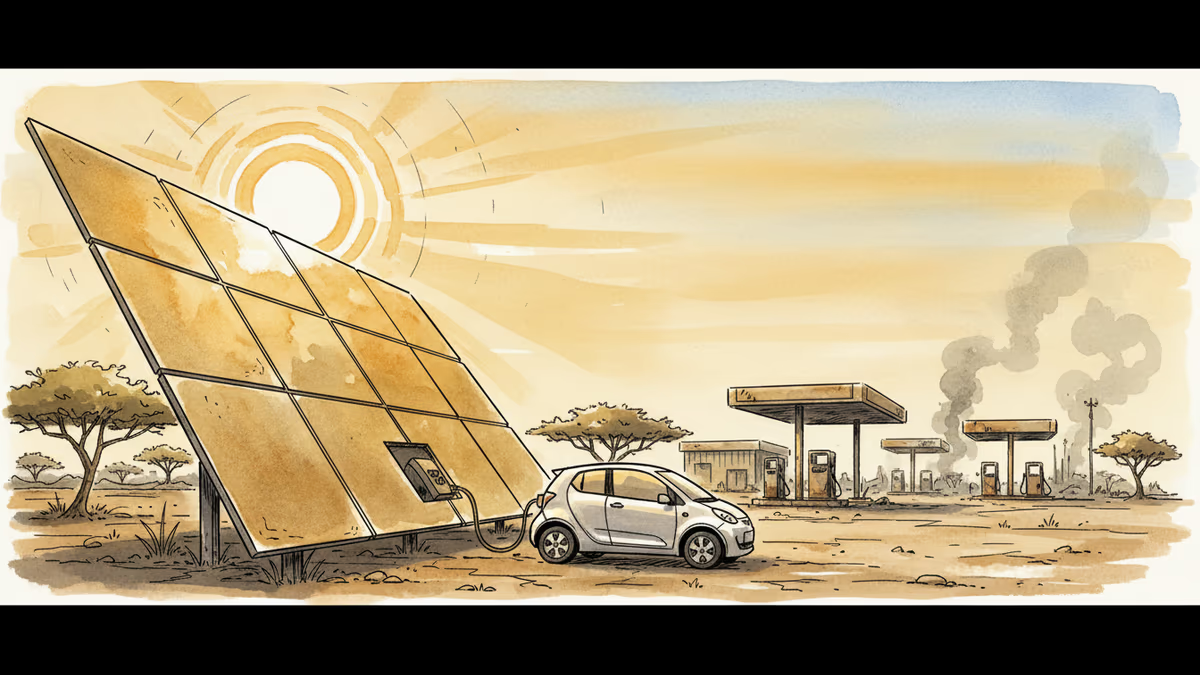
Africa's EV Tipping Point Could Come Sooner Than Anyone Expected
New research shows electric vehicles could become economically competitive across Africa by 2040, driven by solar charging systems and falling battery costs.
From 1% to Market Revolution in 15 Years
Just 1% of new cars sold across Africa in 2025 were electric. By 2040, that could flip entirely. New research published in Nature Energy suggests that with solar off-grid charging, EVs could actually be cheaper to own than gas vehicles across most of the continent within 15 years.
It's a dramatic shift from previous analyses that predicted fossil-fuel dominance through at least 2050. "EVs have serious economic potential in most African countries in the not-so-distant future," says Bessie Noll, senior researcher at ETH Zürich and lead author of the study.
The Solar Charging Game-Changer
The breakthrough isn't just about falling battery prices. Researchers calculated total cost of ownership—purchase price, financing, and fuel costs combined. What makes Africa unique is the charging infrastructure challenge.
With unreliable grids in many regions, the study factored in complete solar off-grid charging systems: panels, batteries, and inverters. These mini-grids are already spreading across Africa, potentially becoming the primary way EV owners charge their vehicles.
Electric two-wheelers will lead the charge, becoming competitive by 2030. Cars and minibuses follow by 2040. The hardest segment? Small cars, according to Christian Moretti, researcher at ETH Zürich and the Paul Scherrer Institute.
The Financing Reality Check

But there's a massive hurdle: financing costs. In some African countries, loan interest can exceed the vehicle's sticker price. Political instability and economic uncertainty make borrowing expensive, and EVs' higher upfront costs amplify this problem.
The landscape varies dramatically. South Africa, Mauritius, and Botswana are already close to conditions needed for EV cost parity. High-risk countries like Sudan (amid civil war) or Ghana (recovering from economic crisis) would need drastically lower financing costs.
"People will start to pick up these technologies when they're competitive," says Nelson Nsitem, lead Africa energy transition analyst at BloombergNEF.
Three Perspectives on Africa's EV Future
Optimists see leapfrogging potential. Just as Africa skipped landlines for mobile phones, it could bypass traditional automotive infrastructure for solar-powered EVs.
Skeptics point to financing barriers and infrastructure gaps. Kelly Carlin from Rocky Mountain Institute notes that banks may charge higher rates for EV loans, seeing the newer technology as riskier.
Pragmatists focus on segments. Two-wheelers and commercial vehicles may adopt faster than passenger cars, driven by economics rather than environmental concerns.
The Global Context
This isn't happening in isolation. Global EV momentum is "unmistakable," says Carlin. But Africa's path could be fundamentally different—solar-powered, financing-constrained, and potentially more sustainable than the grid-dependent transitions in developed markets.
The implications extend beyond transportation. If Africa becomes a major EV market by 2040, it could reshape global supply chains, battery demand, and climate goals.
Authors
Related Articles
Waymo's new Ojai robotaxi isn't just a vehicle upgrade. It's the company's most serious attempt yet at cracking the cost problem that has kept autonomous vehicles from scaling. Here's what's really at stake.

SolarSquare is raising $55-60M at a $450-500M valuation, more than doubling its worth in 18 months. Here's what's driving investor conviction in India's residential solar market.
Mercedes-AMG's new GT 4-door coupe packs three YASA axial flux motors producing 1,153 hp and 1,475 lb-ft of torque. Here's what it means for the EV performance race—and who actually wins.
Auto China 2026 set records with 1,451 vehicles and 181 world premieres. But the real story isn't the size—it's how Chinese automakers stopped competing on price and started competing on brains.
Waymo's new Ojai robotaxi isn't just a vehicle upgrade. It's the company's most serious attempt yet at cracking the cost problem that has kept autonomous vehicles from scaling. Here's what's really at stake.
SolarSquare is raising $55-60M at a $450-500M valuation, more than doubling its worth in 18 months. Here's what's driving investor conviction in India's residential solar market.
Mercedes-AMG's new GT 4-door coupe packs three YASA axial flux motors producing 1,153 hp and 1,475 lb-ft of torque. Here's what it means for the EV performance race—and who actually wins.
Auto China 2026 set records with 1,451 vehicles and 181 world premieres. But the real story isn't the size—it's how Chinese automakers stopped competing on price and started competing on brains.
Thoughts
Share your thoughts on this article
Sign in to join the conversation