
China Just Approved the World's First Commercial Brain Chip
China's NEO brain implant is now a legally sold medical device — the world's first commercial BCI. What this means for Neuralink, global regulators, and the future of human-machine interfaces.
Before Neuralink gets FDA clearance, before Europe finishes its ethical review, China just sold the world's first commercial brain chip. The race wasn't won in the lab — it was won in the regulatory office.
Neuracle Medical Technology's implant, NEO, received approval from China's National Medical Products Administration (NMPA), making it the first brain-computer interface (BCI) authorized for commercial sale as a medical treatment anywhere on Earth. The target population: people aged 19 to 60 with paralysis caused by neck or spinal cord injuries.
What NEO Actually Does — and Doesn't Do
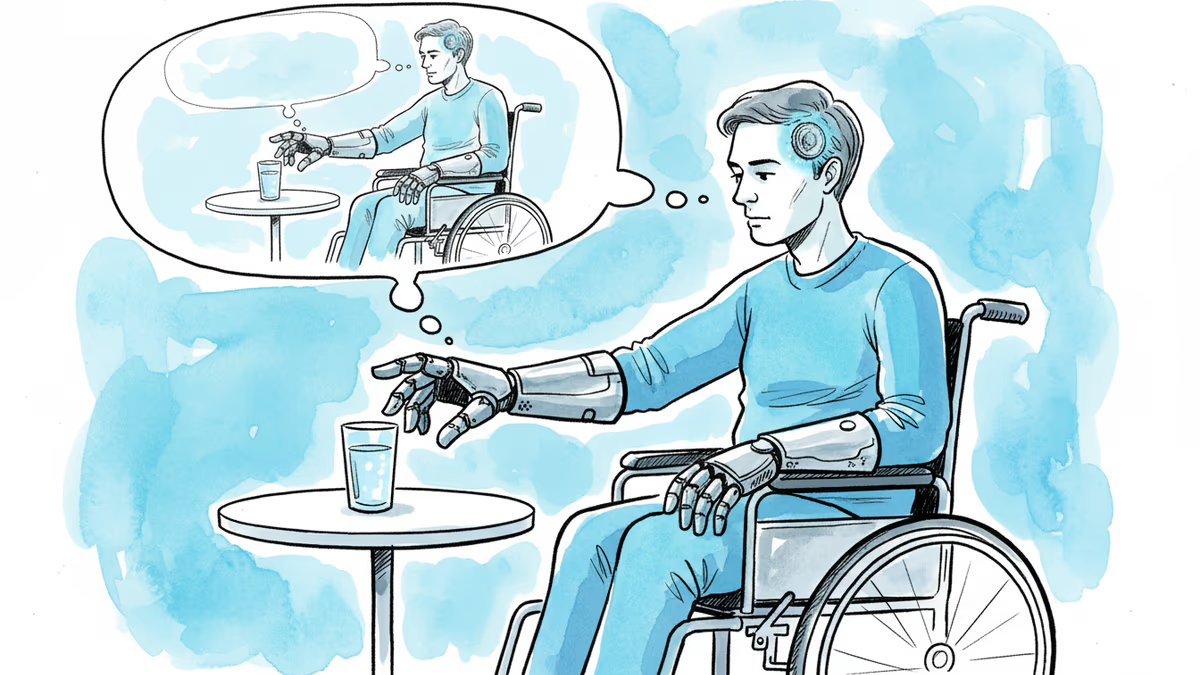
The device is elegantly simple in concept. A coin-sized chip embeds in the skull. Eight electrodes extend outward, resting on the brain's motor cortex — the region that processes intended movement. When a user thinks about moving their hand, the chip captures that neural signal, transmits it to a computer, and the computer translates it into movement commands for a robotic assistive glove.
The practical result: paralyzed users can pick up objects, handle utensils, and manage basic hygiene items. Not walking. Not typing. Not communicating complex thoughts. But for someone who cannot move their hands at all, these are not small things.
According to Nature, 32 people participated in clinical trials over 18 months, with no adverse side effects reported. That safety record is what unlocked the NMPA's approval.
Compare that to Neuralink. Elon Musk's company has implanted devices in human subjects, but early participants experienced electrode retraction issues, and FDA commercial approval remains out of reach. Several other BCI companies — Synchron, Precision Neuroscience, BrainGate — are deep in research and trials but nowhere near a commercial product authorization. NEO crossed the finish line first, not necessarily because it's the most advanced, but because it got approved.
Beijing's Five-Year Plan for Your Brain
This approval didn't happen in isolation. Months earlier, China released a policy document outlining 17 steps to build a globally competitive BCI industry within five years. The scope is broad: mass production of non-invasive wearable BCIs (forehead-mounted, head-mounted, ear-worn), pilot programs in high-risk industries like nuclear energy, mining, and hazardous materials handling, and accelerated pathways for medical applications.

Phoenix Peng, co-founder of BCI companies NeuroXess and Gestala, told WIRED: "The Chinese government has always supported disruptive technologies. This policy means BCI has already moved from the concept level to the product level."
The strategic logic is familiar: move fast, set standards, make others follow. China did this with electric vehicles, solar panels, and 5G infrastructure. BCI may be next.
Three Ways to Read This Moment
For patients and disability advocates, this is unambiguously good news — at least in principle. A device that restores hand function to paralyzed individuals, with an 18-month clean safety record, represents real progress. The question is whether that safety window is long enough. Brain implants interact with living tissue over years and decades. What happens at year three? Year ten? The data simply doesn't exist yet.
For investors and competitors, the competitive dynamics just shifted. The global BCI market is projected to reach $6 billion by 2030. China has now established a commercial beachhead. Neuralink, Synchron, and others must now compete not just on technology but on the narrative of being "proven" — and China's device has a head start on that story.
For regulators in the US and EU, this creates an uncomfortable pressure. If a Chinese BCI is commercially available and patients want access, how long can stricter regulatory bodies hold the line? The FDA's caution has been justified by real safety concerns. But regulatory arbitrage — where patients or companies route around slower regulators — is a real phenomenon. Medical tourism for BCI procedures could become a thing.
The Uncomfortable Question Nobody Wants to Answer
Here's the tension at the heart of this story: 32 patients over 18 months is a small dataset for a device that goes inside a human skull. The FDA typically requires far larger, longer trials before commercial authorization. China's NMPA approved NEO on a timeline that most Western regulators would consider preliminary.
Is China's faster approval a feature or a bug? Defenders argue that overly cautious regulation denies life-changing technology to people who need it now. Critics argue that the history of medical devices is littered with products that seemed safe at 18 months and caused harm at 18 years.
Neither side is obviously wrong. And that's precisely what makes this moment complicated.
Authors
Related Articles
Moonshot AI raised $2B at a $20B valuation. Its Kimi models rank second on OpenRouter. What China's open-weight AI surge means for the global LLM market.
CATL's third-gen Shenxing LFP battery claims charging speeds nearly 5x faster than Hyundai or Porsche's best 800V systems. Here's what that really means.
Elon Musk promised minds merged with AI. Neuralink delivered a brain-controlled cursor. The gap between the two reveals something important about how Silicon Valley sells the future.

ByteDance's Seedance 2.0 is shocking China's creative industry, but Hollywood studios are fighting back with cease-and-desist letters. What's driving this cultural divide?
Moonshot AI raised $2B at a $20B valuation. Its Kimi models rank second on OpenRouter. What China's open-weight AI surge means for the global LLM market.
CATL's third-gen Shenxing LFP battery claims charging speeds nearly 5x faster than Hyundai or Porsche's best 800V systems. Here's what that really means.
Elon Musk promised minds merged with AI. Neuralink delivered a brain-controlled cursor. The gap between the two reveals something important about how Silicon Valley sells the future.
ByteDance's Seedance 2.0 is shocking China's creative industry, but Hollywood studios are fighting back with cease-and-desist letters. What's driving this cultural divide?
Thoughts
Share your thoughts on this article
Sign in to join the conversation