
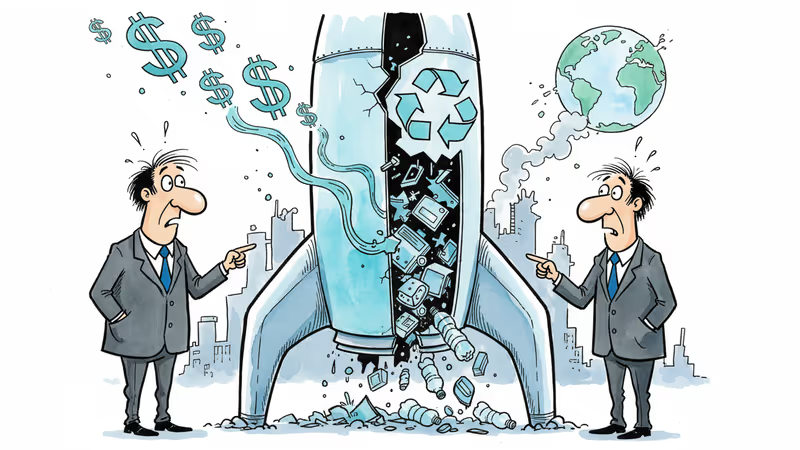
The $15 Million Question: Why Rocket Reusability Isn't Always Worth It
Blue Origin and SpaceX faced the same dilemma about reusing rocket upper stages. Their different choices reveal the complex economics of space launch.
$15 million. That's what SpaceX can launch a Falcon 9 rocket for internally, even with a brand-new upper stage that gets thrown away after every mission. This number sits at the heart of a 15-year debate that has shaped the entire commercial space industry.
The question isn't whether rockets can be made fully reusable—it's whether they should be. And the answer, it turns out, depends on economics that most people never see.
The Great Reusability Divide
Both Blue Origin and SpaceX engineers have wrestled with the same fundamental trade-off: recover and refurbish an upper stage, or build it cheap enough that throwing it away makes financial sense?
SpaceX chose the throwaway path for Falcon 9. Despite Elon Musk's early ambitions for full reusability, the company pivoted to a hybrid approach. They perfected first-stage recovery—the expensive part with nine engines—while accepting that the single-engine upper stage would be expendable. Instead, they focused on driving down manufacturing costs and recovering payload fairings.
Blue Origin, meanwhile, continues debating upper stage reusability for their New Glenn rocket, powered by two large BE-3U engines. The discussion has persisted since the rocket's early design phases, suggesting the economics aren't clear-cut.

The Hidden Math of Space Economics
The $15 million internal cost that SpaceX achieved reveals why this debate matters. When your total launch cost is that low, spending additional millions to develop, test, and operate upper stage recovery systems might not pencil out—especially when those systems add complexity, weight, and potential failure points.
Consider the variables: upper stage recovery requires heat shields, landing systems, recovery vessels, refurbishment facilities, and extensive testing between flights. Each reuse cycle involves inspection, part replacement, and recertification. Meanwhile, a simple expendable upper stage can be mass-produced using modern manufacturing techniques.
The breakeven calculation depends on flight frequency, manufacturing scale, and the specific technical challenges of each rocket design. SpaceX's high launch cadence—over 60 flights in 2023—allows them to amortize manufacturing costs across many vehicles while maintaining rapid production lines.
The Starship Gamble
SpaceX's current focus on making Starship fully reusable represents a different bet entirely. Unlike Falcon 9's incremental approach, Starship was designed from the ground up for complete reusability. This suggests that for truly large rockets intended for high-frequency operations—like Mars missions or satellite constellation deployment—full reusability becomes economically essential.
The key insight: reusability economics change dramatically with scale. A small upper stage might be cheaper to replace than recover. A massive second stage carrying 100+ tons to orbit? The math flips.
Authors
Related Articles
American Airlines just signed Starlink for 500+ aircraft. It's not just about faster inflight internet — it's a calculated move in the run-up to what could be the largest IPO in history.
SpaceX's upgraded Starship V3 completed its first test flight, deploying 20 Starlink simulators but losing the Super Heavy booster. With an IPO weeks away, the stakes just got higher.
SpaceX's IPO filing puts AI at the center, claiming a $26.5 trillion market opportunity. But can Grok compete with OpenAI and Anthropic for enterprise customers?
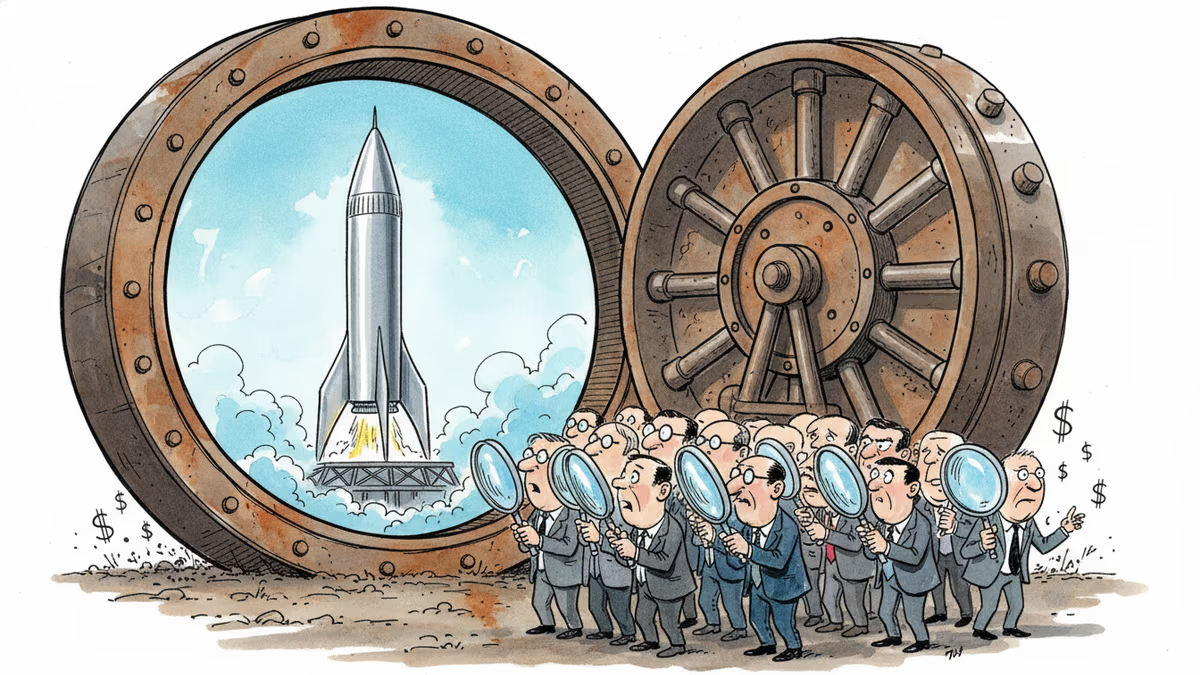
SpaceX filed a nearly 400-page S-1 with the SEC, targeting an IPO as early as June 12. Here's what the filing reveals—and what it doesn't.
American Airlines just signed Starlink for 500+ aircraft. It's not just about faster inflight internet — it's a calculated move in the run-up to what could be the largest IPO in history.
SpaceX's upgraded Starship V3 completed its first test flight, deploying 20 Starlink simulators but losing the Super Heavy booster. With an IPO weeks away, the stakes just got higher.
SpaceX's IPO filing puts AI at the center, claiming a $26.5 trillion market opportunity. But can Grok compete with OpenAI and Anthropic for enterprise customers?
SpaceX filed a nearly 400-page S-1 with the SEC, targeting an IPO as early as June 12. Here's what the filing reveals—and what it doesn't.
Thoughts
Share your thoughts on this article
Sign in to join the conversation