
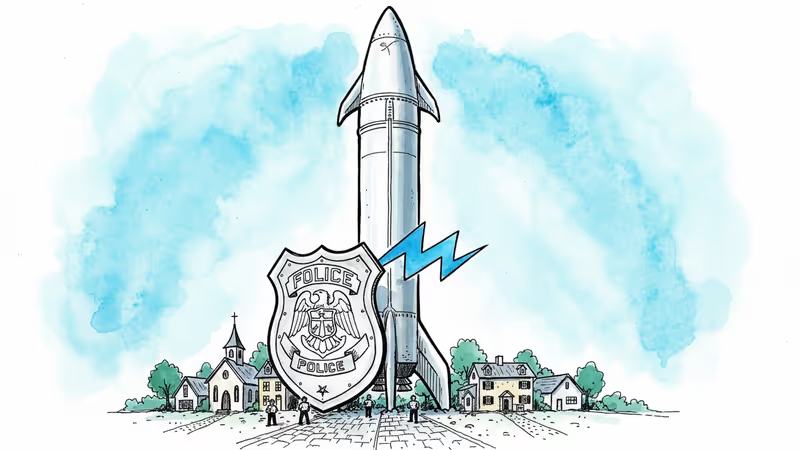
Musk's Space City Now Building Its Own Police Force
SpaceX's company town Starbase approved creating a municipal police department. A new experiment in corporate governance extends from city services to law enforcement.
When a small town of a few hundred residents decides to create its own police force, it's usually unremarkable local news. But when that town is Elon Musk'sSpaceX-built company city, it becomes something entirely different.
Starbase, the South Texas community where SpaceX builds and tests its Starship rockets, just took a significant step toward complete municipal independence. The city commission approved an ordinance Tuesday to establish a municipal police department, pending approval from the Texas Commission on Law Enforcement.
From Rocket Factory to Self-Governing City
The numbers tell the story of Starbase's unique situation. This isn't your typical small town—it's home to just a few hundred residents, most of whom are SpaceX employees or their families. Yet it sits in geographic isolation, with the nearest neighboring town, Brownsville, 10 miles away and a 45-minute drive on a good day.
"There is a lot of assets here with the operations of SpaceX," city administrator Kent Myers explained. "Those assets need to be protected, and so the police department will play a critical part in protecting those assets." The department will be led by a police chief elected by the city commission and is expected to hire eight officers.
Starbase has contracted security consulting firm Vision Quest Solutions to build out the department, which could be operational within months. It's the latest addition to public services that have emerged since the city's incorporation last year. In October, SpaceX employees launched a volunteer fire department. The city also created a fire marshal position and took over building inspections and permitting.
When Corporate Contracts Fall Short
Starbase initially tried outsourcing law enforcement to Cameron County's sheriff's office through a $3.5 million, five-year contract. The deal called for eight deputies overall, with two patrolling the city at any given time. The city also struck a separate agreement to use the county jail, paying $100 per day per inmate plus additional expenses like medical care.

But the arrangement didn't work out. "We didn't have a lot of success in finding deputies through the county, so we decided to change direction," Myers told local outlet Valley Central. Sheriff Manuel Treviño pointed to the contract's lack of civil service protections as part of the problem.
The failed partnership highlights a fundamental challenge: traditional government structures weren't designed for corporate towns with unique security needs and isolated locations.
The New Company Town Model
What's happening in Starbase represents a modern twist on an old American concept. Company towns dominated by single employers were common in the late 19th and early 20th centuries, particularly in mining and manufacturing. But a 21st-century tech company creating a city specifically for space exploration—complete with its own police force—breaks new ground.
Starbase serves as more than just a rocket manufacturing site. It's Musk's testing ground for the kind of self-sufficient community he envisions for Mars colonization. The city's evolution from corporate facility to full-service municipality offers insights into how future space settlements might govern themselves.
The implications extend beyond space exploration. As remote work reshapes where people live and work, other tech giants might consider similar experiments in creating purpose-built communities with integrated governance structures.
Questions of Accountability and Control
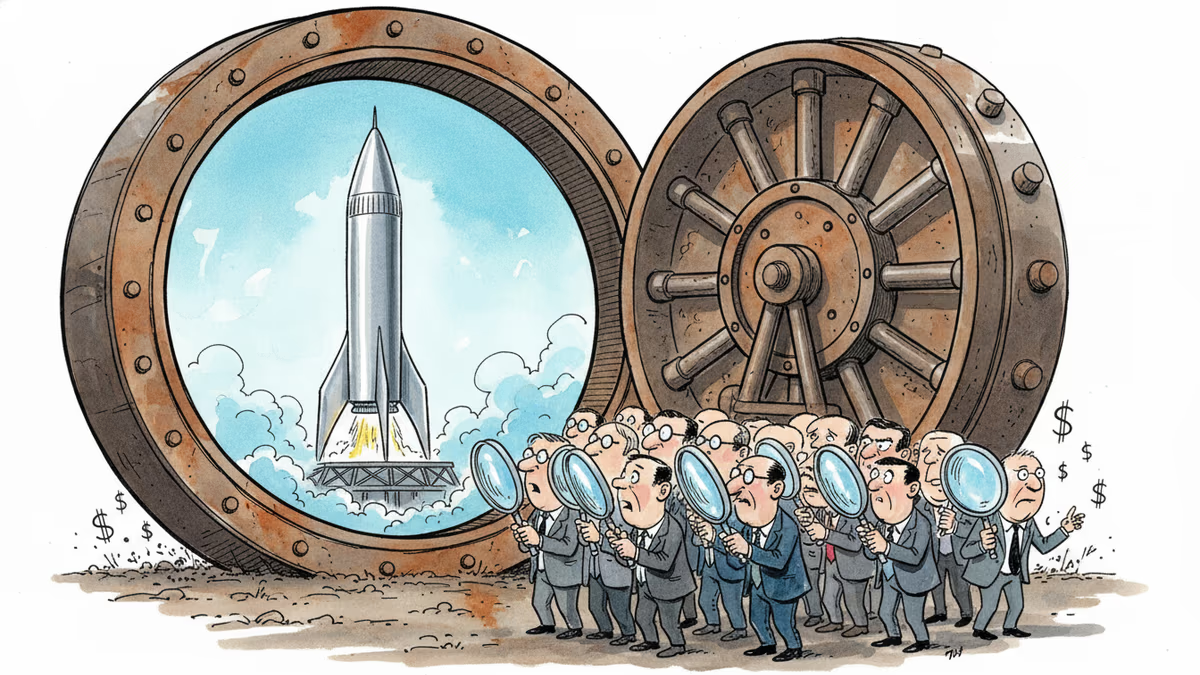
The creation of Starbase's police department raises fundamental questions about corporate power and democratic oversight. Unlike traditional municipalities where residents elect leaders through competitive democratic processes, Starbase's governance structure remains closely tied to SpaceX's interests.
The city commission that will select the police chief consists largely of SpaceX employees or affiliates. This creates a unique situation where a private company's security needs directly influence public law enforcement priorities and policies.
Regulatory approval from the Texas Commission on Law Enforcement will provide some oversight, but the long-term accountability mechanisms remain unclear as Starbase continues expanding its municipal services.
Authors
Related Articles
American Airlines just signed Starlink for 500+ aircraft. It's not just about faster inflight internet — it's a calculated move in the run-up to what could be the largest IPO in history.
SpaceX's upgraded Starship V3 completed its first test flight, deploying 20 Starlink simulators but losing the Super Heavy booster. With an IPO weeks away, the stakes just got higher.
SpaceX's IPO filing puts AI at the center, claiming a $26.5 trillion market opportunity. But can Grok compete with OpenAI and Anthropic for enterprise customers?
SpaceX filed a nearly 400-page S-1 with the SEC, targeting an IPO as early as June 12. Here's what the filing reveals—and what it doesn't.
American Airlines just signed Starlink for 500+ aircraft. It's not just about faster inflight internet — it's a calculated move in the run-up to what could be the largest IPO in history.
SpaceX's upgraded Starship V3 completed its first test flight, deploying 20 Starlink simulators but losing the Super Heavy booster. With an IPO weeks away, the stakes just got higher.
SpaceX's IPO filing puts AI at the center, claiming a $26.5 trillion market opportunity. But can Grok compete with OpenAI and Anthropic for enterprise customers?
SpaceX filed a nearly 400-page S-1 with the SEC, targeting an IPO as early as June 12. Here's what the filing reveals—and what it doesn't.
Thoughts
Share your thoughts on this article
Sign in to join the conversation