
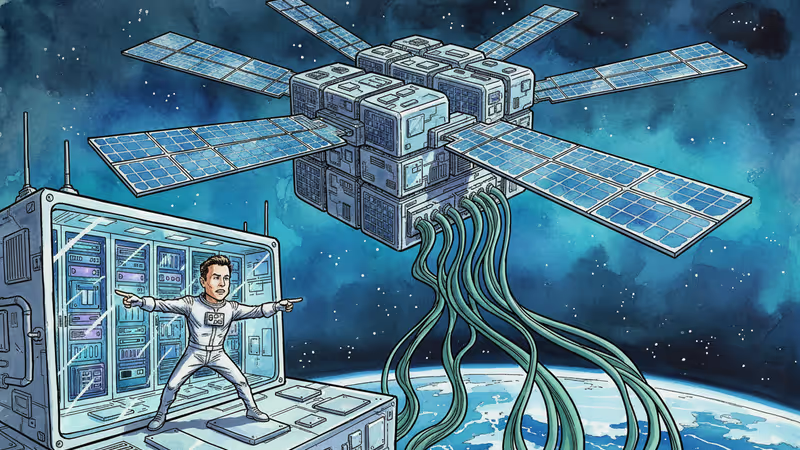
Musk's $1.25 Trillion Bet on Space-Based AI Data Centers
Elon Musk announces merger of SpaceX and xAI to build orbital data centers, claiming space is the only way to scale AI. We examine the ambitious plan's feasibility and implications for the tech industry.
$1.25 trillion. That's the value Elon Musk placed on his Monday announcement to merge SpaceX and xAI. But the price tag wasn't the most audacious part—it was his reasoning: "AI needs to go to space."
Musk argues that AI's reliance on "large terrestrial data centers" consuming "immense amounts of power and cooling" creates environmental strain and community pushback. His solution? Move the servers to orbit. "In the long term, space-based AI is obviously the only way to scale," he declared.
The Physics of the Proposal
Musk's logic isn't entirely far-fetched. Data centers currently consume 1-2% of global electricity, and this figure is climbing rapidly as AI demand explodes. By 2030, some estimates suggest data centers could account for 8% of global power consumption.
Space offers compelling advantages. Solar panels operate at 8-10 times higher efficiency without atmospheric interference, providing 24/7 power generation. The vacuum of space naturally solves cooling challenges that plague earthbound facilities. No NIMBY protests, no zoning restrictions, no environmental impact assessments.
Google is already exploring similar territory with Project Suncatcher, aiming to build solar-powered orbital data centers. Musk isn't alone in looking skyward for computing solutions.
The Reality Check
But the numbers tell a sobering story. Launch costs remain prohibitive—even SpaceX's Falcon Heavy charges $1,400 per kilogram. A typical hyperscale data center weighs thousands of tons. The math doesn't add up yet.

Latency presents another hurdle. Earth-to-orbit communication introduces 240-millisecond delays minimum—death for real-time AI applications. Maintenance becomes nearly impossible. A failed server rack in space can't exactly call tech support.
Radiation and space debris pose constant threats to delicate semiconductor equipment. The harsh environment that makes space attractive for power generation makes it hostile for sensitive electronics.
Industry Implications
If Musk's vision materializes, it could reshape the entire cloud computing landscape. Traditional data center companies like Amazon Web Services, Microsoft Azure, and Google Cloud would face a fundamental disruption to their terrestrial infrastructure investments.
Semiconductor companies would need to develop radiation-hardened chips specifically for orbital deployment. Satellite manufacturers could find themselves in the data center business. Launch providers would see unprecedented demand.
The geopolitical implications are equally significant. Space-based computing infrastructure raises questions about jurisdiction, regulation, and national security. Which country's laws govern a data center orbiting Earth?
The Investment Reality
Despite the technical challenges, investors are taking notice. The space economy is projected to reach $1 trillion by 2040, and computing represents a potentially massive slice. Companies developing space-qualified hardware, advanced propulsion systems, and orbital manufacturing capabilities could see substantial opportunities.
However, the timeline matters. Current technology suggests space data centers remain 10-15 years away from economic viability. That's assuming breakthrough advances in launch costs, component durability, and orbital assembly techniques.
Authors
Related Articles
American Airlines just signed Starlink for 500+ aircraft. It's not just about faster inflight internet — it's a calculated move in the run-up to what could be the largest IPO in history.
SpaceX's upgraded Starship V3 completed its first test flight, deploying 20 Starlink simulators but losing the Super Heavy booster. With an IPO weeks away, the stakes just got higher.
SpaceX's IPO filing puts AI at the center, claiming a $26.5 trillion market opportunity. But can Grok compete with OpenAI and Anthropic for enterprise customers?
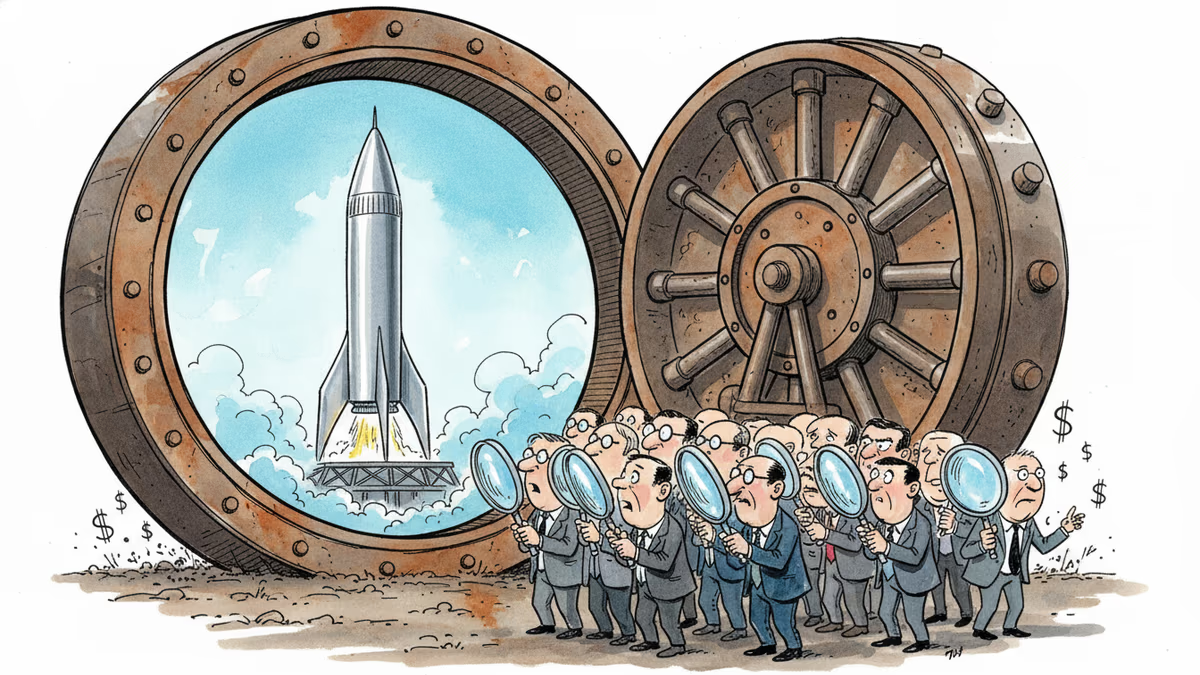
SpaceX filed a nearly 400-page S-1 with the SEC, targeting an IPO as early as June 12. Here's what the filing reveals—and what it doesn't.
American Airlines just signed Starlink for 500+ aircraft. It's not just about faster inflight internet — it's a calculated move in the run-up to what could be the largest IPO in history.
SpaceX's upgraded Starship V3 completed its first test flight, deploying 20 Starlink simulators but losing the Super Heavy booster. With an IPO weeks away, the stakes just got higher.
SpaceX's IPO filing puts AI at the center, claiming a $26.5 trillion market opportunity. But can Grok compete with OpenAI and Anthropic for enterprise customers?
SpaceX filed a nearly 400-page S-1 with the SEC, targeting an IPO as early as June 12. Here's what the filing reveals—and what it doesn't.
Thoughts
Share your thoughts on this article
Sign in to join the conversation