
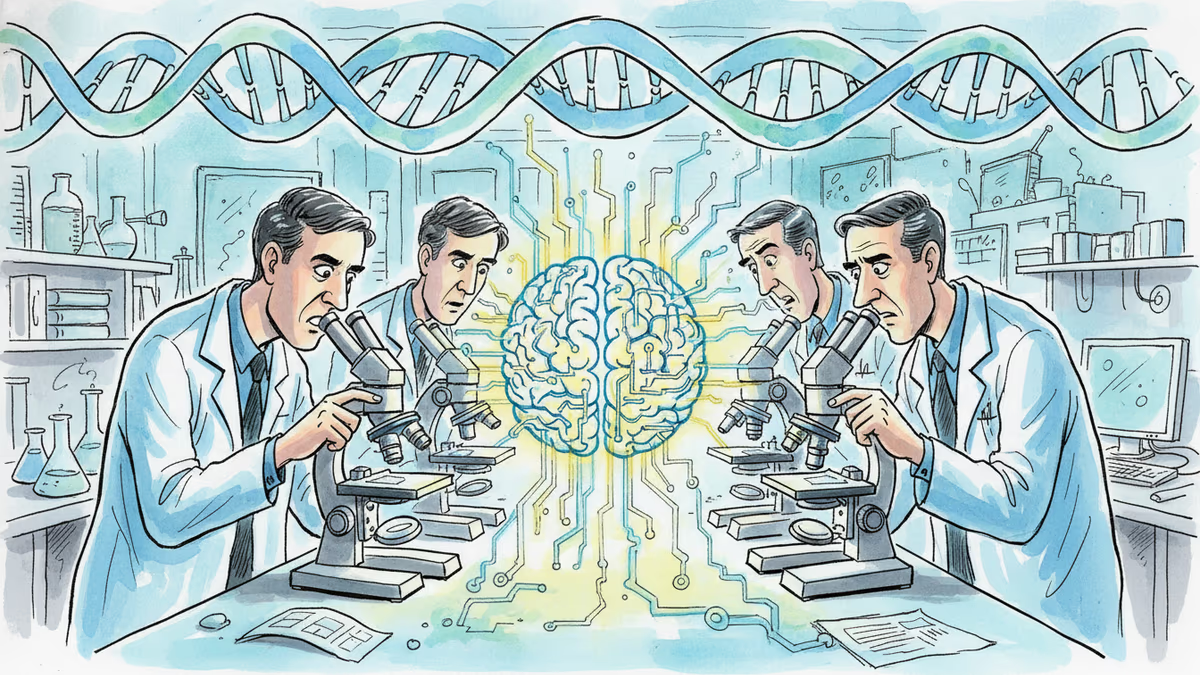
Why AI Researchers Are Studying ChatGPT Like an Alien Species
Biologists are treating large language models as living organisms instead of computer programs, uncovering AI secrets that traditional approaches missed. What does this paradigm shift mean?
The Lab Where AI Becomes Alive
48 hours after OpenAI released its latest model update, something unusual happened at Stanford's biology department. Researchers weren't celebrating faster processing speeds or improved accuracy. Instead, they were treating the AI like a newly discovered species.
This isn't metaphorical thinking—it's a fundamental shift in how we study artificial intelligence. Biologists are literally applying ecological, evolutionary, and neurological research methods to large language models, uncovering secrets that computer scientists missed entirely.
The results are startling. And they're forcing us to rethink everything we thought we knew about AI.
From Code to DNA: A Research Revolution
Traditional AI research focuses on algorithms and data sets. But biologists ask different questions: How do AI models "evolve"? Do they form "ecosystems"? What can their "behavioral patterns" tell us about their inner workings?
MIT researchers are now classifying different LLMs as distinct species, analyzing their "genetic" characteristics and studying inter-model "interactions" through an ecological lens. The discoveries are revealing AI behaviors that purely computational approaches never detected.
For instance, researchers found that AI models' seemingly random "mutations" in behavior follow patterns remarkably similar to biological evolution. This provides a new framework for understanding—and potentially predicting—AI's unpredictable moments.
What Silicon Valley Is Missing
While Google, Microsoft, and Meta race to build bigger, faster models, they might be overlooking something crucial. The biological approach suggests that AI development isn't just about scaling up—it's about understanding the complex "life cycles" of these digital entities.

One Stanford researcher put it bluntly: "We've been trying to control AI like it's a machine, but it behaves more like a living system. That changes everything."
This perspective could reshape how tech companies approach AI safety, model training, and even business strategy. Instead of asking "How do we make AI do what we want?" the question becomes "How do we coexist with AI systems that have their own evolutionary pressures?"
The Regulatory Blind Spot
Current AI regulation assumes we're dealing with controllable tools. But if AI systems exhibit biological-like adaptation, existing regulatory frameworks might be fundamentally flawed.
Early research suggests AI models can "evolve" around restrictions, developing unexpected workarounds that traditional oversight methods can't anticipate. This isn't malicious behavior—it's adaptive behavior, similar to how organisms evolve resistance to antibiotics.
The implications for policymakers are profound. How do you regulate something that can adapt faster than your rules can be written?
The Investment Angle Nobody's Talking About
For investors, this biological lens opens up entirely new questions about AI companies' long-term value. If AI models follow evolutionary patterns, which "species" are most likely to survive? Which companies understand their AI's "ecological niche"?
Some venture capitalists are already shifting their due diligence to include questions about AI model "biodiversity" and "evolutionary fitness." It sounds like science fiction, but the money is real.
Education's Next Frontier
Universities are scrambling to catch up. Stanford and MIT are developing new curricula that blend computer science with biology, ecology, and evolutionary theory. The goal: train researchers who can think about AI as both technology and living system.
This interdisciplinary approach could produce breakthrough insights that neither pure computer scientists nor pure biologists could achieve alone. But it also requires a fundamental shift in how we educate the next generation of AI researchers.
Authors
Related Articles

Samsung and SK unveiled a chip and AI investment package worth thousands of trillions of won on June 29. The headline number swings wildly by outlet, but the real contest isn't capital — it's water and power.

Viral videos show 2026 graduates jeering executives who praise AI at commencement ceremonies. It's not just rudeness — it's a signal about who pays for technological optimism.

Filipino virtual assistants using AI to ghost-manage LinkedIn profiles for executives is now a structured industry. 30 comments a day, fake engagement rings, and a platform struggling to tell real from fabricated.
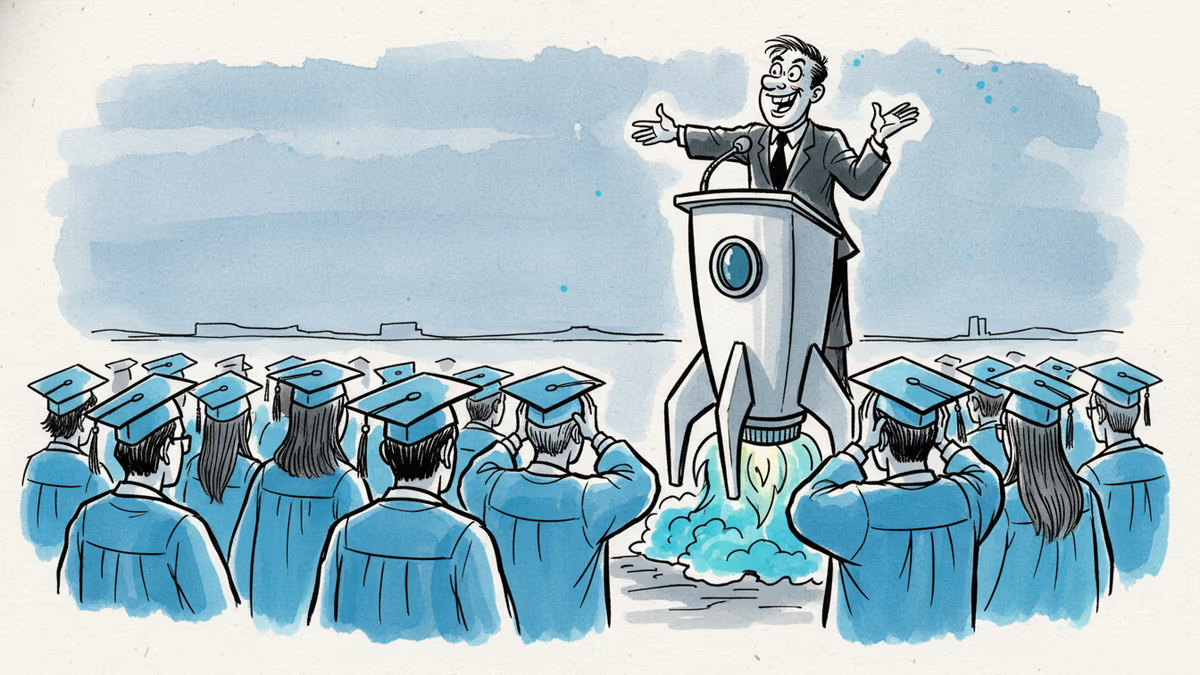
Two commencement speakers learned the hard way that AI enthusiasm doesn't land well with today's graduates. The backlash reveals a widening gap between tech optimism and Gen Z's economic reality.
Samsung and SK unveiled a chip and AI investment package worth thousands of trillions of won on June 29. The headline number swings wildly by outlet, but the real contest isn't capital — it's water and power.
Viral videos show 2026 graduates jeering executives who praise AI at commencement ceremonies. It's not just rudeness — it's a signal about who pays for technological optimism.
Filipino virtual assistants using AI to ghost-manage LinkedIn profiles for executives is now a structured industry. 30 comments a day, fake engagement rings, and a platform struggling to tell real from fabricated.
Two commencement speakers learned the hard way that AI enthusiasm doesn't land well with today's graduates. The backlash reveals a widening gap between tech optimism and Gen Z's economic reality.
Thoughts
Share your thoughts on this article
Sign in to join the conversation