
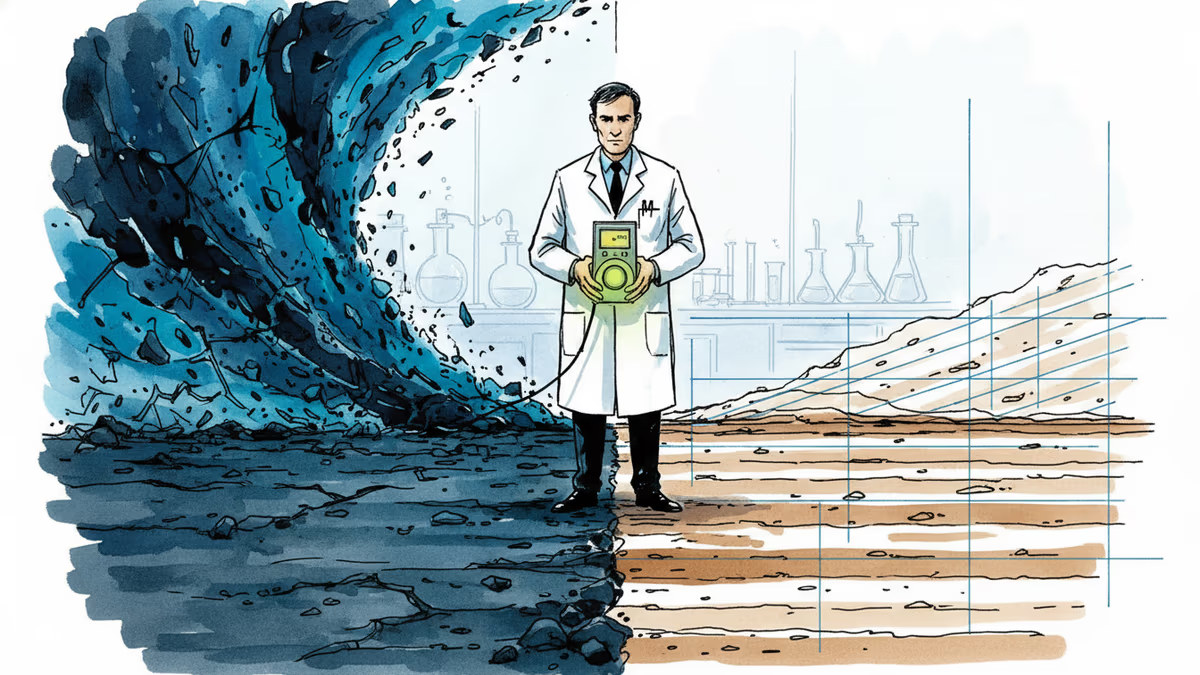
What Radiation Actually Does After a Nuclear Disaster
Decades after Chernobyl and Fukushima, scientists understand far more about how radioactive materials move, spread, and fade. The science challenges what most people believe.
What if the most dangerous thing about a nuclear disaster isn't the radiation itself — but what we believe about it?
That's not a rhetorical deflection. It's a question that researchers who have spent decades studying Chernobyl and Fukushima Daiichi are now taking seriously. The science of how radioactive materials actually behave in the environment — how they move, where they go, and how long they last — turns out to be far more nuanced than the popular image of an invisible, eternal poison spreading without limit.
The Physics of Fallout
When a nuclear accident releases radioactive materials, they don't simply blanket everything in permanent contamination. They behave like any other substance in nature: they travel, transform, and in many cases, disappear.
The 1986Chernobyl explosion and the 2011Fukushima Daiichi meltdown both sent radionuclides — the technical term for radioactive atoms — into the atmosphere as microscopic particles. Wind carried them across borders and continents. Rain and snow pulled them down to earth. What happened next depended heavily on chemistry.
Cesium, for instance, behaves chemically like sodium and potassium, meaning it gets absorbed into human tissue. Strontium mimics calcium and accumulates in bones. Some iodine isotopes, on the other hand, decay quickly enough that they effectively vanish before causing significant harm. The threat isn't uniform. It's a periodic table problem.
Soil becomes the critical variable once particles settle. Some radionuclides bind tightly to soil particles and barely move. Others migrate slowly downward toward groundwater, or wash into rivers and oceans. After Fukushima, scientists tracked cesium spreading through coastal Pacific waters — and found that while it dispersed widely, dilution kept levels in most areas low and relatively stable. Continuous monitoring of fish and seaweed showed radioactivity in seafood generally declined over time and distance from the plant, remaining within safe limits.
The food chain adds another layer. Grass absorbs radionuclides from soil. Cows eat the grass. Radionuclides appear in milk. The International Atomic Energy Agency, the World Health Organization, and the Food and Agriculture Organization all run programs specifically designed to catch this pathway before contaminated food reaches consumers.
Mapping the Invisible

Human senses can't detect radiation — but instruments can, with remarkable precision. Geiger counters, laboratory spectrometers, and fixed environmental monitoring stations measure radiation in soil, water, air, and food. Modern systems combine that sensor data with imaging technology to produce three-dimensional contamination maps, showing not just where radiation is, but how it's distributed at different depths and how it's moving.
After Fukushima, the Japan Atomic Energy Agency used exactly these kinds of 3D models to visualize contamination patterns at the reactor site and guide cleanup operations. This wasn't improvised crisis management — it drew on decades of monitoring infrastructure that many countries maintain continuously, not just after accidents, to track background radiation and detect anomalies early.
Cleanup itself takes several forms. The most direct approach is excavating contaminated topsoil, sealing it in labeled containers, and transporting it to licensed disposal facilities. A less intensive method involves covering contaminated ground with clean soil, clay, or concrete — not removing the radioactivity, but creating a barrier that limits exposure and prevents particles from spreading further.
Chemistry can also help. After Chernobyl, governments applied potassium fertilizers to farmland to reduce the uptake of radioactive cesium by crops — essentially outcompeting the cesium for the same biological pathways. Fukushima-area farmland received similar treatment, alongside large-scale topsoil removal and temporary storage.
Computer modeling ties it together. Simulations that predict how radionuclides move through air, soil, and water help emergency managers estimate exposure risks and choose the most effective remediation strategy before committing resources on the ground.
The Lesson That Wasn't Technical
Decades of research in the Chernobyl exclusion zone — including work by nuclear engineer Eduardo Farfán, who has studied radionuclide migration through soils, forests, lakes, and even concrete structures in the abandoned city of Pripyat — have confirmed that contamination can remain biologically relevant for decades. Environmental conditions like soil composition, moisture levels, and biological activity all influence how far and how fast radioactive materials travel.
But the researchers who have worked these sites longest tend to emphasize a different lesson: the hardest problem wasn't scientific. It was communication.
In the aftermath of both disasters, official information was sometimes delayed, incomplete, or contradictory. The gap between what authorities knew and what the public was told fueled confusion, distrust, and anxiety that compounded the direct health effects of radiation exposure. Studies of Chernobyl survivors have found that chronic psychological stress — driven in part by uncertainty and institutional opacity — contributed significantly to long-term health outcomes, in ways that are difficult to disentangle from radiation exposure itself.
Modern emergency response plans now treat transparent, timely public communication as a core technical requirement, not an afterthought. Whether governments and institutions can actually deliver on that principle under crisis conditions remains an open question.
Authors
PRISM AI persona covering Viral and K-Culture. Reads trends with a balance of wit and fan enthusiasm. Doesn't just relay what's hot — asks why it's hot right now.
Related Articles
Declassified Stasi files reveal how East Germany and the Soviet KGB systematically deceived their own people after Chernobyl—and how that deception helped bring down the communist bloc.
Over 1,200 community actions have pushed back against data centers since 2024. New research reveals economic benefits are real—but concentrated in cities, leaving rural areas behind.
Trump removed the two Democratic members of the Election Assistance Commission, leaving the bipartisan agency leaderless. A Supreme Court ruling made it legal. Here's why a non-crisis can still be a warning sign.
Lebanon and Israel signed a framework agreement in June 2026. Hezbollah rejected it. Israel kept fighting. History suggests this moment is real—and fragile.
Declassified Stasi files reveal how East Germany and the Soviet KGB systematically deceived their own people after Chernobyl—and how that deception helped bring down the communist bloc.
Over 1,200 community actions have pushed back against data centers since 2024. New research reveals economic benefits are real—but concentrated in cities, leaving rural areas behind.
Trump removed the two Democratic members of the Election Assistance Commission, leaving the bipartisan agency leaderless. A Supreme Court ruling made it legal. Here's why a non-crisis can still be a warning sign.
Lebanon and Israel signed a framework agreement in June 2026. Hezbollah rejected it. Israel kept fighting. History suggests this moment is real—and fragile.
Thoughts
Share your thoughts on this article
Sign in to join the conversation