

Europe AI Digital Sovereignty: The High-Stakes Race to Break US Dominance
Europe is accelerating its push for AI digital sovereignty to break reliance on US tech giants. Inspired by DeepSeek's efficiency, EU labs are leveraging open-source models amidst growing political tensions with the Trump administration.
They're shaking hands, but Europe's keeping its fists clenched. As the rift between the US and its allies widens, AI labs across the continent are scouting for inventive ways to close the gap with American rivals. From processor design to datacenter capacity, US giants like Nvidia, Google, and OpenAI currently outpace Europe across the entire production line.
Pursuing Europe AI Digital Sovereignty in the Trump Era
Europe isn't ready to surrender. Buoyed by the success of China-based DeepSeek, which proved that massive GPU fleets aren't the only way to win, European researchers are doubling down on imaginative model design. "We've been too gullible to the narrative that innovation is only done in the US," claims Rosaria Taddeo, a professor at the University of Oxford. She argues that digital sovereignty is no longer optional—it's a necessity.

The geopolitical climate has added a fresh layer of urgency. Recent clashes between the Trump administration and European leaders over tariff policies and the regulation of Elon Musk's X have highlighted the risks of dependency. After the European Commission fined X roughly $140 million, US Secretary of State Marco Rubio condemned it as an attack on American tech. In a worst-case scenario, experts fear the US could leverage its AI infrastructure as a bargaining chip in trade negotiations.
Open Source as a Force Multiplier
To counter this, projects like SOOFI are working on a competitive general-purpose model with 100 billion parameters slated for release within the year. Unlike the "closed shops" of Silicon Valley, European labs are betting on open-source development to multiply their collective power. By sharing training data and model intricacies, they hope to foster a collaborative ecosystem that can eventually challenge the US dominance.
Authors
Related Articles
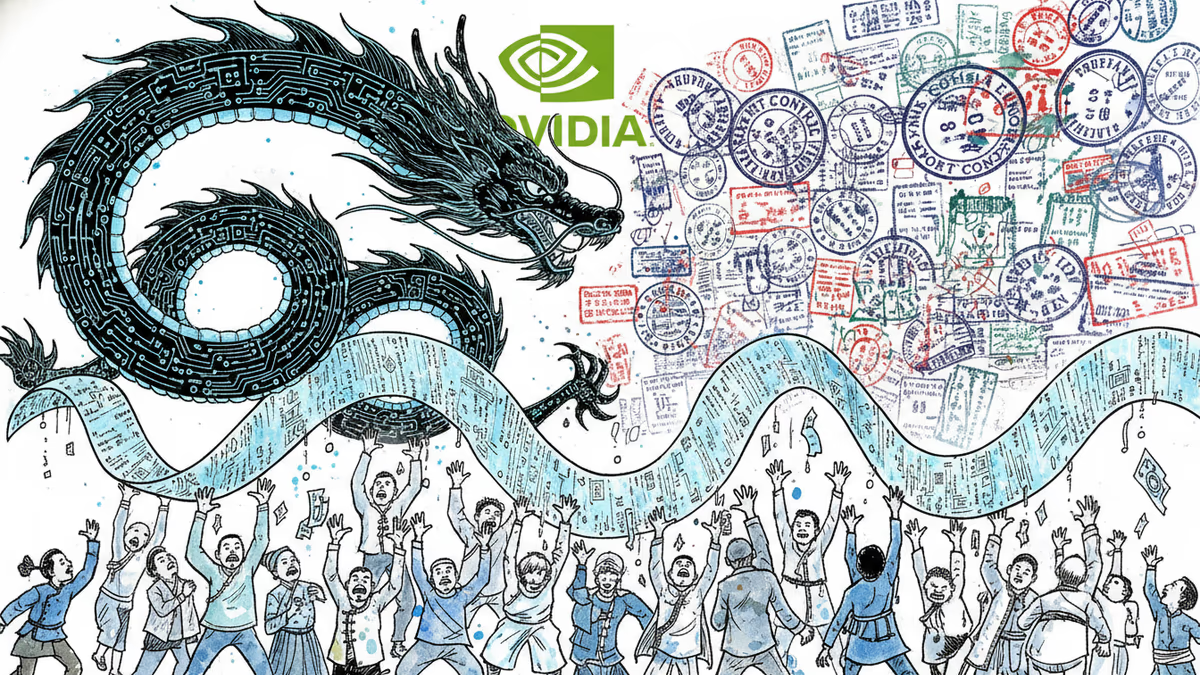
DeepSeek's V4 won't replicate the R1 shock—but it redraws the open-source AI map on pricing, long-context efficiency, and China's push to ditch Nvidia. Here's what's worth watching.

Stanford-Princeton study reveals systematic censorship in Chinese AI models. DeepSeek refuses 36% of sensitive questions while US models refuse less than 3%.
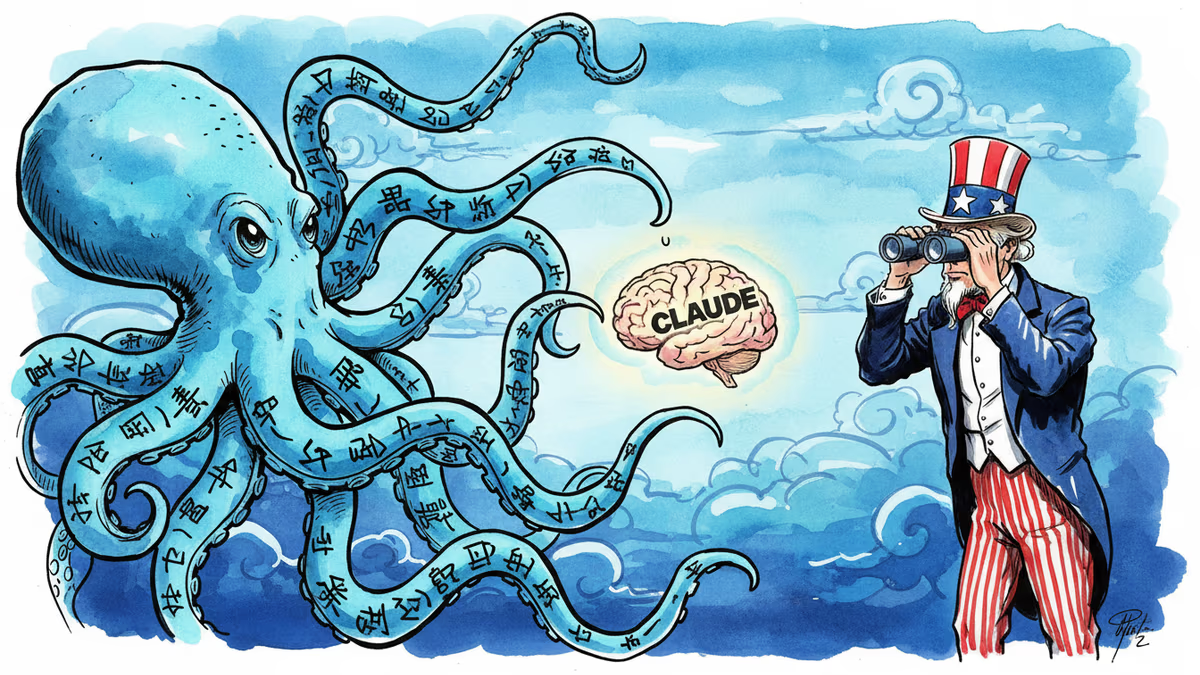
Anthropic exposes how DeepSeek, Moonshot AI, and MiniMax used 24,000+ fake accounts to steal Claude's capabilities through 16 million conversations. The scale and implications revealed.
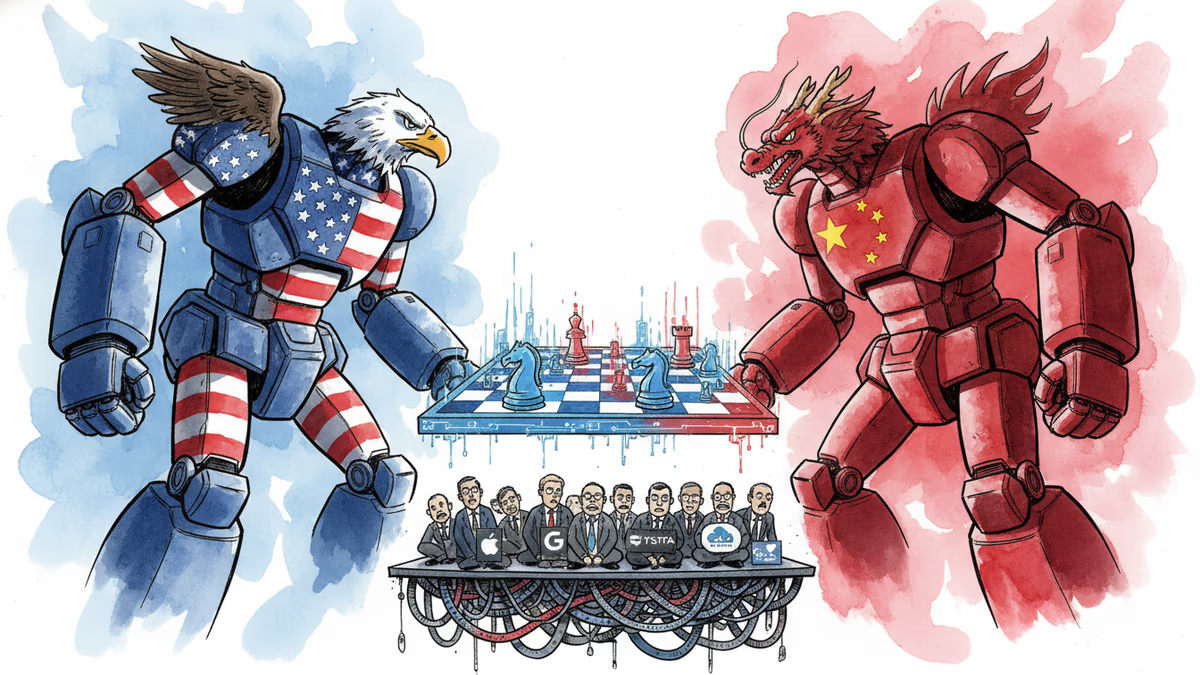
OpenAI accused DeepSeek of stealing AI capabilities before any new model launch. The real battle isn't about copying—it's about who controls AI's future.
DeepSeek's V4 won't replicate the R1 shock—but it redraws the open-source AI map on pricing, long-context efficiency, and China's push to ditch Nvidia. Here's what's worth watching.
Stanford-Princeton study reveals systematic censorship in Chinese AI models. DeepSeek refuses 36% of sensitive questions while US models refuse less than 3%.
Anthropic exposes how DeepSeek, Moonshot AI, and MiniMax used 24,000+ fake accounts to steal Claude's capabilities through 16 million conversations. The scale and implications revealed.
OpenAI accused DeepSeek of stealing AI capabilities before any new model launch. The real battle isn't about copying—it's about who controls AI's future.
Thoughts
Share your thoughts on this article
Sign in to join the conversation