
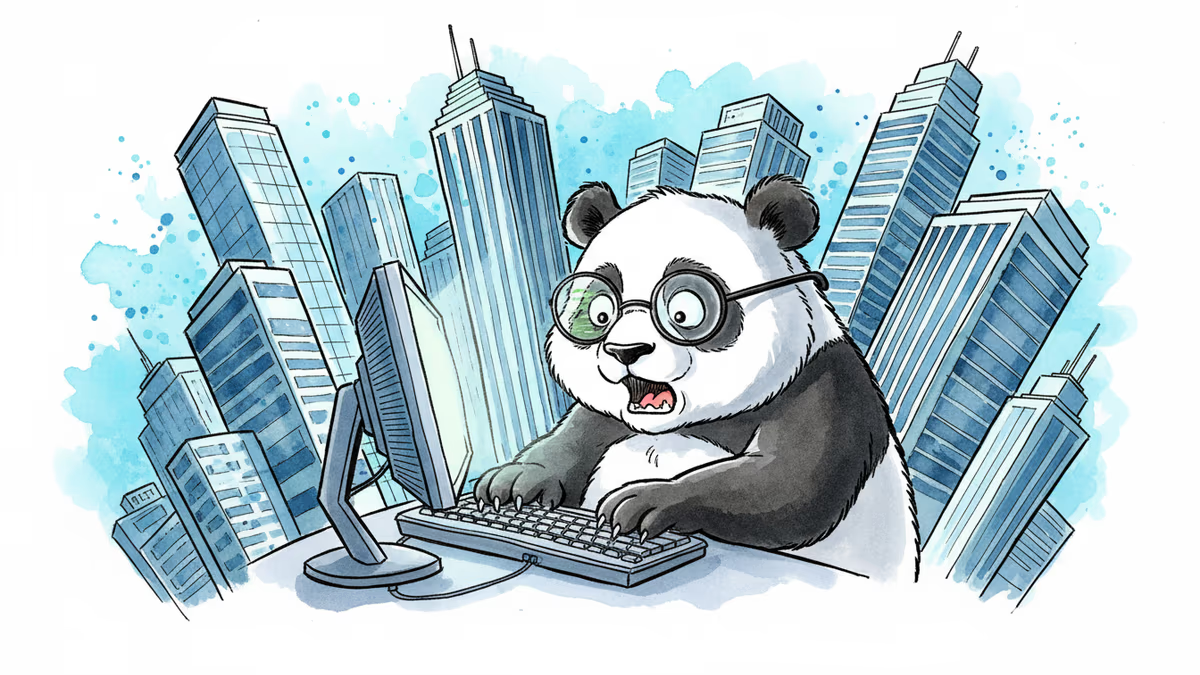
How China's Open-Source AI Is Rewriting Silicon Valley's Rules
From DeepSeek to Qwen, Chinese open-source AI models are reshaping global standards with 1/7th the cost and matching performance. The infrastructure shift that's changing everything.
3 billion downloads. That's how many times Alibaba's Qwen models have been pulled from Hugging Face, overtaking Meta's Llama as the most downloaded AI model family globally. It's not just a number—it's a signal that the center of gravity in AI development is shifting.
The DeepSeek Moment That Changed Everything
When DeepSeek released its R1 reasoning model in January 2025, Silicon Valley wasn't just surprised—it was blindsided. Here was a Chinese AI system that could match OpenAI's o1 in reasoning tasks, released completely free under an MIT license. Within 48 hours, it had knocked ChatGPT off the top of the US App Store. Tech stocks shed roughly $1 trillion in market value overnight.
But the real shock wasn't DeepSeek's performance. It was the strategy. Unlike ChatGPT or Claude, which you pay to access through APIs, DeepSeek published everything: the model weights, the training techniques, even detailed research papers. Anyone could download, inspect, modify, and redistribute it.
"Thirty years ago, no Chinese person would believe they could be at the center of global innovation," says Alex Wu, CEO of Atoms and a prominent figure in China's open-source ecosystem. "DeepSeek shows that with solid technical talent and the right culture, world-class work is possible."
The Price War That Isn't Really About Price
Last week, Moonshot AI's Kimi K2.5 matched Claude Opus on early benchmarks while costing roughly one-seventh the price. For developers, it's a no-brainer. But this isn't just about undercutting competitors—it's about fundamentally different business models.
Martin Casado from Andreessen Horowitz put a number on Silicon Valley's quiet adoption: 80% of startups pitching with open-source AI stacks are running on Chinese models. OpenRouter, which tracks API usage across different models, shows Chinese models rising from nearly 0% in late 2024 to almost 30% in recent weeks.
The demand is global. Z.ai had to limit new subscriptions to its coding tools after usage surged, with primary demand coming from the US, China, India, Japan, and Brazil.
Beyond Copying: A Different Innovation Model
It would be a mistake to view Chinese models as mere "dupes" of Western systems. Alibaba's Qwen represents something different: a full product ecosystem released as infrastructure rather than service.

Qwen offers everything from lightweight models that run on laptops to massive data-center systems, all with task-specific variants that the community can freely modify. The result? On Hugging Face, more than 40% of new language model derivatives are now based on Qwen, while Llama has fallen to about 15%.
This approach has accelerated innovation cycles. Capabilities that once took months to reach open-source now emerge within days. DeepSeek's memory efficiency techniques, Tencent's music generation models, and Shanghai AI Lab's scientific reasoning systems are being rapidly adopted across the global research community.
The Infrastructure Play
What's happening goes deeper than model performance. Chinese companies are positioning their AI as the foundational layer that others build upon. OpenClaw, a viral open-source AI agent that can take over your computer, revealed that Kimi's K2.5 had become its most-used model by token count—meaning it was processing more total text than even Claude Opus.
This infrastructure strategy creates network effects. As more developers build on Chinese models, the ecosystem becomes more valuable, attracting more contributors and accelerating development.
The Geopolitical Dimension
China's open-source push isn't just commercial—it's strategic. After being shut out of advanced chip exports and facing restrictions on US AI services, open-source becomes a way to build influence and set standards.
"In the Chinese programmer community, open source has become politically correct," says Liu Zhiyuan, a Tsinghua University professor and chief scientist at ModelBest. It's framed as a response to US dominance in proprietary AI systems.
China's State Council has formalized this approach, proposing that students' open-source contributions could count toward academic credit. Universities are encouraging AI development and open-source work as a matter of national priority.
The Interdependence Paradox
Despite geopolitical tensions, the AI ecosystems remain deeply intertwined. Chinese models still rely on Nvidia chips and US cloud platforms for training. Talent flows across borders, and researchers continue collaborating in public forums.
"The open-source ecosystems in China and the US are tightly bound together," notes Tiezhen Wang from Hugging Face. This interdependence creates both opportunity and vulnerability for all players.
Anthropicβs CEO Dario Amodei captured the competitive reality after DeepSeek's releases: Export controls are "not a way to duck the competition" between the US and China. American AI companies "must have better models" to prevail.
Authors
Related Articles
Moonshot AI raised $2B at a $20B valuation. Its Kimi models rank second on OpenRouter. What China's open-weight AI surge means for the global LLM market.
DeepSeek's V4 won't replicate the R1 shock—but it redraws the open-source AI map on pricing, long-context efficiency, and China's push to ditch Nvidia. Here's what's worth watching.
Anthropic is cutting off third-party tools like OpenClaw from Claude Code subscription limits — right as OpenClaw's creator joins OpenAI. Engineering constraint or competitive move?
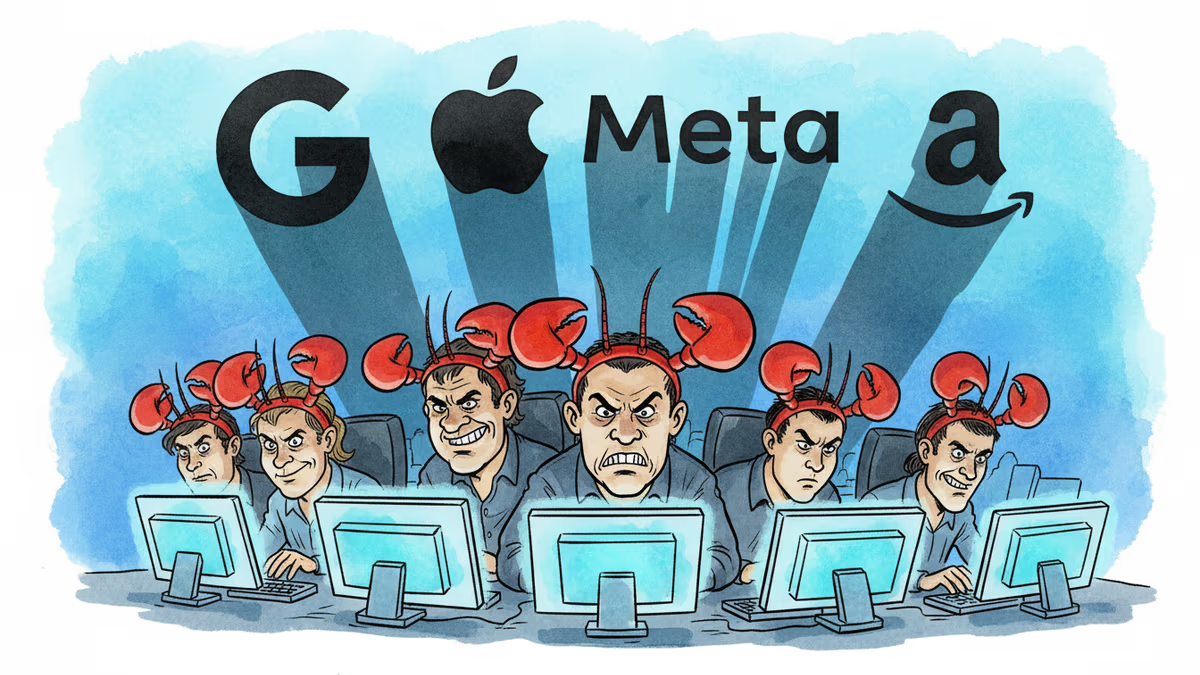
Hundreds gathered at ClawCon to celebrate OpenClaw, an open-source AI platform challenging Big Tech's closed models. A look at the growing developer revolt.
Moonshot AI raised $2B at a $20B valuation. Its Kimi models rank second on OpenRouter. What China's open-weight AI surge means for the global LLM market.
DeepSeek's V4 won't replicate the R1 shock—but it redraws the open-source AI map on pricing, long-context efficiency, and China's push to ditch Nvidia. Here's what's worth watching.
Anthropic is cutting off third-party tools like OpenClaw from Claude Code subscription limits — right as OpenClaw's creator joins OpenAI. Engineering constraint or competitive move?
Hundreds gathered at ClawCon to celebrate OpenClaw, an open-source AI platform challenging Big Tech's closed models. A look at the growing developer revolt.
Thoughts
Share your thoughts on this article
Sign in to join the conversation