
AI Made Coding Easy, So Why Are Developers More Miserable?
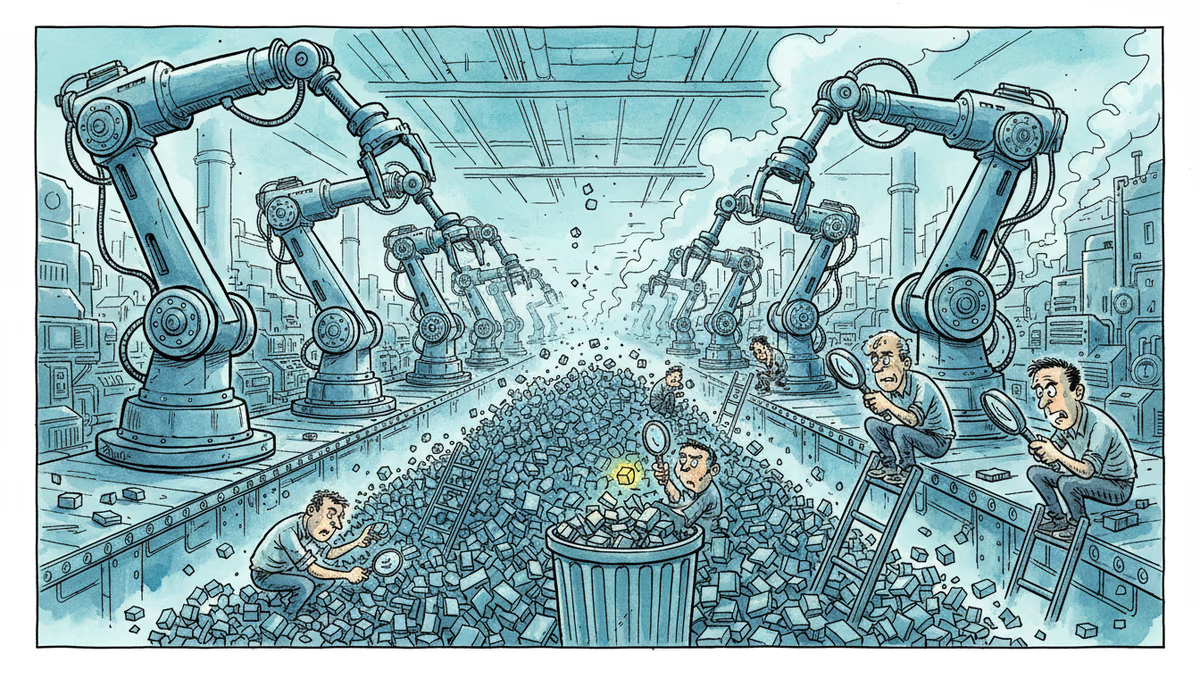
AI coding tools promised software abundance, but open-source projects are drowning in low-quality contributions. The real challenge isn't writing code—it's managing complexity.
90% of Code Contributions Now Head Straight to the Trash
The VLC media player powers billions of video streams worldwide. But Jean-Baptiste Kempf, CEO of the VideoLan Organization, recently made a startling admission: "For people who are junior to the VLC codebase, the quality of the merge requests we see is abysmal."
AI coding tools promised a world of software abundance. Instead, they've created an unexpected problem: making code is easier than ever, but managing that code has become exponentially harder.
When Barriers Fall, Quality Falls With Them
The pattern repeats across major open-source projects. Blender Foundation CEO Francesco Siddi reports that LLM-assisted contributions typically "wasted reviewers' time and affected their motivation." The 3D modeling tool is still developing an official AI policy, but for now, the tools are "neither mandated nor recommended."
The core issue? AI eliminated what developer Mitchell Hashimoto calls "the natural barrier to entry that let OSS projects trust by default." His response was radical: launching a system that limits GitHub contributions to "vouched" users only—effectively ending the open-door policy that defined open source.
cURL went even further, halting its bug bounty program entirely after being overwhelmed by what creator Daniel Stenberg described as "AI slop." The contrast is stark: "In the old days, someone actually invested a lot of time in the security report. There was a built-in friction, but now there's no effort at all."
The Production vs. Maintenance Paradox

Here's the twist: these same projects are experiencing AI's benefits. VLC's Kempf says AI makes building new modules "far easier," provided there's an experienced developer at the helm. "You can give the model the whole codebase of VLC and say, 'I'm porting this to a new operating system.'"
But this reveals a fundamental misalignment. Companies like Meta value new code and products—engineers get promoted for shipping features. Open-source projects prioritize stability and maintenance—unglamorous work that AI can't solve.
"The problem is different from large companies to open-source projects," Kempf observed. "They get promoted for writing code, not maintaining it."
The Complexity Crisis
Open Source Index founder Konstantin Vinogradov, who recently launched an endowment to maintain open-source infrastructure, frames the bigger picture: "On one hand, we have exponentially growing code base with exponentially growing number of interdependencies. On the other hand, we have number of active maintainers, which is maybe slowly growing, but definitely not keeping up. With AI, both parts of this equation accelerated."
This reframes AI's impact entirely. If engineering means producing working software, AI coding tools are revolutionary. But if engineering means managing software complexity, these tools might be making the job impossibly harder.
The Skills That Still Matter
For all the talk of AI replacing programmers, Vinogradov's observation cuts deeper: "AI does not increase the number of active, skilled maintainers. It empowers the good ones, but all the fundamental problems just remain."
The irony is profound. We're entering an era where anyone can generate code, but the skills that matter most—architectural thinking, code review, system design, maintenance—remain distinctly human. The flood of AI-generated code makes these skills more valuable, not less.
Authors
Related Articles

Huawei's CANN is open source under a license barring software for non-Ascend chips. Inside China's second CUDA, and the two links still outside it: pre-training compute and 5nm capacity.
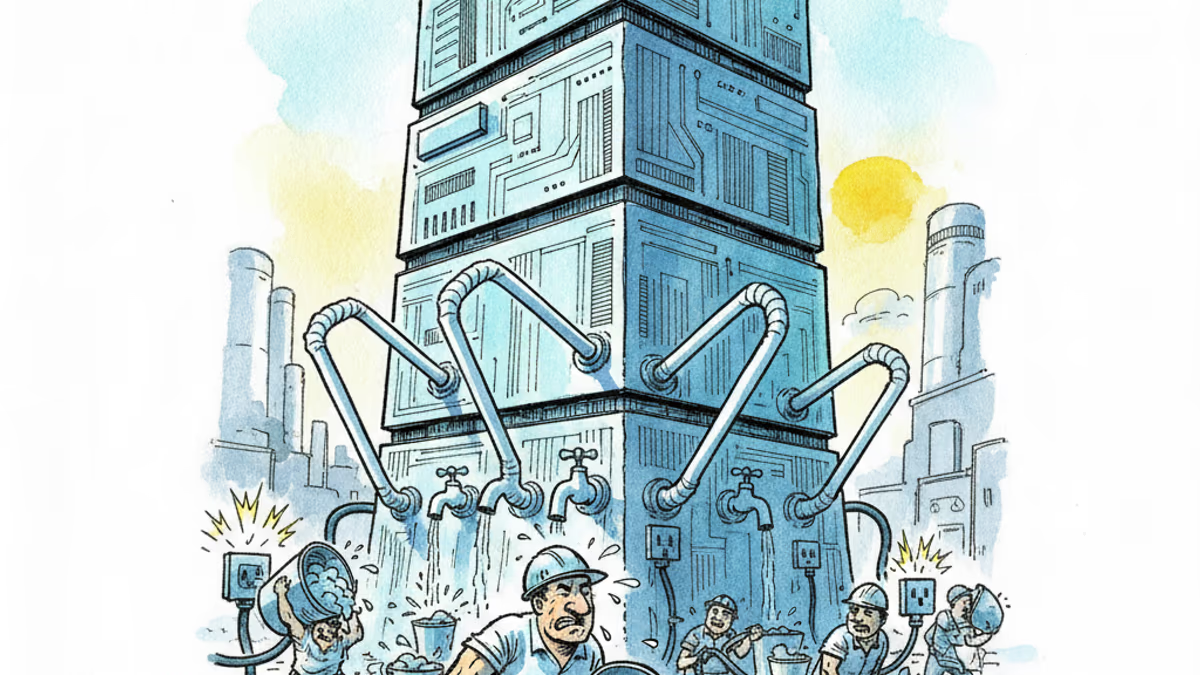
Samsung and SK unveiled a chip and AI investment package worth thousands of trillions of won on June 29. The headline number swings wildly by outlet, but the real contest isn't capital — it's water and power.

Viral videos show 2026 graduates jeering executives who praise AI at commencement ceremonies. It's not just rudeness — it's a signal about who pays for technological optimism.

Filipino virtual assistants using AI to ghost-manage LinkedIn profiles for executives is now a structured industry. 30 comments a day, fake engagement rings, and a platform struggling to tell real from fabricated.
Huawei's CANN is open source under a license barring software for non-Ascend chips. Inside China's second CUDA, and the two links still outside it: pre-training compute and 5nm capacity.
Samsung and SK unveiled a chip and AI investment package worth thousands of trillions of won on June 29. The headline number swings wildly by outlet, but the real contest isn't capital — it's water and power.
Viral videos show 2026 graduates jeering executives who praise AI at commencement ceremonies. It's not just rudeness — it's a signal about who pays for technological optimism.
Filipino virtual assistants using AI to ghost-manage LinkedIn profiles for executives is now a structured industry. 30 comments a day, fake engagement rings, and a platform struggling to tell real from fabricated.
Thoughts
Share your thoughts on this article
Sign in to join the conversation