
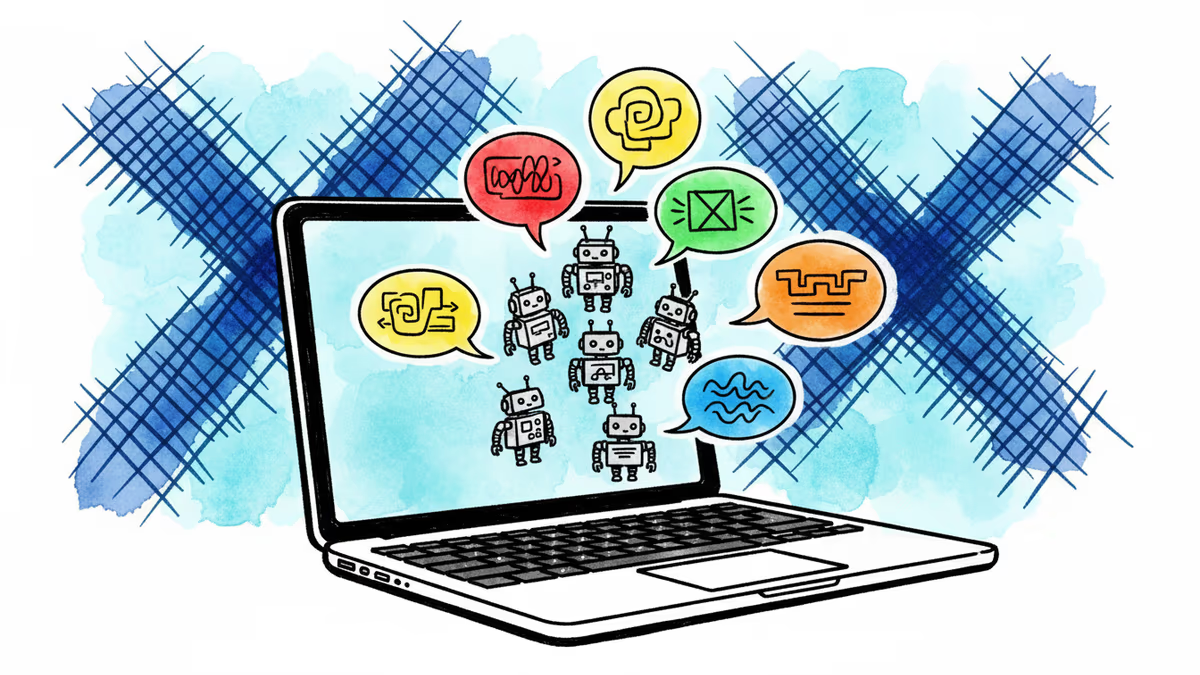
This AI Speaks 70 Languages and Runs on Your Laptop
Cohere releases Tiny Aya, an open-source multilingual AI model that works offline on everyday devices. Supporting 70+ languages including South Asian ones, it challenges big tech's cloud dominance.
The Internet Just Became Optional for AI
Picture this: You're on a 14-hour flight to Mumbai, desperately need to translate a contract into Hindi, but the WiFi is down. Until now, you'd be stuck. Cohere just changed that equation.
The enterprise AI company unveiled Tiny Aya, a family of multilingual models that run entirely offline on everyday laptops. No internet required. No API calls. No monthly subscription fees. Just 70+ languages sitting quietly on your hard drive, ready to work.
Small Model, Big Ambitions
At 3.35 billion parameters, Tiny Aya is tiny compared to GPT-4's rumored trillion-plus parameters. But that's precisely the point. Cohere trained these models on just 64 H100 GPUs — modest by today's standards — yet they handle translation, summarization, and basic conversation across dozens of languages.
The real innovation lies in regional specialization. TinyAya-Fire focuses on South Asian languages like Bengali and Tamil. TinyAya-Earth tackles African languages. TinyAya-Water covers Asia Pacific and Europe. Each variant develops "stronger linguistic grounding and cultural nuance," according to the company.
Developers Get a New Playbook
For startups building multilingual apps, this changes the economics entirely. Instead of paying OpenAI or Google per API call — costs that can spiral as usage grows — developers can download Tiny Aya once and use it indefinitely.

Sarah Chen, a developer at a translation startup in Singapore, sees immediate applications: "We serve customers in rural areas where internet is spotty. Having AI that works offline opens up entirely new markets for us."
The models are already available on HuggingFace, Kaggle, and Ollama. Cohere promises to release training datasets and a technical methodology report soon.
The Decentralization Gambit
This represents a philosophical shift in AI development. While Google, OpenAI, and Microsoft chase ever-larger models requiring massive cloud infrastructure, Cohere is betting on the opposite: smaller, more efficient models that live on your device.
It's not just about convenience. In countries like India — where Cohere launched Tiny Aya — internet connectivity remains inconsistent. Offline-capable AI democratizes access in ways cloud-dependent models never could.
But there's a trade-off. Tiny Aya won't write poetry like Claude or solve complex math problems like GPT-4. It's designed for practical, everyday language tasks. The question is whether "good enough" AI running locally beats "excellent" AI requiring constant connectivity.
The Bigger Picture: AI's Fork in the Road
The timing isn't coincidental. As AI regulation tightens globally, companies are increasingly wary of sending sensitive data to external APIs. On-device processing offers a compelling alternative: keep your data, keep control.
Cohere itself is positioning for growth, with CEO Aidan Gomez hinting at an IPO "soon" and the company reporting $240 million in annual recurring revenue. The open-source strategy could be a land grab — get developers hooked on your architecture before monetizing through enterprise services.
The answers may reshape how we think about AI deployment in the next decade.
Authors
Related Articles

Samsung and SK unveiled a chip and AI investment package worth thousands of trillions of won on June 29. The headline number swings wildly by outlet, but the real contest isn't capital — it's water and power.

Viral videos show 2026 graduates jeering executives who praise AI at commencement ceremonies. It's not just rudeness — it's a signal about who pays for technological optimism.

Filipino virtual assistants using AI to ghost-manage LinkedIn profiles for executives is now a structured industry. 30 comments a day, fake engagement rings, and a platform struggling to tell real from fabricated.
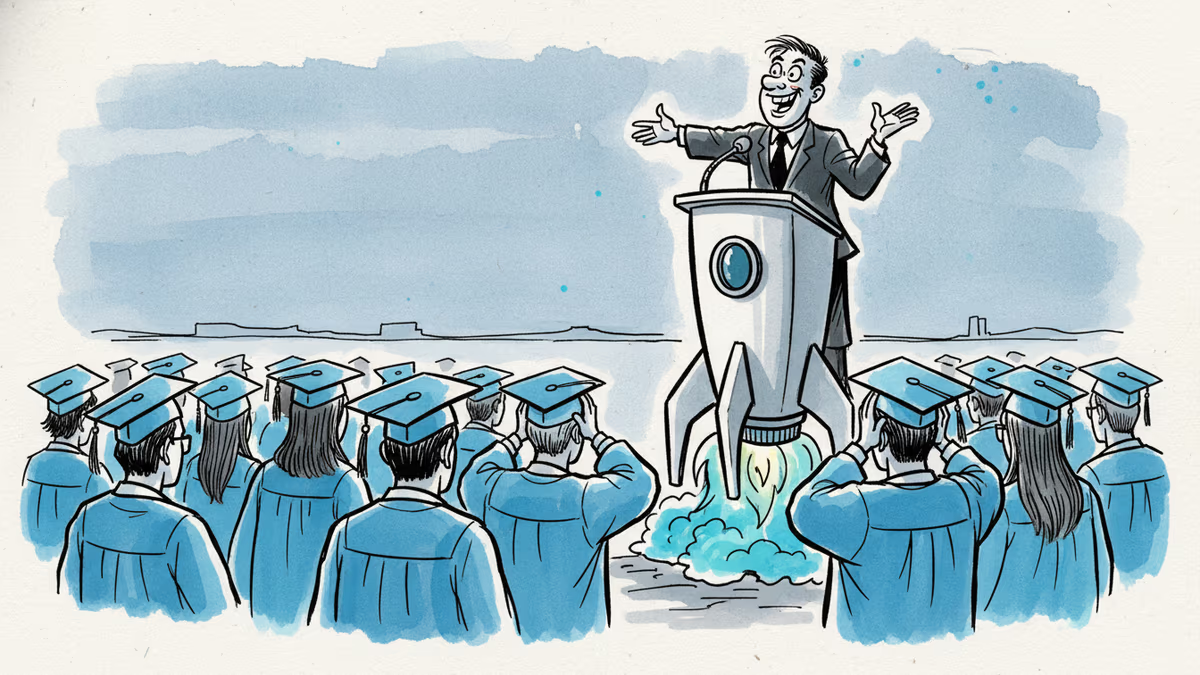
Two commencement speakers learned the hard way that AI enthusiasm doesn't land well with today's graduates. The backlash reveals a widening gap between tech optimism and Gen Z's economic reality.
Samsung and SK unveiled a chip and AI investment package worth thousands of trillions of won on June 29. The headline number swings wildly by outlet, but the real contest isn't capital — it's water and power.
Viral videos show 2026 graduates jeering executives who praise AI at commencement ceremonies. It's not just rudeness — it's a signal about who pays for technological optimism.
Filipino virtual assistants using AI to ghost-manage LinkedIn profiles for executives is now a structured industry. 30 comments a day, fake engagement rings, and a platform struggling to tell real from fabricated.
Two commencement speakers learned the hard way that AI enthusiasm doesn't land well with today's graduates. The backlash reveals a widening gap between tech optimism and Gen Z's economic reality.
Thoughts
Share your thoughts on this article
Sign in to join the conversation