
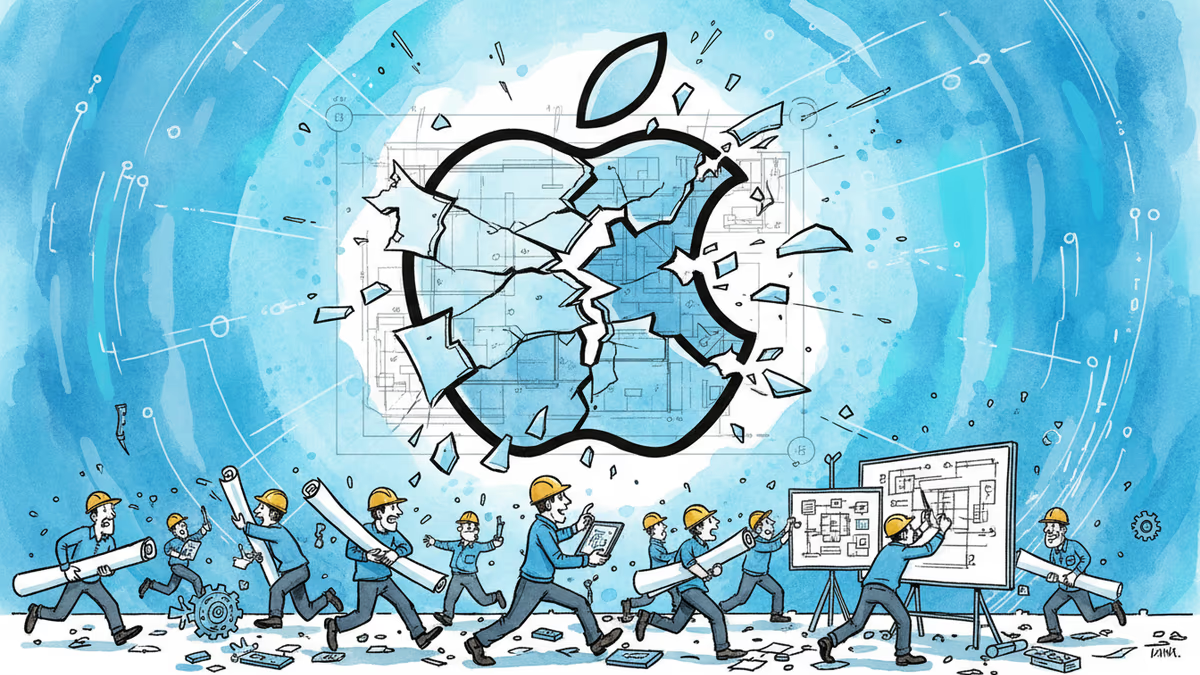
Apple Just Broke Its Own M-Chip Playbook. Here's Why
Apple's M5 Pro and Max chips abandon the company's proven scaling formula. From CPU architecture to packaging, what does this dramatic shift signal?
The 5-Year Formula Just Got Tossed
Apple's chip strategy has been beautifully predictable. Take the base M chip, add more CPU cores, more GPU cores, more memory bandwidth—voilà, you've got Pro and Max versions. It worked for 5 generations. Until now.
The M5 Pro and M5 Max represent Apple's most dramatic departure from its silicon playbook yet. We're not talking minor tweaks—the CPU architecture itself has changed, along with how these chips are packaged together. Without performance benchmarks in hand, we can only analyze the technical tea leaves. But those leaves tell a fascinating story.
Intel and AMD's Nightmare Scenario
For years, competitors could predict Apple's moves. The scaling pattern was clear: more of everything, following Moore's Law logic. Intel and AMD could plan their roadmaps accordingly, knowing roughly what Apple would deliver in 18 months.

That predictability just evaporated. The M5's architectural overhaul means rival chipmakers are flying blind. "Apple essentially reset the game board," notes one semiconductor analyst who requested anonymity. "Everyone's strategic planning just became obsolete."
The ripple effects extend beyond performance metrics. Supply chain partners, software developers, and enterprise customers all built assumptions around Apple's consistent scaling approach. Now they're scrambling to understand what comes next.
When Success Becomes a Prison
Why abandon a winning formula? Apple's previous M-chip generations delivered exactly what they promised—predictable performance gains through brute-force scaling. But that approach has natural limits.
Industry insiders suggest Apple hit a wall. Not a performance wall, but a strategic one. The AI revolution demands different computational approaches. Traditional CPU/GPU scaling might excel at video editing and gaming, but falls short for the neural processing workloads defining computing's future.
The M5's architectural changes hint at Apple's answer: specialized processing units, novel interconnects, and fundamentally different ways of moving data around. It's a bet on a post-Moore's Law world where clever design trumps raw transistor counts.
Authors
Related Articles

After 15 years of fragmented mobile messaging, Apple and Google are rolling out end-to-end encrypted RCS messaging between iPhones and Android devices. Here's what changed, why it took so long, and what it means for your privacy.
Apple agreed to pay $250 million to settle claims it misled iPhone 16 buyers about Apple Intelligence features. What this means for consumers, Big Tech marketing, and the AI industry.
Apple quietly removed the entry-level $599 Mac Mini, raising the starting price to $799 — just one day after Tim Cook warned of chip supply constraints on the earnings call.

Apple names John Ternus, its hardware engineering chief, as the next CEO. The shift from operator to product person signals where Apple thinks its next decade of growth will come from — and raises real questions about what comes next.
After 15 years of fragmented mobile messaging, Apple and Google are rolling out end-to-end encrypted RCS messaging between iPhones and Android devices. Here's what changed, why it took so long, and what it means for your privacy.
Apple agreed to pay $250 million to settle claims it misled iPhone 16 buyers about Apple Intelligence features. What this means for consumers, Big Tech marketing, and the AI industry.
Apple quietly removed the entry-level $599 Mac Mini, raising the starting price to $799 — just one day after Tim Cook warned of chip supply constraints on the earnings call.
Apple names John Ternus, its hardware engineering chief, as the next CEO. The shift from operator to product person signals where Apple thinks its next decade of growth will come from — and raises real questions about what comes next.
Thoughts
Share your thoughts on this article
Sign in to join the conversation