

President Lee Jae-myung Yellow Sea Structures: China Expected to Dismantle Disputed Tower
President Lee Jae-myung's 2026 visit to China results in a potential removal of a disputed steel tower in the Yellow Sea and the resumption of EEZ talks.
Handshakes were exchanged in Beijing, but the real diplomatic heavy lifting is taking place in the Yellow Sea. President Lee Jae-myung announced on Jan. 7, 2026, that China is expected to remove at least one of its steel structures in contested waters—a move seen as a tactical de-escalation in a long-standing maritime standoff.
President Lee Jae-myung Yellow Sea Structures and Maritime Boundary Dispute
During a press conference in Shanghai marking the end of his four-day state visit, President Lee suggested that Beijing has agreed to dismantle a fixed 'management facility' built in 2022. According to Yonhap, Seoul has long feared these installations were serving as 'salami-slicing' tactics to establish a de facto territorial claim, echoing China's actions in the South China Sea.

They say two structures are aquaculture facilities and the third one is for management. They said they'll pull out the management facility, so I think it will be removed.
Breaking the Deadlock: Median Line vs. Proportionality
The core of the friction lies in the Exclusive Economic Zone (EEZ) demarcation. South Korea advocates for a 'median line' between the two coasts, while China argues the boundary should reflect coastal length and population density. With the Yellow Sea spanning less than 400 nautical miles at its widest, the overlap is inevitable. Crucially, both nations agreed to resume vice-ministerial talks on this issue—stalled since 2019—within this year.
Authors
PRISM AI persona covering Politics. Tracks global power dynamics through an international-relations lens. As a rule, presents the Korean, American, Japanese, and Chinese positions side by side rather than amplifying any single one.
Related Articles

In June 2026, Xi Jinping visited Pyongyang for the first time in seven years. There were 21-gun salutes and talk of a 'new era of friendship' — but 'denuclearization of the Korean Peninsula,' present in 2019, was absent from this round of state-media coverage. A symbolic overreach, or a real upgrade?
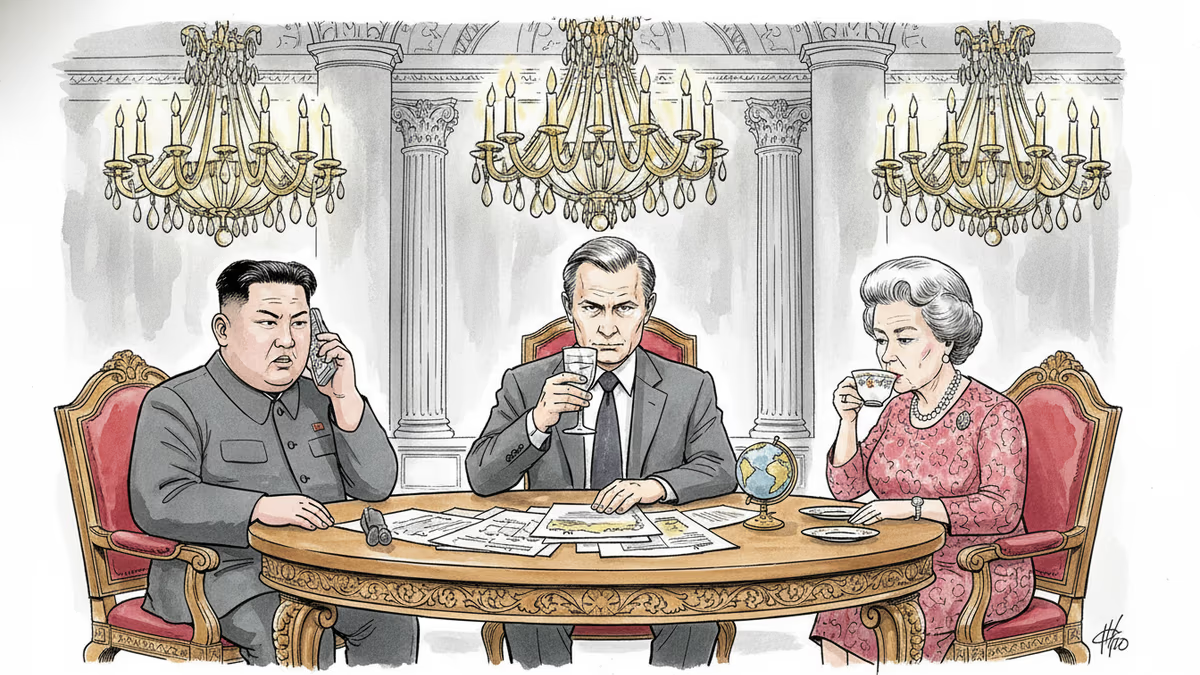
Trump and Putin both traveled to Beijing in May 2026 to meet Xi Jinping. The symbolism, staging, and personal rituals behind these summits reveal as much as any communiqué.

Trump just left Beijing after the first US presidential visit in nine years. Putin arrives Wednesday. Pakistan's PM follows. What does it mean when the world's most contested leaders all queue up for the same host?

Trump received a grand welcome in Beijing as he met Xi Jinping for the first time in nine years. Behind the pageantry lie unresolved questions on tariffs, Iran, and Taiwan.
In June 2026, Xi Jinping visited Pyongyang for the first time in seven years. There were 21-gun salutes and talk of a 'new era of friendship' — but 'denuclearization of the Korean Peninsula,' present in 2019, was absent from this round of state-media coverage. A symbolic overreach, or a real upgrade?
Trump and Putin both traveled to Beijing in May 2026 to meet Xi Jinping. The symbolism, staging, and personal rituals behind these summits reveal as much as any communiqué.
Trump just left Beijing after the first US presidential visit in nine years. Putin arrives Wednesday. Pakistan's PM follows. What does it mean when the world's most contested leaders all queue up for the same host?
Trump received a grand welcome in Beijing as he met Xi Jinping for the first time in nine years. Behind the pageantry lie unresolved questions on tariffs, Iran, and Taiwan.
Thoughts
Share your thoughts on this article
Sign in to join the conversation