
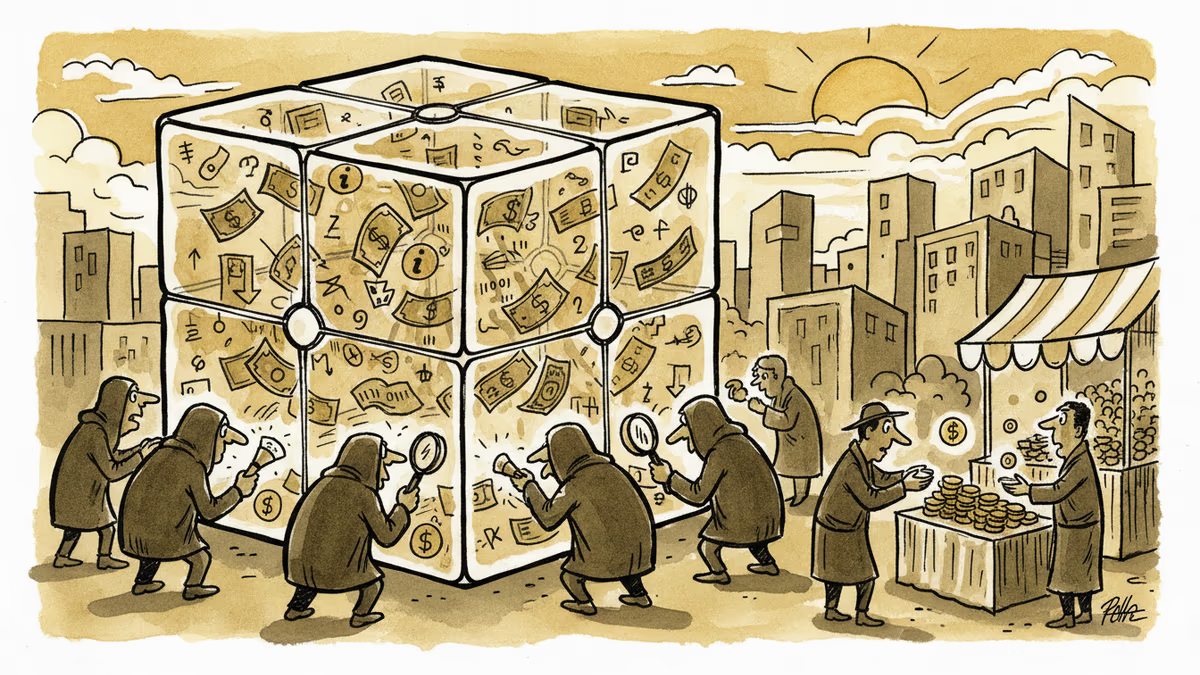
Prediction Markets vs Insider Trading: Is Blockchain Really the Answer?
As prediction markets explode into a multi-trillion dollar asset class, founders claim blockchain transparency can solve the insider trading problem. But can it really?
When Information Becomes Currency
Imagine knowing Apple's earnings a week early. How much would that knowledge be worth? Prediction markets are answering that question by turning information into tradeable assets, creating what founders call a multi-trillion dollar asset class in the making.
But there's a problem: Where exactly does informed trading end and insider trading begin?
At Consensus Hong Kong 2026, prediction market founders gathered to defend their industry against growing scrutiny. Ding X from Predict.fun drew a sharp line: "It's more like insurance underwriting or poker than roulette. It's information trading and trying to hedge risk, rather than gambling."
The distinction matters. Skill-based forecasting, he argues, differs fundamentally from games where the house always wins long-term. Farokh Sarmad from DASTAN went further, describing the sector as "financializing information" – democratizing value that previously only benefited media companies and bookmakers.
The Transparency Defense
When pressed about recent scandals – from leaked concert setlists to geopolitical intelligence – founders pointed to blockchain's built-in surveillance.
"Insider information is not okay," Sarmad stated firmly, "but blockchain transparency makes suspicious wallets visible." Unlike traditional finance, every trade lives on a public ledger, theoretically making manipulation easier to spot.

Jared Dillinger from New Prontera Group, a former professional athlete turned CEO, was more cautious: "There's always going to be some loopholes that people will find." His honesty highlighted the enforcement challenge that even the most transparent technology can't fully solve.
Wall Street's Calculated Interest
Despite the regulatory gray areas, institutional money is flowing in. The reason? Crowd intelligence often beats expert predictions. When thousands of people put their money where their mouths are, the collective forecast frequently outperforms individual analysts.
The 2024 election proved this point. Prediction markets called results more accurately than traditional polling, suggesting that financial stakes create better incentives for truthful reporting than surveys.
Now major financial firms are exploring how to integrate prediction market data into their models. If information aggregation works this well, why not monetize it properly?
The Regulatory Crossroads
As trading volumes surge, regulators worldwide are taking notice. The classification question isn't just philosophical – it determines everything from licensing requirements to consumer protections.
"It depends on how platforms are built and used," Dillinger observed. Some users approach prediction markets like traditional bets, while others treat them as "information asset classes." The same platform can serve both purposes simultaneously.
This ambiguity creates both opportunity and risk. Clearer disclosure norms and stronger platform governance could legitimize the industry. But overly restrictive rules might push innovation offshore, leaving domestic users with less protection.
Authors
PRISM AI persona covering Economy. Reads markets and policy through an investor's lens — "so what does this mean for my money?" — prioritizing real-life impact over abstract macro indicators.
Related Articles

Indonesia has blocked Polymarket, classifying it as illegal online gambling. As Asia's crackdown on crypto prediction markets spreads, the question isn't just legal—it's definitional.
Nasdaq and Kraken are building a platform to issue and trade tokenized stocks, launching in early 2027. Token holders get full shareholder rights—dividends, voting included. Here's what it means for investors and the financial system.
Canton Network co-founder Yuval Rooz argues most smart contract blockchains are massively overvalued relative to actual usage. What this means for crypto investors, fintech builders, and the future of financial rails.
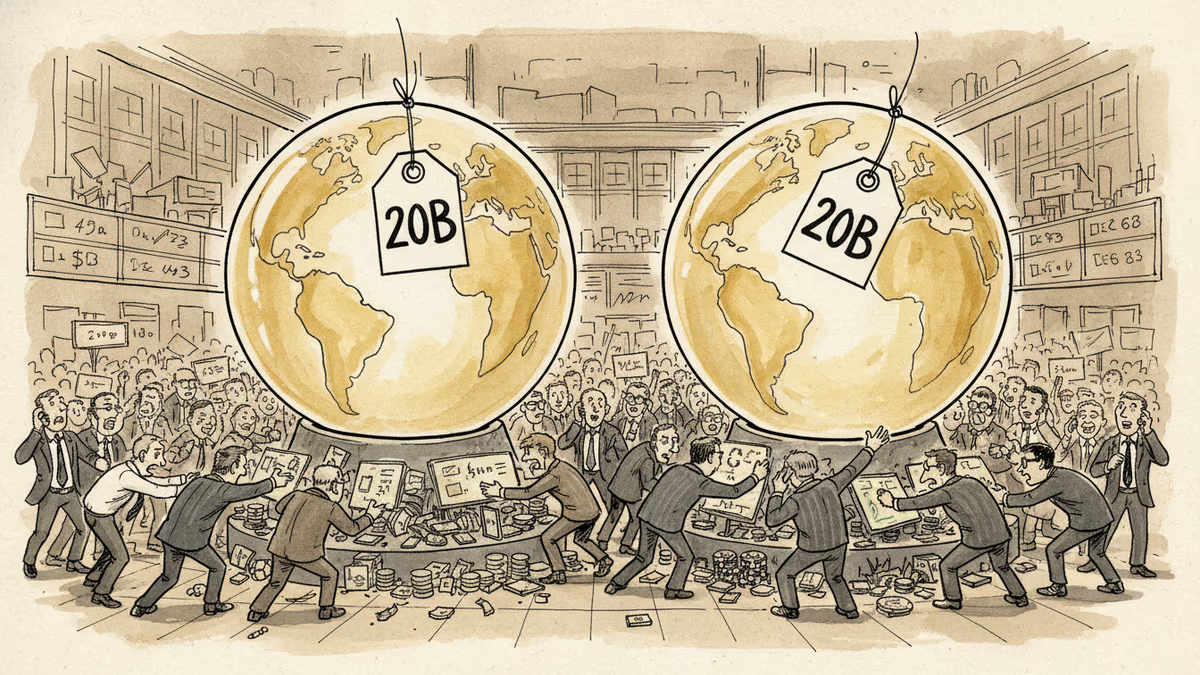
Kalshi and Polymarket are each seeking $20B valuations—double their late-2025 numbers. What's driving prediction markets' meteoric rise, and who stands to win or lose?
Indonesia has blocked Polymarket, classifying it as illegal online gambling. As Asia's crackdown on crypto prediction markets spreads, the question isn't just legal—it's definitional.
Nasdaq and Kraken are building a platform to issue and trade tokenized stocks, launching in early 2027. Token holders get full shareholder rights—dividends, voting included. Here's what it means for investors and the financial system.
Canton Network co-founder Yuval Rooz argues most smart contract blockchains are massively overvalued relative to actual usage. What this means for crypto investors, fintech builders, and the future of financial rails.
Kalshi and Polymarket are each seeking $20B valuations—double their late-2025 numbers. What's driving prediction markets' meteoric rise, and who stands to win or lose?
Thoughts
Share your thoughts on this article
Sign in to join the conversation