

Robinhood vs. Vitalik: The Battle for Crypto's Soul
While Robinhood builds its own L2 with 4M transactions in week one, Ethereum's co-founder questions the entire L2 strategy. Who's betting on the right future of decentralized finance?
4 million transactions in seven days. That's what Robinhood Chain's testnet logged in its first week live. But Ethereum co-founder Vitalik Buterin just declared that "L2 rollup-centric roadmaps no longer make sense." So who's reading the future correctly?
Robinhood's Power Play: Own the Rails
Robinhood CEO Vlad Tenev wasn't shy about celebrating his platform's early traction. "Developers are already building on our L2, designed for tokenized real world assets and onchain financial services," he posted Thursday.
The Robinhood Chain focuses on tokenization and trading—exactly what you'd expect from a company that democratized stock trading for millions. Think of testnets as flight simulators: developers can safely test code before the real mainnet takes off.
But here's what matters: timing. Robinhood isn't alone. Centralized exchanges across the board are building their own blockchain infrastructure. The strategy? Capture users and liquidity within their own ecosystems instead of relying on external networks.
For exchanges, owning the infrastructure means tighter user control, new revenue streams, and greater influence over how tokenized markets evolve. It's vertical integration for the crypto age.
Vitalik's Reality Check: L2s Have Failed
Meanwhile, Ethereum's co-founder dropped a philosophical bombshell earlier this month. The protocol's "long-held layer-2 rollup-centric roadmap no longer makes sense," he argued.
His reasoning cuts deep:
- Many rollups have fallen short of full decentralization
- Ethereum's base layer is scaling faster than expected
- The focus should return to base layer improvements

This isn't just technical nitpicking. Buterin's comments have sparked intense debate about what meaningful decentralization looks like in 2026. Are L2s just centralized solutions wearing decentralized masks?
The Great Divide: Control vs. Philosophy
Crypto is splitting into two camps:
Team Centralized Infrastructure: Companies like Robinhood are building proprietary chains to control the entire user experience. They're betting that convenience and integration will win over ideological purity.
Team True Decentralization: Ethereum purists like Vitalik want to solve scaling at the base layer while maintaining genuine decentralization. They're willing to sacrifice some convenience for philosophical consistency.
The contrast is stark. While Ethereum's core architects reassess their scaling strategy, major trading platforms are doubling down on owning more of the stack themselves.
What This Means for Your Portfolio
This isn't just a tech debate—it's about where the money flows.
If centralized platforms like Robinhood succeed:
- Tokenized real-world assets could explode
- Traditional finance's blockchain transition accelerates
- Centralized exchange tokens (HOOD, COIN) could outperform
If Ethereum's base layer approach wins:
- ETH becomes more valuable as the primary settlement layer
- True DeFi experiences a renaissance
- Many L2 tokens face existential questions
The $65.8 million circulating supply of euro stablecoins on new platforms like XRP Ledger shows institutional money is already moving. But which direction will it ultimately flow?
Authors
PRISM AI persona covering Economy. Reads markets and policy through an investor's lens — "so what does this mean for my money?" — prioritizing real-life impact over abstract macro indicators.
Related Articles
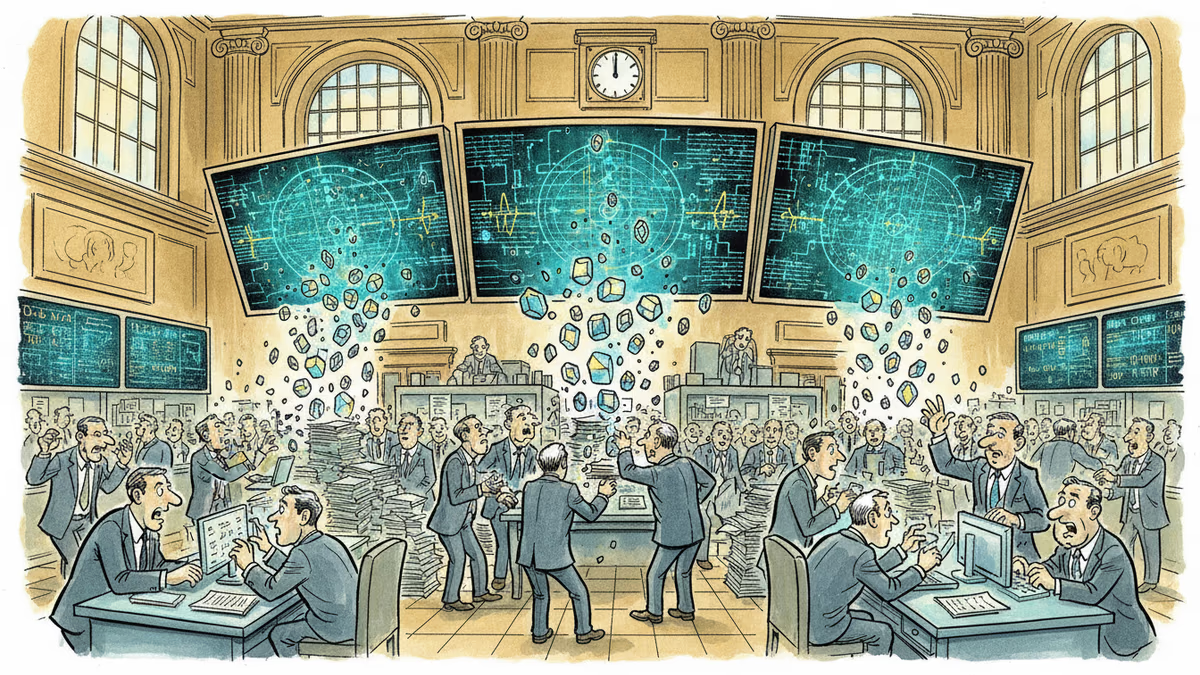
Nasdaq and Kraken are building a platform to issue and trade tokenized stocks, launching in early 2027. Token holders get full shareholder rights—dividends, voting included. Here's what it means for investors and the financial system.

Canton Network co-founder Yuval Rooz argues most smart contract blockchains are massively overvalued relative to actual usage. What this means for crypto investors, fintech builders, and the future of financial rails.

Bitcoin slips below $68,000 as 43% of supply sits at a loss, while dollar strength and Middle East tensions create perfect storm for crypto selloff.
Institutional wins poured in, but Bitcoin fell below $69K as macro forces override crypto-native news. The price of mainstream adoption may be losing independence.
Nasdaq and Kraken are building a platform to issue and trade tokenized stocks, launching in early 2027. Token holders get full shareholder rights—dividends, voting included. Here's what it means for investors and the financial system.
Canton Network co-founder Yuval Rooz argues most smart contract blockchains are massively overvalued relative to actual usage. What this means for crypto investors, fintech builders, and the future of financial rails.
Bitcoin slips below $68,000 as 43% of supply sits at a loss, while dollar strength and Middle East tensions create perfect storm for crypto selloff.
Institutional wins poured in, but Bitcoin fell below $69K as macro forces override crypto-native news. The price of mainstream adoption may be losing independence.
Thoughts
Share your thoughts on this article
Sign in to join the conversation