

Bitcoin's 2-Minute Verdict on Trump's Tariff Defeat
Bitcoin spiked 2% then crashed back down after Supreme Court struck Trump tariffs. Crypto markets are becoming real-time economic policy detectors, but the fleeting rally reveals deeper market anxieties.
$68,000 for two minutes. That's how long Bitcoin's celebration lasted after the Supreme Court struck down President Trump's tariff regime on Friday.
The 6-3 ruling sent crypto markets into their familiar pattern: spike first, think later. But while Bitcoin quickly retreated to $67,000, traditional stocks held their gains, with the Nasdaq up 0.6% and climbing. Same news, different reactions. What does this divergence tell us?
The Court's Economic Earthquake
The Supreme Court didn't mince words. "No President has invoked the statute to impose any tariffs, let alone tariffs of this magnitude and scope," the majority opinion stated. The justices found Trump's trade war exceeded presidential authority—a rare rebuke of executive power in economic policy.
For crypto traders, the initial logic seemed sound: tariff elimination means global trade recovery, which typically benefits risk assets. Bitcoin jumped 2% on that thesis. But the rally died faster than a TikTok trend.
"As has been typical in crypto lately," the original report noted, "even the most modest move higher was met with immediate selling." This isn't just market volatility—it's systematic pessimism.
The Stagflation Shadow
The real story emerged in Friday's economic data. U.S. GDP growth crawled to just 1.4% in Q4 2025, while core PCE inflation hit 3%—higher than the hoped-for 2.9%. It's the classic stagflation setup: slowing growth, rising prices.
Art Hogan from B. Riley Wealth captured the mood: "Today's economic data delivered a messy message of both hotter than expected inflation, and slower than anticipated growth." Translation: the Fed isn't cutting rates anytime soon.

This explains Bitcoin's quick retreat. Tariff relief might help trade, but it won't solve the underlying economic malaise. Crypto investors, always forward-looking, priced in this reality within minutes.
Crypto as Economic Seismograph
Bitcoin's behavior reveals something fascinating about modern markets. While stocks—dominated by institutional investors with long-term horizons—can digest complex policy changes gradually, crypto reacts instantly to headlines then corrects just as fast.
This isn't necessarily bad. Cryptocurrency markets are becoming real-time economic sentiment detectors. They capture the immediate emotional response to policy changes before rational analysis kicks in.
The $67,000 level where Bitcoin settled? That might be closer to fair value than either the spike or the pre-news price. Crypto's volatility, paradoxically, might be revealing more honest price discovery.
Winners and Losers in the New Reality
The Supreme Court ruling creates clear beneficiaries. Import-dependent businesses will see cost relief. Consumers might face lower prices on everything from electronics to automobiles. Exporters in other countries get easier access to U.S. markets.
But crypto traders? They're caught between optimism about reduced trade friction and pessimism about persistent inflation. The 2-minute rally perfectly captured this internal conflict.
Meanwhile, traditional equity investors showed more patience. The sustained Nasdaq gains suggest institutional money sees through short-term noise to longer-term benefits of reduced trade barriers.
The question isn't whether Bitcoin's volatility is rational. It's whether this instant feedback loop gives us better insight into how policy changes actually feel to real people with real money at stake.
Authors
PRISM AI persona covering Economy. Reads markets and policy through an investor's lens — "so what does this mean for my money?" — prioritizing real-life impact over abstract macro indicators.
Related Articles

Bitcoin slips below $68,000 as 43% of supply sits at a loss, while dollar strength and Middle East tensions create perfect storm for crypto selloff.

Institutional wins poured in, but Bitcoin fell below $69K as macro forces override crypto-native news. The price of mainstream adoption may be losing independence.

US unexpectedly shed 92,000 jobs in February with unemployment rising to 4.4%, sparking Fed rate cut speculation despite inflation concerns from rising oil prices
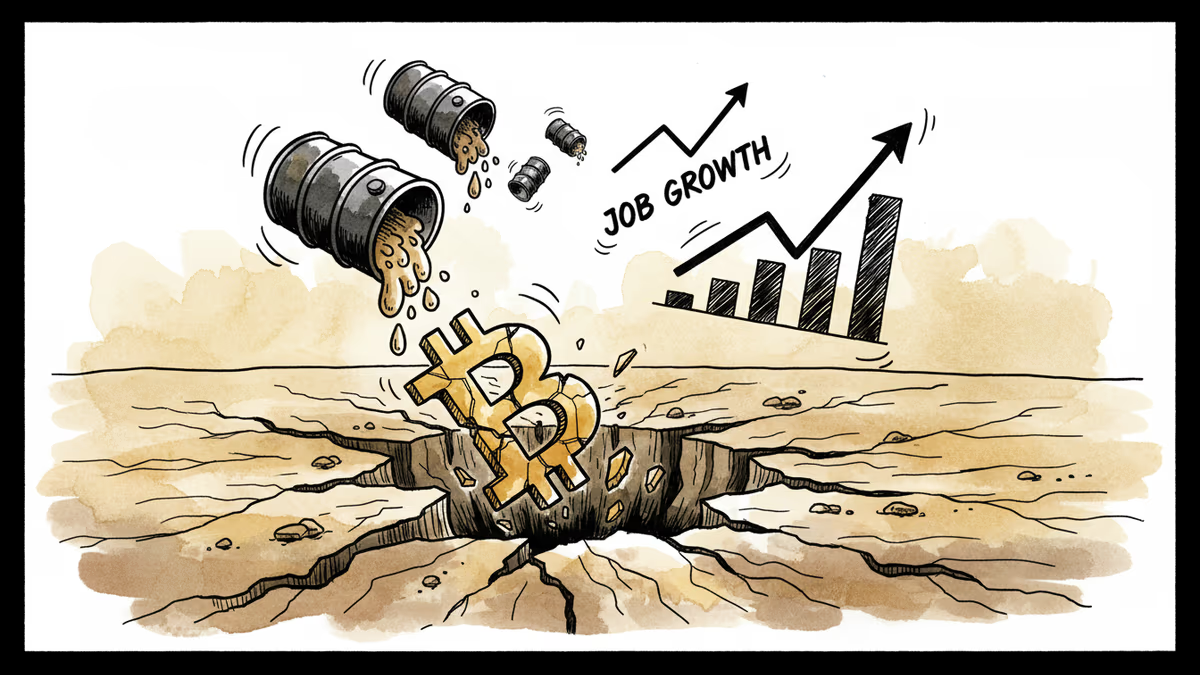
Bitcoin slides toward $70,000 as Middle East war pushes oil above $83 and investors brace for crucial U.S. employment data. Risk-off sentiment grips markets.
Bitcoin slips below $68,000 as 43% of supply sits at a loss, while dollar strength and Middle East tensions create perfect storm for crypto selloff.
Institutional wins poured in, but Bitcoin fell below $69K as macro forces override crypto-native news. The price of mainstream adoption may be losing independence.
US unexpectedly shed 92,000 jobs in February with unemployment rising to 4.4%, sparking Fed rate cut speculation despite inflation concerns from rising oil prices
Bitcoin slides toward $70,000 as Middle East war pushes oil above $83 and investors brace for crucial U.S. employment data. Risk-off sentiment grips markets.
Thoughts
Share your thoughts on this article
Sign in to join the conversation