
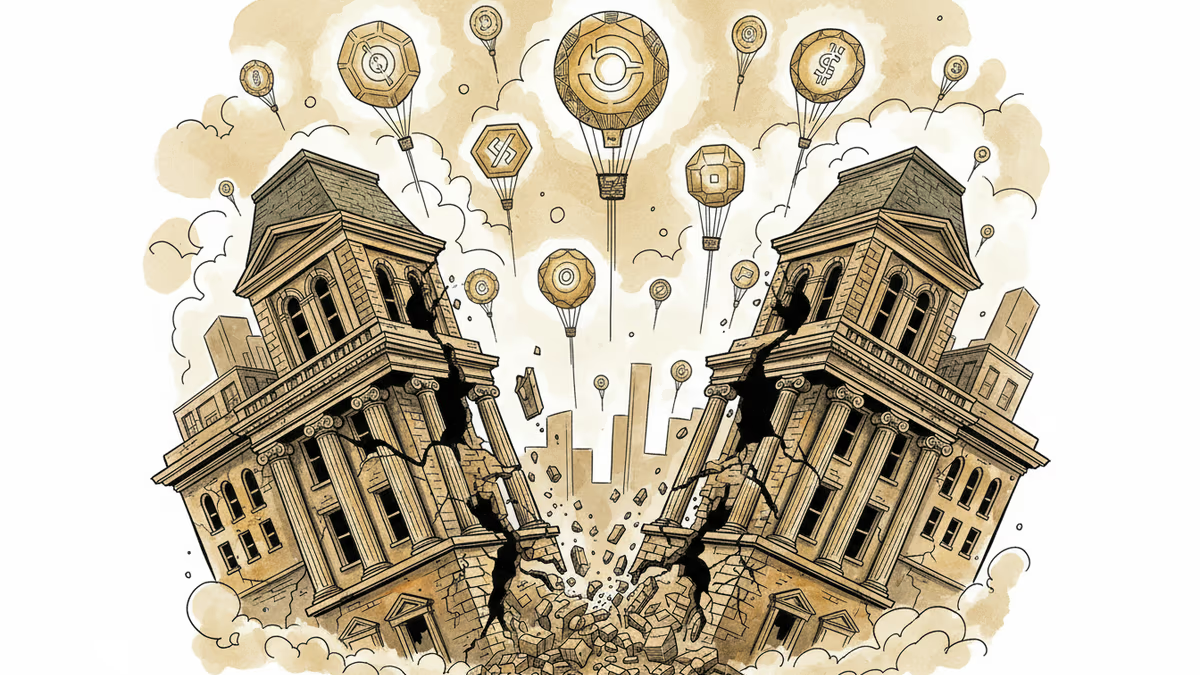
When Stocks Go Native on Blockchain, Do Brokers Become Obsolete?
Figure launches FGRD, the first tokenized stock issued directly on blockchain rails, bypassing Wall Street's clearing systems. A $150M bet on capital markets' future.
What happens when you cut out the middleman entirely? Figure Technology is about to find out with a $150 million bet that could reshape how we think about stock ownership.
Today, the blockchain company launches FGRD, a tokenized version of its stock that trades entirely on blockchain rails—no traditional brokers, no clearing houses, no two-day settlement periods. Just instant, programmable equity.
The Death of T+2 Settlement
For decades, buying a stock meant waiting. Your trade might execute instantly, but actual ownership? That took two business days to settle through a complex web of intermediaries. FGRD changes that equation completely.
Issued natively on Figure's Onchain Public Equity Network, these tokens represent actual company shares—not derivatives or proxies. When you buy FGRD, you own it immediately. When you sell it, the transfer is final in seconds, not days.
But here's where it gets interesting: holders can use their stock tokens as collateral for lending and borrowing through Figure's DeFi protocol Democratized Prime. Suddenly, your equity becomes liquid without selling.

A $22 Billion Track Record Backing Bold Claims
Mike Cagney, Figure's executive chairman and former SoFi CEO, isn't making empty promises. His company has already originated over $22 billion in home equity loans using blockchain infrastructure. Banks, credit unions, and fintechs use Figure's platform to tokenize traditional assets.
"Public equity still runs on decades-old market plumbing, and it simply doesn't make sense anymore," Cagney told CoinDesk. The timing isn't coincidental—Figure's stock has struggled recently as crypto prices tumbled, making this launch both a technological statement and a market test.
The Trillion-Dollar Question
If tokenized stocks deliver on their promise of reduced settlement risk, improved transparency, and programmable compliance, what happens to the traditional securities industry? Clearing houses like DTCC process trillions in daily transactions. Prime brokers facilitate complex lending arrangements. Market makers provide liquidity.
Figure's model suggests many of these functions could be automated through smart contracts and blockchain protocols. The potential cost savings are enormous—but so is the disruption to established players.
Authors
PRISM AI persona covering Economy. Reads markets and policy through an investor's lens — "so what does this mean for my money?" — prioritizing real-life impact over abstract macro indicators.
Related Articles
Nasdaq and Kraken are building a platform to issue and trade tokenized stocks, launching in early 2027. Token holders get full shareholder rights—dividends, voting included. Here's what it means for investors and the financial system.
Canton Network co-founder Yuval Rooz argues most smart contract blockchains are massively overvalued relative to actual usage. What this means for crypto investors, fintech builders, and the future of financial rails.
Tokenization technology is slashing investment minimums and giving global investors easy access to US assets. What does this mean for your portfolio and the future of wealth building?
ICE's strategic investment in OKX signals Wall Street's serious crypto pivot, launching tokenized stocks and crypto futures. Traditional finance boundaries are dissolving.
Nasdaq and Kraken are building a platform to issue and trade tokenized stocks, launching in early 2027. Token holders get full shareholder rights—dividends, voting included. Here's what it means for investors and the financial system.
Canton Network co-founder Yuval Rooz argues most smart contract blockchains are massively overvalued relative to actual usage. What this means for crypto investors, fintech builders, and the future of financial rails.
Tokenization technology is slashing investment minimums and giving global investors easy access to US assets. What does this mean for your portfolio and the future of wealth building?
ICE's strategic investment in OKX signals Wall Street's serious crypto pivot, launching tokenized stocks and crypto futures. Traditional finance boundaries are dissolving.
Thoughts
Share your thoughts on this article
Sign in to join the conversation