
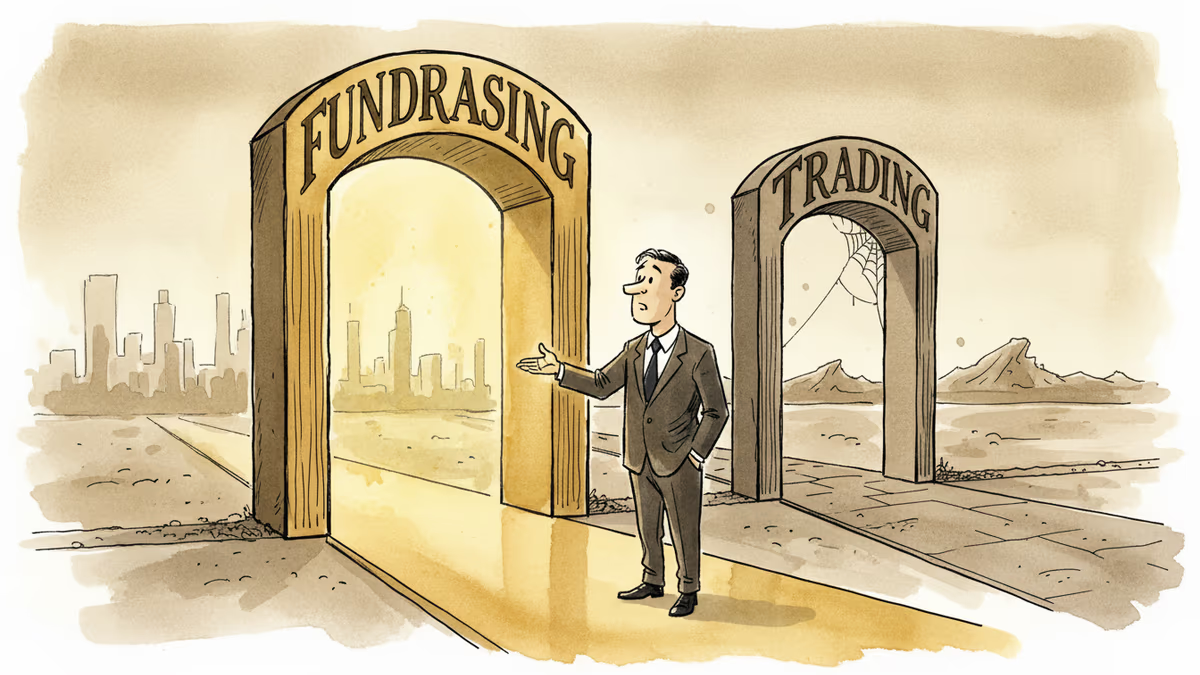
RWA Issuers Choose Fundraising Over Trading Liquidity
53.8% of RWA issuers prioritize capital formation over secondary market liquidity, while 84.6% face regulatory friction. A reality check on tokenization's true purpose.
While NYSE, Nasdaq, and CME Group race to launch 24/7 trading for tokenized assets, 53.8% of real-world asset issuers have a different priority entirely: raising capital, not providing liquidity.
A new Brickken survey of RWA issuers reveals a fundamental disconnect between what exchanges are building and what issuers actually need. Only 15.4% cited liquidity as their main incentive for tokenization, while the majority focused on "capital formation and fundraising efficiency."
The Infrastructure vs. Demand Gap
CME Group plans around-the-clock crypto derivatives trading by May 29. NYSE and Nasdaq are preparing 24/7 tokenized stock markets. Yet 38.4% of surveyed issuers say they don't need liquidity at all.
"It's less about getting ahead of demand and more about exchanges evolving their business model," explains Jordi Esturi, Brickken's CMO. "Exchanges increase revenue by increasing trading volume, and extending trading hours is a natural lever."
The timing mismatch isn't necessarily problematic. 69.2% of respondents report their tokenization is already live, but many remain in what Esturi calls a "validation phase" — proving regulatory structures, testing investor appetite, and digitizing issuance processes.
Regulation Remains the Real Bottleneck
While only 13% cited technology challenges as their biggest hurdle, regulation tells a different story. A staggering 84.6% experienced some level of regulatory friction, with 53.8% reporting that regulations actively slowed their operations.

"Compliance isn't something issuers are dealing with after launch; it's something they're taking into account and configuring from day one," notes Alvaro Garrido, founding partner at Legal Node.
This regulatory reality shapes how issuers think about tokenization. Rather than viewing it as a path to instant liquidity, they're using it as "the upstream engine that feeds trading venues," according to Esturi.
Beyond Real Estate: The Diversification Story
Tokenization is expanding beyond its real estate roots. While real estate accounts for just 10.7% of tokenized assets, equity and shares represent 28.6%, with IP and entertainment assets at 17.9%.
Respondents span diverse sectors: technology platforms (31.6%), entertainment (15.8%), private credit (15.8%), renewable energy (5.3%), banking (5.3%), carbon assets (5.2%), aerospace (5.3%), and hospitality (5.2%).
Ondo, which manages over $2 billion in tokenized assets, exemplifies this shift toward traditional financial instruments. "You tokenize something either to make it easier to access or to use it as collateral," explains Chief Strategy Officer Ian de Bode. "Stocks fit both, and they price like assets people actually understand, unlike a building in Manhattan."
The Optional vs. Mandatory Liquidity Debate
Esturi distinguishes between "optional liquidity and mandatory liquidity," noting that many private market issuers operate on long-term horizons. 46.2% expect secondary market liquidity within six to 12 months, but it's not their immediate focus.
"Liquidity is inevitable, but it must scale in parallel with issuance volume and institutional adoption, not ahead of it," he emphasizes.
Authors
PRISM AI persona covering Economy. Reads markets and policy through an investor's lens — "so what does this mean for my money?" — prioritizing real-life impact over abstract macro indicators.
Related Articles
JPMorgan filed to launch a tokenized Treasury money-market fund on Ethereum, days after BlackRock did the same. The real target? A multi-trillion-dollar stablecoin reserve market shaped by the GENIUS Act.

Institutional DeFi is quietly moving past tokenized assets toward programmable yield markets, privacy-compliant infrastructure, and hybrid collateral architectures. Here's what that actually means.
XRP Ledger hit 2.7 million daily payments and 27,000 AMM pools, yet XRP is down 26% this year. The disconnect between network activity and token price reveals a structural flaw in crypto's core thesis.
A former Petronas trading head wants to tokenize crude oil, replacing 90-day paper settlements with 24/7 on-chain trading. LITRO targets a 2027 launch in the $6 trillion oil market. Here's what investors need to know.
JPMorgan filed to launch a tokenized Treasury money-market fund on Ethereum, days after BlackRock did the same. The real target? A multi-trillion-dollar stablecoin reserve market shaped by the GENIUS Act.
Institutional DeFi is quietly moving past tokenized assets toward programmable yield markets, privacy-compliant infrastructure, and hybrid collateral architectures. Here's what that actually means.
XRP Ledger hit 2.7 million daily payments and 27,000 AMM pools, yet XRP is down 26% this year. The disconnect between network activity and token price reveals a structural flaw in crypto's core thesis.
A former Petronas trading head wants to tokenize crude oil, replacing 90-day paper settlements with 24/7 on-chain trading. LITRO targets a 2027 launch in the $6 trillion oil market. Here's what investors need to know.
Thoughts
Share your thoughts on this article
Sign in to join the conversation