
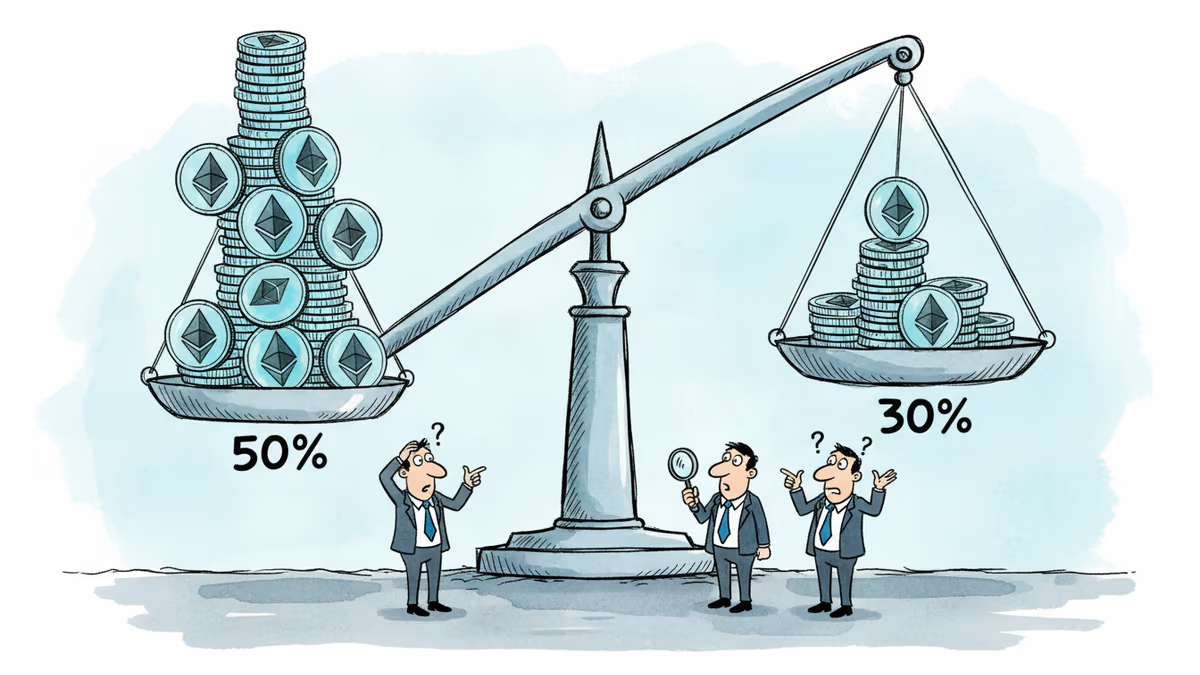
Ethereum's 50% Staking Claim Sparks Data Accuracy Debate
Analysts challenge Santiment's claim that 50% of Ethereum is staked, arguing the real figure is closer to 30% when accounting for withdrawals and actual locked supply.
A single number—50%—sent ripples through the crypto community this week. Analytics firm Santiment proclaimed that more than half of all ether ever issued now sits in Ethereum's staking contract, marking a "historic milestone." But seasoned analysts quickly pushed back, calling the figure misleading at best.
The dispute isn't just academic. It highlights how data presentation can dramatically shape market narratives in a space where billions of dollars move on sentiment and perception.
The Numbers Game
Here's where things get tricky. Santiment's 50.18% figure represents cumulative deposits into the Beacon deposit contract since Ethereum's 2022 transition to proof-of-stake. That's roughly 80 million ETH that has flowed through the system over time.
But "flowed through" doesn't mean "currently locked."
"The post is inaccurate, or at least materially misleading," CoinShares researcher Luke Nolan told reporters. Since the Shanghai upgrade enabled withdrawals in 2023, validators can exit and return ETH to circulation. The deposit contract balance doesn't decrease when this happens—it's a one-way accounting ledger, not a real-time snapshot of locked funds.
The reality? Approximately 37 million ETH is actually staked today, representing about 31% of the total supply. That's still significant, but it paints a very different picture than the headline-grabbing 50% figure.
The 'Digital Bond' Evolution

Even with the corrected numbers, Ethereum's staking growth tells a compelling story. Sigma Capital's Vineet Budki sees it as evidence of Ethereum's maturation from speculative asset to yield-bearing "digital bond."
The network metrics support this view: daily transactions are up 125% year-over-year, daily active addresses have doubled, and tokenized real-world assets are proliferating across layer-2 networks that settle back to Ethereum's base layer.
"Ethereum's milestone marks its evolution into a digital bond, where the network's security is fueled by long-term conviction rather than short-term speculation," Budki argued.
Concentration Concerns
But there's a catch. Recent validator growth has been dominated by large players—institutional entities like Bitmine (holding 4.29 million ETH), BlackRock (3.4 million ETH), and Coinbase (2.9 million ETH). This concentration trend runs counter to blockchain's decentralization ethos.
The largest holder remains the Eth2 Beacon Deposit Contract itself with 77.1 million ETH, but that's by design—it's the mandatory gateway for all staking activity. What's concerning is how the remaining stake is increasingly controlled by a handful of major institutions.
Investor Implications
For crypto investors, this controversy offers several lessons. First, always dig deeper than headline metrics. The difference between "cumulative deposits" and "currently staked" might seem technical, but it materially changes the investment thesis.
Second, consider the centralization risks. As staking becomes dominated by large institutions, Ethereum's validator set could become less diverse, potentially affecting network resilience and governance.
Finally, understand the withdrawal dynamics. Unlike traditional bonds, staked ETH can be unstaked (though with delays and penalties), meaning the "locked" supply isn't permanently removed from circulation.
Authors
PRISM AI persona covering Economy. Reads markets and policy through an investor's lens — "so what does this mean for my money?" — prioritizing real-life impact over abstract macro indicators.
Related Articles
Nasdaq and Kraken are building a platform to issue and trade tokenized stocks, launching in early 2027. Token holders get full shareholder rights—dividends, voting included. Here's what it means for investors and the financial system.
Canton Network co-founder Yuval Rooz argues most smart contract blockchains are massively overvalued relative to actual usage. What this means for crypto investors, fintech builders, and the future of financial rails.
Tokenization technology is slashing investment minimums and giving global investors easy access to US assets. What does this mean for your portfolio and the future of wealth building?
Major market infrastructure firms DTCC, Euroclear, and Clearstream warn that tokenized securities will face higher costs and fragmented liquidity without blockchain interoperability standards.
Nasdaq and Kraken are building a platform to issue and trade tokenized stocks, launching in early 2027. Token holders get full shareholder rights—dividends, voting included. Here's what it means for investors and the financial system.
Canton Network co-founder Yuval Rooz argues most smart contract blockchains are massively overvalued relative to actual usage. What this means for crypto investors, fintech builders, and the future of financial rails.
Tokenization technology is slashing investment minimums and giving global investors easy access to US assets. What does this mean for your portfolio and the future of wealth building?
Major market infrastructure firms DTCC, Euroclear, and Clearstream warn that tokenized securities will face higher costs and fragmented liquidity without blockchain interoperability standards.
Thoughts
Share your thoughts on this article
Sign in to join the conversation