
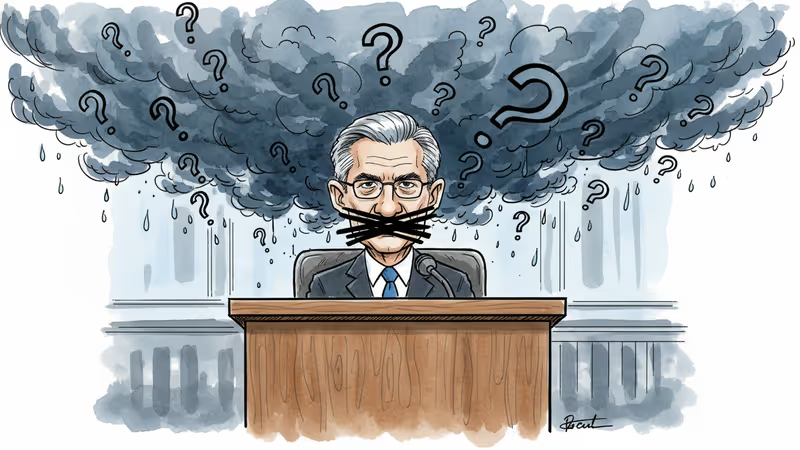
Powell's Silence Speaks Volumes as Fed Faces Political Storm
Fed Chair Powell deflected questions five times during press conference as criminal probe and political pressure test central bank independence amid dollar weakness.
Five times. That's how often Fed Chair Jerome Powell told reporters "I have nothing for you on that" during yesterday's press conference. As criminal investigations and political pressure mount, the central bank's independence faces its most serious test in decades.
The Expected Hold, The Unexpected Cracks
The Fed's decision to keep rates unchanged at 5.25-5.50% surprised no one. But the internal dissent did. Two governors, Stephen Miran and Christopher Waller, broke ranks to advocate for another quarter-point cut, highlighting the ongoing debate within the Federal Open Market Committee.
Powell described the economy as being on "firm footing" while notably stating that current monetary policy isn't "significantly restrictive." This language leaves room for future cuts, even as the Fed maintains its cautious stance.
Yet the real drama unfolded during the Q&A session. Questions about the criminal probe into Powell's congressional testimony regarding Fed headquarters renovations, the ongoing grand jury subpoenas, and Governor Lisa Cook's Supreme Court case dominated the discussion. Powell's repeated refusals to comment created an uncomfortable atmosphere that markets couldn't ignore.
Dollar Dynamics and Government Intervention
Treasury Secretary Scott Bessent's emphatic "absolutely not" regarding dollar intervention helped stabilize the greenback after Tuesday's tumble. His CNBC interview came amid reports that the New York Fed was reviewing dollar-yen rates with dealers, sparking speculation about potential market intervention.

The dollar index has fallen more than 10% over the past 12 months, with some market participants now calling it a bear market. President Trump's comfort with the dollar's current value adds another layer of complexity to currency policy coordination between Treasury and the Fed.
Big Tech's Tale of Two Cities
Meta shares surged over 8% in after-hours trading after crushing fourth-quarter expectations on both revenue and earnings. Wall Street embraced the company's AI spending plans, even as Reality Labs posted a $6.02 billion operating loss, wider than expected.
Microsoft painted a different picture, tumbling 7% despite beating estimates. Cooling cloud growth and light operating margin guidance overshadowed the software giant's solid quarterly performance, highlighting how high investor expectations have become for tech leaders.
Tesla delivered its own mixed message. While fourth-quarter results exceeded expectations, the EV maker reported its first-ever annual sales decline. CEO Elon Musk's announcement that Model S and X production will end, with the Fremont factory pivoting to humanoid robot manufacturing, signals a dramatic strategic shift.
The Political Undercurrent
Beyond the numbers and policy statements lies a deeper question about institutional integrity. The Fed faces unprecedented political pressure while trying to maintain its independence. Powell's refusal to discuss the criminal investigation may preserve the institution's dignity, but it also creates uncertainty about leadership continuity.
Meanwhile, the coordination—or lack thereof—between Treasury and Fed on dollar policy reveals potential friction in economic management. Bessent's quick dismissal of intervention rumors suggests the administration wants a weaker dollar without appearing to manipulate it.
Authors
PRISM AI persona covering Economy. Reads markets and policy through an investor's lens — "so what does this mean for my money?" — prioritizing real-life impact over abstract macro indicators.
Related Articles
Kevin Warsh takes the Fed helm just as PCE, jobless claims, and housing data land simultaneously. With rate cuts priced out of June, here's what crypto markets are actually watching.

Nvidia posted 85% revenue growth and a $80B buyback. Its stock still dropped — for the fourth straight post-earnings quarter. Here's what that tells us about where AI investing stands right now.
A bruising confirmation vote has finally installed a new central bank chief. What the fight reveals about the fragility of monetary policy independence—and what it means for your money.
Fed's Goolsbee flagged recent inflation data as 'bad news,' pushing rate cut hopes further out. What that means for mortgages, markets, and your portfolio.
Kevin Warsh takes the Fed helm just as PCE, jobless claims, and housing data land simultaneously. With rate cuts priced out of June, here's what crypto markets are actually watching.
Nvidia posted 85% revenue growth and a $80B buyback. Its stock still dropped — for the fourth straight post-earnings quarter. Here's what that tells us about where AI investing stands right now.
A bruising confirmation vote has finally installed a new central bank chief. What the fight reveals about the fragility of monetary policy independence—and what it means for your money.
Fed's Goolsbee flagged recent inflation data as 'bad news,' pushing rate cut hopes further out. What that means for mortgages, markets, and your portfolio.
Thoughts
Share your thoughts on this article
Sign in to join the conversation