

The $32 Billion Alumni Network Behind Startup Battlefield's 2026 Return
TechCrunch's Startup Battlefield opens applications mid-February, continuing a legacy that's produced Dropbox, Discord, and 1,700+ companies worth $32 billion collectively.
200 slots. $32 billion in collective alumni funding. One equity-free $100,000 prize. TechCrunch'sStartup Battlefield is opening applications mid-February 2026, and the numbers tell a story that goes far beyond a typical pitch competition.
This isn't just another startup contest. Since its inception, Startup Battlefield has become the launching pad for companies that now define entire industries. Dropbox, Discord, Cloudflare, Trello, and Mint all emerged from this San Francisco stage before becoming household names. The 1,700+ alumni companies represent a collective validation of something rare in the startup world: a competition that actually predicts long-term success.
The Battlefield Blueprint
The mechanics are deceptively simple. TechCrunch selects 200 early-stage startups from thousands of global applicants. These companies receive free exhibit space at Disrupt, exclusive masterclasses, direct investor access, and the chance to pitch live on stage. The winner takes home $100,000 in equity-free funding and the coveted Disrupt Cup.
But the real prize isn't the money—it's the exposure. Being selected for Startup Battlefield signals to the venture capital ecosystem that your company has been vetted by one of tech journalism's most influential platforms. It's a stamp of credibility that opens doors long after the San Francisco event ends.
The 2026 iteration follows the established timeline: applications open mid-February, close in mid-June, with selected startups notified around September 1st. A virtual preparation program then begins, designed to help founders refine their pitch before taking the Disrupt stage.
Why This Matters Now
The timing of Startup Battlefield's 2026 return coincides with a venture capital landscape that's become increasingly selective. After the funding frenzy of 2020-2021, investors are demanding more proof points, clearer paths to profitability, and stronger market validation. In this environment, the TechCrunch endorsement carries even more weight.

The competition's focus areas—AI, climate, health, fintech—mirror the sectors where institutional capital is concentrating. For founders building in these spaces, Startup Battlefield offers something that's become increasingly scarce: guaranteed face time with tier-one investors who are actually writing checks.
Consider the math from an investor's perspective. If you're a VC attending Disrupt, you're seeing 200 pre-screened companies in three days. That's a deal flow efficiency that's impossible to replicate through cold outreach or even warm introductions.
The Selection Paradox
Here's where it gets interesting: Startup Battlefield's success might be creating its own challenge. As the competition's reputation grows, so does the application volume. More applicants means lower acceptance rates, which theoretically should increase the quality of selected companies. But it also means potentially great startups get filtered out simply due to volume.
The 200 slot limit hasn't scaled with application growth, creating an increasingly exclusive club. This raises questions about whether the competition is becoming too selective for its own good, or whether scarcity is precisely what maintains its value proposition.
From a founder's perspective, the opportunity cost calculation has shifted. The time investment required for a Startup Battlefield application—pitch deck refinement, demo preparation, application essays—competes with building product and acquiring customers. The 1-in-X odds of selection (where X grows larger each year) make this a higher-stakes bet.
Beyond the Stage
What's often overlooked is Startup Battlefield's role as a market signal. The 200 selected companies effectively become TechCrunch's annual prediction of which early-stage startups will matter. Investors, corporate development teams, and even competitors pay attention to this list as a form of industry intelligence.
The alumni network effect compounds over time. Dropbox alumni now angel invest in newer Battlefield companies. Discord executives mentor current participants. The $32 billion in collective funding creates a self-reinforcing ecosystem where past winners help future participants succeed.
But this also creates potential blind spots. Does the selection process favor certain types of founders, business models, or market approaches? The alumni success stories skew heavily toward B2B software and consumer platforms—categories where TechCrunch's editorial team has deep expertise and investor networks are most established.
Authors
Related Articles
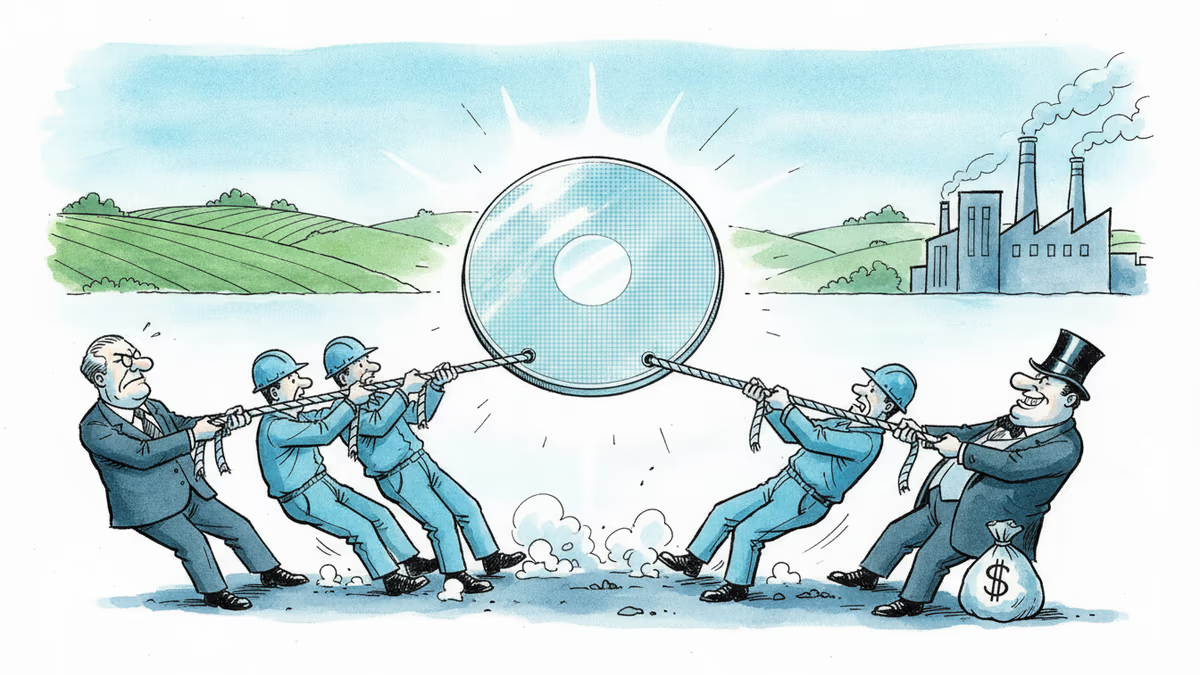
Samsung Electronics' union branch revealed that 84% of survey respondents oppose the government's roughly $290 billion (₩400 trillion) semiconductor megaproject in Gwangju. Government, management, the union and shareholders are all reading the same national project in sharply different ways.
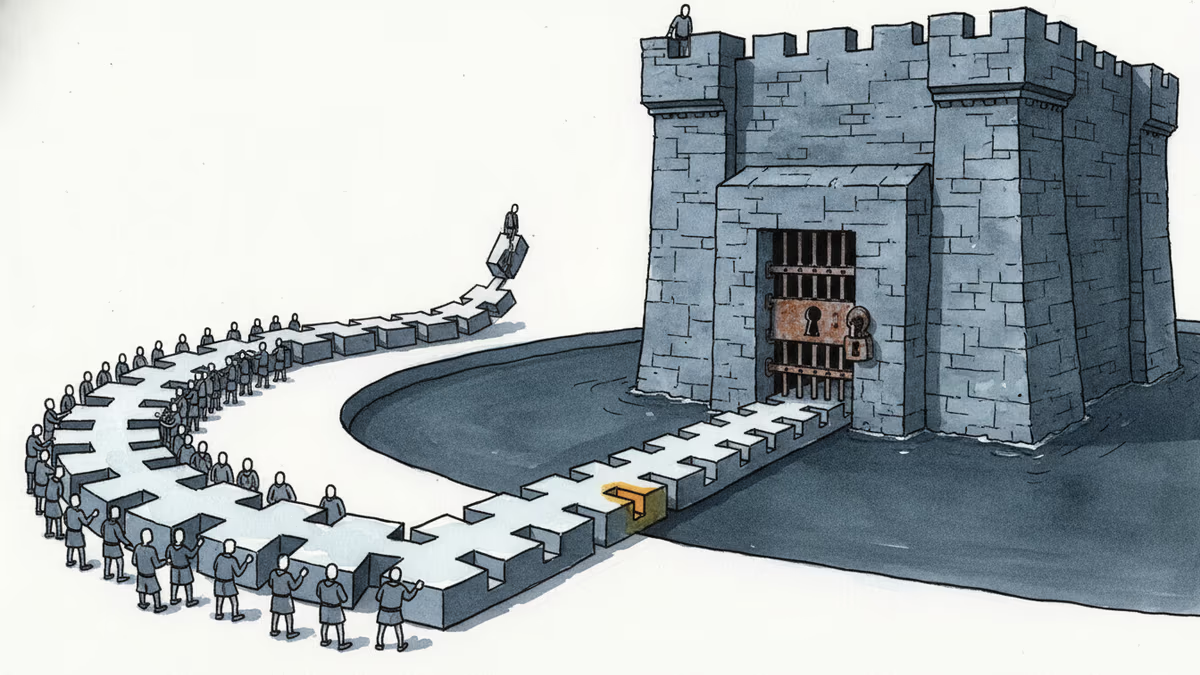
Nvidia shipped roughly a billion RISC-V cores in 2024, then announced it would run CUDA on the open standard. We break down how royalty-free instruction sets and open software stacks are trying to route around CUDA's lock-in. Part 2 of the Semiconductor Sovereignty series.
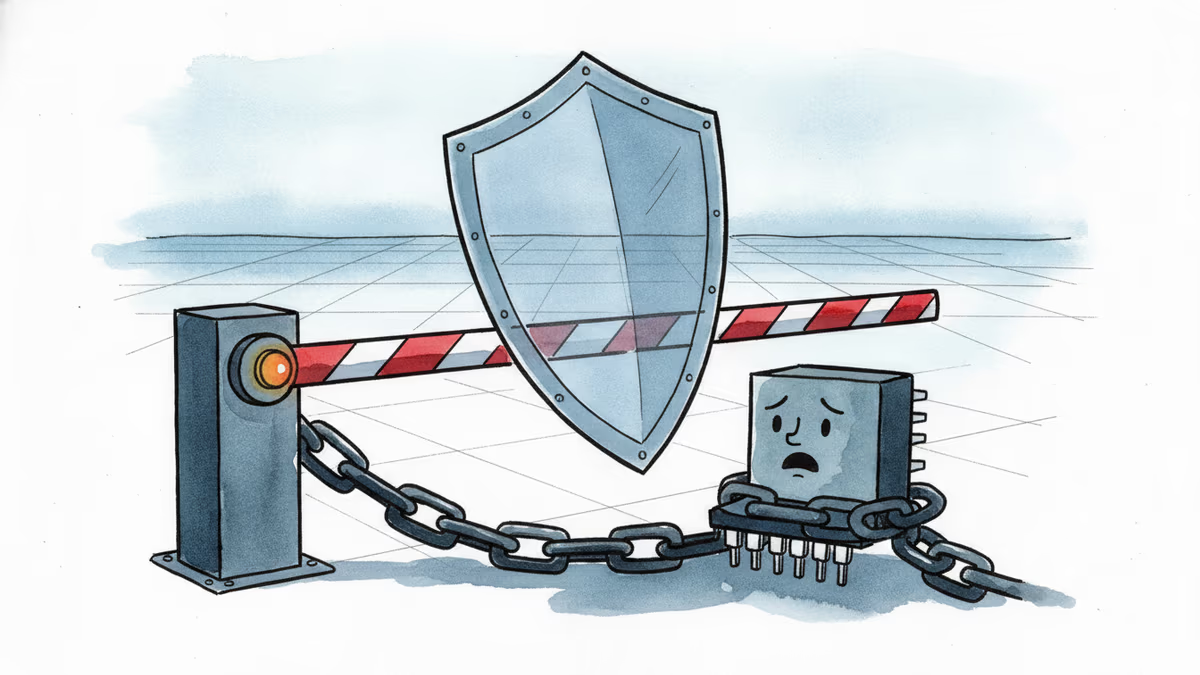
US AI-chip export controls split into three layers in the first half of 2026 — January easing, a May crackdown on circumvention, and a pending bill. Nvidia erased China from its guidance and still posted a record $81.6 billion quarter. A look at the export policy that both shields and cages it.
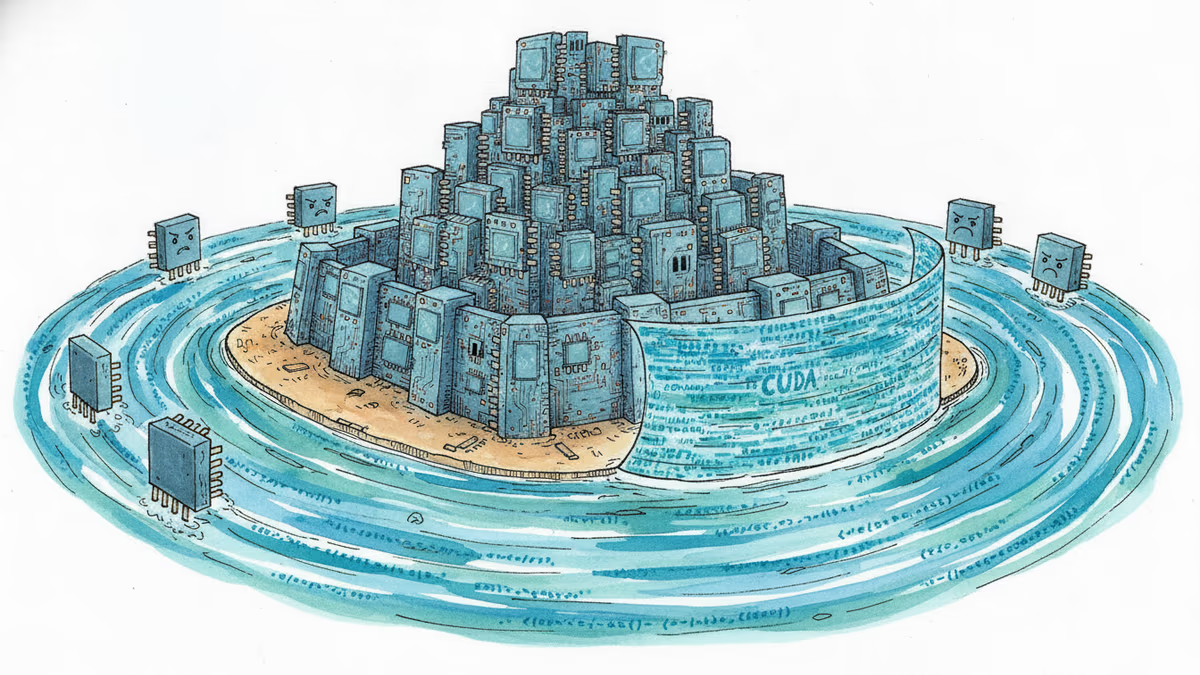
AMD's MI325X matches or beats Nvidia on memory and bandwidth — yet Nvidia's 86-92% share holds. The real moat is CUDA, 20 years in the making. Part 1 of 4.
Samsung Electronics' union branch revealed that 84% of survey respondents oppose the government's roughly $290 billion (₩400 trillion) semiconductor megaproject in Gwangju. Government, management, the union and shareholders are all reading the same national project in sharply different ways.
Nvidia shipped roughly a billion RISC-V cores in 2024, then announced it would run CUDA on the open standard. We break down how royalty-free instruction sets and open software stacks are trying to route around CUDA's lock-in. Part 2 of the Semiconductor Sovereignty series.
US AI-chip export controls split into three layers in the first half of 2026 — January easing, a May crackdown on circumvention, and a pending bill. Nvidia erased China from its guidance and still posted a record $81.6 billion quarter. A look at the export policy that both shields and cages it.
AMD's MI325X matches or beats Nvidia on memory and bandwidth — yet Nvidia's 86-92% share holds. The real moat is CUDA, 20 years in the making. Part 1 of 4.
Thoughts
1 thoughts
Share your thoughts on this article
Sign in to join the conversation