
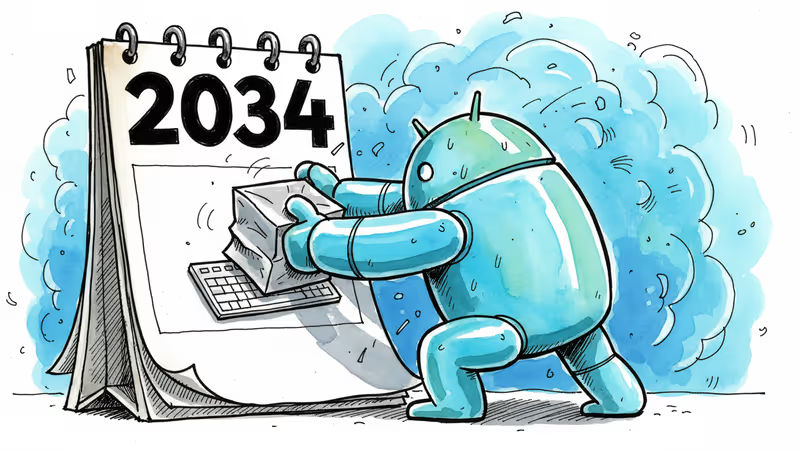
Chromebooks Have a 2034 Expiration Date
Google plans to discontinue Chromebooks in 2034, transitioning to Android-based PCs called Aluminium. What does this mean for education and enterprise?
16 years of simple, web-based computing will end in 2034. Google has revealed plans to discontinue Chromebooks and transition to Android-based PCs called "Aluminium," according to court documents from its ongoing antitrust case.
The revelation emerged during Google's search monopoly trial, which began in 2020 and concluded with a guilty verdict in 2024. As Google sought to exclude its upcoming Android PCs from antitrust remedies, it had to disclose more details about the Chromebook timeline than it ever intended.
From Web-First to App-Everything
Chromebooks launched in 2010 with the Cr-48 pilot program, offering free laptops to select users. The concept was radical: strip away complexity, focus on web browsing, and make computing affordable. It worked. Chromebooks became the go-to choice for schools and budget-conscious consumers.
But the computing landscape has shifted dramatically. Smartphones normalized app-based interactions, and users increasingly expect their desktop experience to mirror their mobile workflow. Google's ChromeOS felt increasingly limited compared to the rich ecosystem of Android apps.
The upcoming Aluminium project represents Google's answer: bringing the full Android app ecosystem to desktop computing. Instead of being confined to web apps and browser extensions, users will access millions of mobile apps on larger screens with keyboard and mouse support.
Education Sector Faces Transition Challenge
The education market, where Chromebooks found their strongest foothold, faces the biggest disruption. Schools chose Chromebooks for their simplicity, security, and cost-effectiveness. Teachers could manage entire classrooms without extensive IT support, and students couldn't easily break or compromise the systems.

Android PCs promise more functionality, but they also introduce complexity. Will teachers need additional training? How will schools handle app management and security across millions of potential Android applications? The 10-year transition window gives educational institutions time to plan, but it also creates uncertainty for current procurement decisions.
Districts investing in Chromebooks today must consider whether their 5-7 year refresh cycles align with Google's timeline. Some may accelerate transitions to avoid being caught with obsolete devices, while others might delay major purchases until Android PC options mature.
Enterprise Implications Beyond Education
While schools dominated Chromebook adoption, enterprises also embraced them for specific use cases: call centers, retail points of sale, and roles requiring basic computing. These organizations now face similar transition decisions.
Android PCs could unlock new enterprise possibilities. Imagine customer service representatives using the same apps on desktop that field workers use on tablets, or retail systems that seamlessly integrate mobile payment apps with desktop inventory management.
However, enterprise IT departments are notoriously cautious about platform changes. The simplicity that made Chromebooks attractive for mass deployment might be lost in Android's complexity. Google will need to prove that Android PCs can maintain the manageability and security that made Chromebooks enterprise-friendly.
The Bigger Platform Play
Google's decision reflects broader industry trends. Microsoft has been pushing Windows toward app stores and mobile-style interfaces. Apple continues merging iOS and macOS experiences. The distinction between mobile and desktop computing continues blurring.
But Google faces unique challenges. Unlike Apple's controlled ecosystem or Microsoft's enterprise dominance, Google must convince users to abandon a proven platform for an unproven one. Chromebooks succeeded because they solved specific problems simply. Android PCs must prove they can solve more problems without creating new ones.
The timing also raises questions about Google's long-term strategy. With AI reshaping computing interfaces and cloud services becoming more sophisticated, will traditional desktop paradigms even matter in 2034? Google might be betting that by then, the distinction between mobile and desktop will be irrelevant.
Authors
Related Articles
In a post-Google I/O interview, Sundar Pichai acknowledged flawed search results, real AI anxiety, and an AGI timeline that makes the label irrelevant. Here's what he said — and what it means.
Google is building AI agents that search the web proactively, without user prompting. That's not just a product update — it's a fundamental shift in who controls the information you receive.
Google unveiled the 'Googlebook' platform to replace Chromebook and ChromeOS—but revealed zero hardware specs. What's the strategy, and what does it mean for users, manufacturers, and the education market?
After 15 years of fragmented mobile messaging, Apple and Google are rolling out end-to-end encrypted RCS messaging between iPhones and Android devices. Here's what changed, why it took so long, and what it means for your privacy.
In a post-Google I/O interview, Sundar Pichai acknowledged flawed search results, real AI anxiety, and an AGI timeline that makes the label irrelevant. Here's what he said — and what it means.
Google is building AI agents that search the web proactively, without user prompting. That's not just a product update — it's a fundamental shift in who controls the information you receive.
Google unveiled the 'Googlebook' platform to replace Chromebook and ChromeOS—but revealed zero hardware specs. What's the strategy, and what does it mean for users, manufacturers, and the education market?
After 15 years of fragmented mobile messaging, Apple and Google are rolling out end-to-end encrypted RCS messaging between iPhones and Android devices. Here's what changed, why it took so long, and what it means for your privacy.
Thoughts
1 thoughts
Share your thoughts on this article
Sign in to join the conversation