
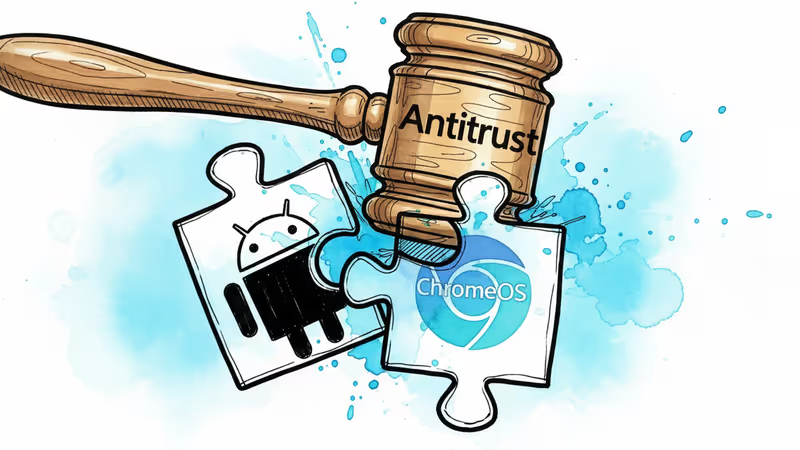
Google's Android-ChromeOS Merger Isn't Just About Better Tablets
Google is rushing to merge Android and ChromeOS into Aluminium OS, but antitrust pressure may be forcing their hand faster than planned
"Finally." That single word captures what many have felt watching Google juggle two operating systems for over a decade. Android dominates phones but stumbles on tablets. ChromeOS works great in classrooms but feels limited everywhere else. Now, leaked glimpses of Aluminium OS suggest Google is finally ready to merge them—but perhaps not entirely by choice.
When Two Worlds Collide
The leaked Aluminium OS represents Google's attempt to create what users have long wanted: Android's massive app ecosystem combined with ChromeOS's desktop-class productivity features. Early reports point to deployment on Intel Panther Lake devices, including a "Ruby" laptop and high-end "Sapphire" tablet.
On paper, it makes perfect sense. Android commands 85% of the global smartphone market but has never cracked the tablet code. Meanwhile, ChromeOS found success in education with 42% of the K-12 market, yet remained a niche player for general consumers. A unified platform could theoretically solve both problems.
But timing tells a different story. Google wasn't planning to rush this integration—until external pressures forced their hand.
The Antitrust Accelerator
Previously unreported court documents reveal the real catalyst behind Google's sudden urgency: ongoing antitrust litigation. As regulators circle Google's search monopoly, the company is scrambling to maintain influence across computing platforms. If courts order the breakup of Google's search business, a unified OS becomes crucial for preserving the company's reach into users' daily computing lives.
This creates a fascinating paradox. Google must balance the risk of releasing an unpolished product against the possibility that regulatory action could limit their future options. With Microsoft already supporting Android apps on Windows 11 and Apple blurring lines between Mac and iPad, Google's window for OS innovation may be narrowing.

The leaked timeline suggests Google is prioritizing speed over perfection—a risky bet in an industry where first impressions often determine long-term success.
The Ecosystem Chess Game
Aluminium OS isn't just about better tablets; it's about controlling the computing experience from phone to desktop. For consumers, this could mean seamless app continuity and simplified device management. Your Android phone apps would work identically on your laptop, with synchronized settings and data.
But this integration raises questions about competition and choice. A unified Google OS could make it even harder for alternative app stores, browsers, or services to gain traction. Samsung, Google's biggest Android partner, might find itself more dependent on Google's ecosystem decisions. Meanwhile, smaller device manufacturers could face pressure to adopt Google's vision or risk being left behind.
The education sector, where ChromeOS thrives, presents another complexity. Schools appreciate ChromeOS's simplicity and security model. Adding Android's full app ecosystem could introduce management headaches and security concerns that educators have avoided.
The Messy Middle
Google's challenge isn't just technical—it's cultural. Android users expect freedom and customization. ChromeOS users value simplicity and security. Satisfying both audiences while maintaining the distinct advantages of each platform requires careful balancing.
Early reports suggest Google is taking a "best of both worlds" approach, but history shows OS mergers rarely go smoothly. Microsoft's Windows RT failed partly because it confused users about app compatibility. Apple's success with iOS and macOS comes from keeping them separate while adding strategic integration points.
The leaked "Ruby" and "Sapphire" devices will serve as crucial test cases. If Google can demonstrate clear advantages over existing solutions, the merger gains momentum. If users encounter the typical growing pains of unified platforms—app incompatibilities, performance issues, or feature confusion—the project could stall.
Authors
Related Articles
In a post-Google I/O interview, Sundar Pichai acknowledged flawed search results, real AI anxiety, and an AGI timeline that makes the label irrelevant. Here's what he said — and what it means.
Google is building AI agents that search the web proactively, without user prompting. That's not just a product update — it's a fundamental shift in who controls the information you receive.
Google unveiled the 'Googlebook' platform to replace Chromebook and ChromeOS—but revealed zero hardware specs. What's the strategy, and what does it mean for users, manufacturers, and the education market?
After 15 years of fragmented mobile messaging, Apple and Google are rolling out end-to-end encrypted RCS messaging between iPhones and Android devices. Here's what changed, why it took so long, and what it means for your privacy.
In a post-Google I/O interview, Sundar Pichai acknowledged flawed search results, real AI anxiety, and an AGI timeline that makes the label irrelevant. Here's what he said — and what it means.
Google is building AI agents that search the web proactively, without user prompting. That's not just a product update — it's a fundamental shift in who controls the information you receive.
Google unveiled the 'Googlebook' platform to replace Chromebook and ChromeOS—but revealed zero hardware specs. What's the strategy, and what does it mean for users, manufacturers, and the education market?
After 15 years of fragmented mobile messaging, Apple and Google are rolling out end-to-end encrypted RCS messaging between iPhones and Android devices. Here's what changed, why it took so long, and what it means for your privacy.
Thoughts
Share your thoughts on this article
Sign in to join the conversation