
Fitbit Users Get 16-Month Reprieve as Google Extends Migration Deadline
Google extends Fitbit account migration deadline to May 2026, giving users more time to decide on data transfer. What this means for wearable market competition.
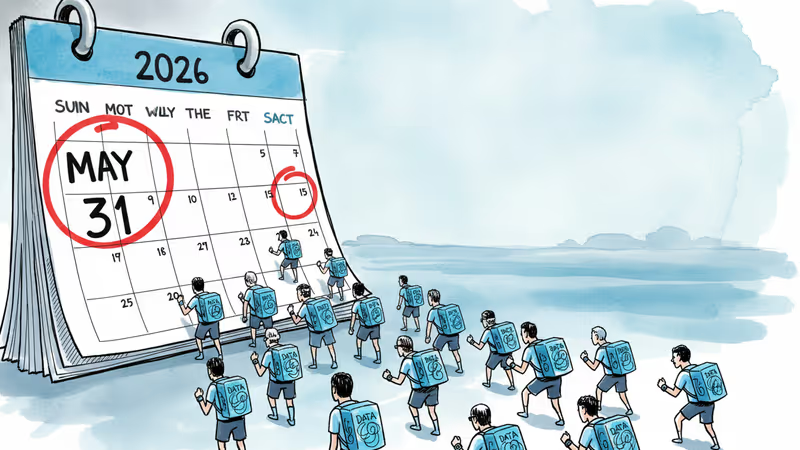
Google just handed Fitbit users an unexpected gift: 16 more months to make up their minds. The tech giant has pushed back its account migration deadline from February 2nd to May 19th, 2026, giving holdout users significantly more time to decide whether they want to move their fitness data into Google's ecosystem.
The extension comes with a clearer timeline for data deletion. Users now have until July 15th, 2026 to download or delete their data before Google begins processing deletions. That's nearly six months after the migration deadline – a buffer that suggests Google learned from past user backlash over rushed transitions.
Why the Sudden Backtrack?
This isn't just administrative housekeeping. The extended timeline reveals the complexity Google faces in absorbing Fitbit's user base, which it acquired for $2.1 billion in 2021. Privacy regulations, particularly in Europe, have made seamless data transfers more challenging than initially anticipated.
More tellingly, it suggests significant user resistance. Many Fitbit users aren't just reluctant – they're actively avoiding the switch. For them, this isn't about upgrading to a better service; it's about maintaining control over years of personal health data that they'd rather not hand over to Google's advertising machine.

The company's decision to extend the deadline, rather than force migration, indicates it values user retention over aggressive integration timelines. But it also raises questions about how many users will ultimately make the switch versus simply abandon their devices.
The Wearable Market Reshuffles
This extended timeline creates interesting dynamics in the wearable space. While Google deliberates, competitors like Apple and Samsung continue gaining ground. Apple Watch maintains its premium position, while Samsung's Galaxy Watch series offers Android users an alternative that doesn't require Google account integration.
For consumers, the delay provides breathing room to explore alternatives. The wearable market has matured significantly since Fitbit's heyday, with more options offering comparable features without the data migration headaches.
The extension also highlights a broader trend: tech acquisitions are getting messier as users become more privacy-conscious. Gone are the days when users would seamlessly adopt whatever platform their favorite service migrated to.
Authors
Related Articles

In a post-Google I/O interview, Sundar Pichai acknowledged flawed search results, real AI anxiety, and an AGI timeline that makes the label irrelevant. Here's what he said — and what it means.
Xreal's Project Aura debuted at Google I/O with OLED displays, hand tracking, and an IPO on the horizon. The industry has burned billions for a decade. So why does it feel like something has actually shifted?
Google is building AI agents that search the web proactively, without user prompting. That's not just a product update — it's a fundamental shift in who controls the information you receive.
Google unveiled the 'Googlebook' platform to replace Chromebook and ChromeOS—but revealed zero hardware specs. What's the strategy, and what does it mean for users, manufacturers, and the education market?
In a post-Google I/O interview, Sundar Pichai acknowledged flawed search results, real AI anxiety, and an AGI timeline that makes the label irrelevant. Here's what he said — and what it means.
Xreal's Project Aura debuted at Google I/O with OLED displays, hand tracking, and an IPO on the horizon. The industry has burned billions for a decade. So why does it feel like something has actually shifted?
Google is building AI agents that search the web proactively, without user prompting. That's not just a product update — it's a fundamental shift in who controls the information you receive.
Google unveiled the 'Googlebook' platform to replace Chromebook and ChromeOS—but revealed zero hardware specs. What's the strategy, and what does it mean for users, manufacturers, and the education market?
Thoughts
1 thoughts
Share your thoughts on this article
Sign in to join the conversation