
Google's AI Creates Playable Worlds from Text Prompts
Google launches Project Genie, an AI that generates interactive virtual worlds from simple text descriptions. Available now for premium subscribers, but is it game-changing or just clever tech?
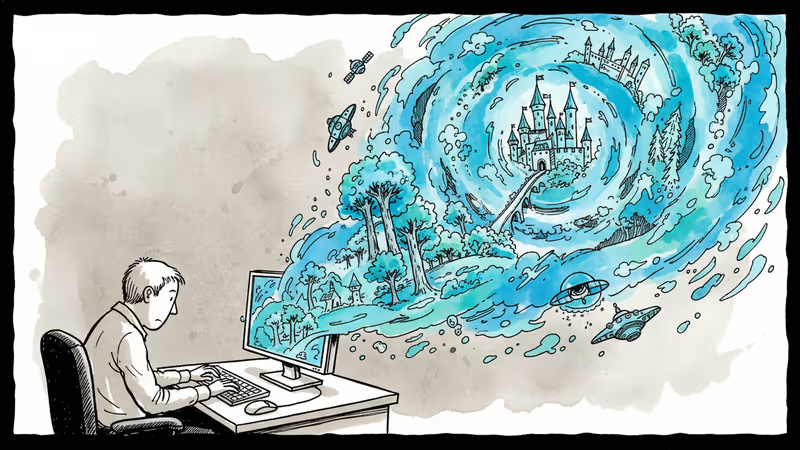
Type "a knight exploring a forest village" and watch as AI conjures an entire interactive world you can actually play in. No coding, no 3D modeling, no months of development—just words becoming worlds.
Google has quietly launched Project Genie, an AI system that generates playable virtual environments from simple text prompts. It's the public release of Genie 3, previously available only to select testers, now accessible to subscribers of Google's premium AI service.
Memory That Lasts Minutes, Not Seconds
What makes Project Genie different isn't just world generation—it's world persistence. The AI creates what Google calls "world models"—not technically 3D environments, but responsive videos that react to your inputs like a real game.
The breakthrough lies in memory. While earlier AI models forgot details within seconds, Genie 3 maintains world consistency for several minutes. In AI terms, that's practically eternal. Move your character behind a tree, come back later, and the tree's still there exactly where you left it.
Users can either choose from Google's pre-built worlds or create entirely new ones. Upload a reference image or simply describe what you want: "a cyberpunk city with flying cars" or "underwater coral reef with friendly dolphins." The AI handles the rest, generating characters, environments, and interactive elements.
Democratizing Game Development?
The implications stretch far beyond novelty. Traditional game development requires teams of designers, artists, and programmers working for months or years. Project Genie compresses that timeline to minutes.

For indie developers and content creators, this could be transformative. No need for massive budgets or technical expertise—just ideas and imagination. Want to test a game concept? Describe it and start playing immediately.
But there are clear limitations. Generated worlds last only minutes, complex game mechanics remain elusive, and sophisticated storytelling isn't possible yet. Think of it as a rapid prototyping tool rather than a complete game development solution.
The Creator Economy Meets AI
Project Genie arrives as the creator economy explodes. TikTok creators become millionaires, YouTube channels rival traditional media, and platforms like Roblox let users build and monetize their own games. AI-generated worlds could be the next frontier.
Imagine streamers generating custom game worlds live on air, or teachers creating interactive educational experiences on demand. The tool could spawn entirely new forms of entertainment and learning.
Yet questions linger about sustainability and depth. Will AI-generated worlds have the staying power of carefully crafted games? Can algorithmic creativity match human imagination and emotional resonance?
The Platform Play
Google's strategy isn't just about technology—it's about platform control. By making Project Genie exclusive to premium subscribers, Google is building a moat around AI-powered creativity tools.
Microsoft has Minecraft and gaming studios, Meta has VR worlds, Apple has its App Store ecosystem. Google's bet is that AI-generated content will be the next battleground, and controlling the creation tools means controlling the ecosystem.
This raises concerns about creative gatekeeping. If a few tech giants control the tools for digital world creation, what happens to independent innovation? Will tomorrow's virtual worlds reflect human diversity or algorithmic bias?
Authors
Related Articles
Samsung and SK unveiled a chip and AI investment package worth thousands of trillions of won on June 29. The headline number swings wildly by outlet, but the real contest isn't capital — it's water and power.

In a post-Google I/O interview, Sundar Pichai acknowledged flawed search results, real AI anxiety, and an AGI timeline that makes the label irrelevant. Here's what he said — and what it means.
Google is building AI agents that search the web proactively, without user prompting. That's not just a product update — it's a fundamental shift in who controls the information you receive.

Viral videos show 2026 graduates jeering executives who praise AI at commencement ceremonies. It's not just rudeness — it's a signal about who pays for technological optimism.
Samsung and SK unveiled a chip and AI investment package worth thousands of trillions of won on June 29. The headline number swings wildly by outlet, but the real contest isn't capital — it's water and power.
In a post-Google I/O interview, Sundar Pichai acknowledged flawed search results, real AI anxiety, and an AGI timeline that makes the label irrelevant. Here's what he said — and what it means.
Google is building AI agents that search the web proactively, without user prompting. That's not just a product update — it's a fundamental shift in who controls the information you receive.
Viral videos show 2026 graduates jeering executives who praise AI at commencement ceremonies. It's not just rudeness — it's a signal about who pays for technological optimism.
Thoughts
Share your thoughts on this article
Sign in to join the conversation