
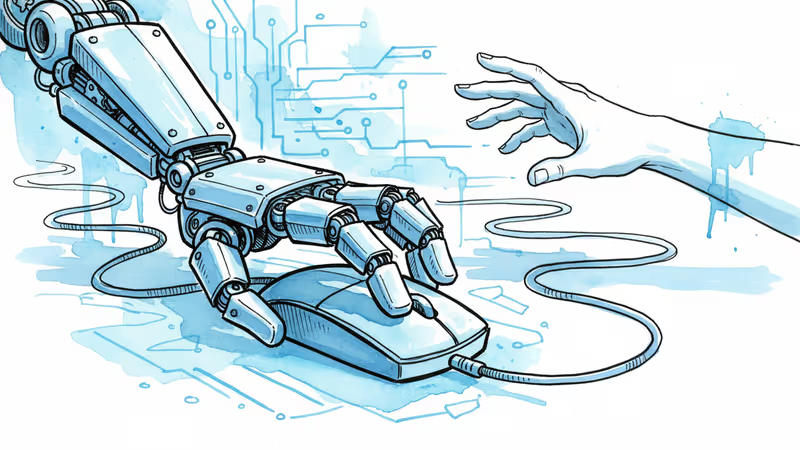
Google's AI Will Click For You—But Should It?
Google's new Auto Browse lets AI navigate websites and shop for you. Convenience comes with trade-offs that could reshape how we experience the web.
For over two decades, clicking has been our primary way of navigating the digital world. Now Google wants to change that fundamental interaction with Auto Browse, a feature that lets AI agents click around websites on your behalf—booking tickets, shopping for clothes, and completing other digital tasks while you watch.
Released this week to Gemini Pro and Ultra subscribers in the US, Auto Browse represents Google's vision of a "post-click internet." But early testing reveals a technology that's technically impressive yet surprisingly limited in ways that matter most to users.
How Auto Browse Actually Works
The concept sounds futuristic: Tell Google's Gemini chatbot in your Chrome sidebar to "book two symphony tickets for tonight," and watch as an AI agent opens tabs, navigates websites, and attempts to complete the purchase. The bot even explains its reasoning process before taking action, similar to how reasoning models work.
In practice, Auto Browse performed better than similar agent tools tested last year. It successfully navigated to correct websites, applied filters, and completed multi-step tasks without getting sidetracked. Each action gets logged for users to review.
But the devil's in the details. When asked to find "two seats next to an aisle" for a symphony performance, the AI interpreted instructions too literally—selecting seats in separate rows rather than side-by-side. Technically correct, practically useless for a date night.
The Efficiency Trap
This highlights Auto Browse's core limitation: it optimizes for task completion, not task quality. When shopping for leather jackets on Depop, the AI simply added the first three search results to the cart. No curation, no style consideration—just algorithmic efficiency.
The camping trip planning request took 15 minutes and delivered half-completed results. The AI checked availability for only one of five recommended campgrounds, essentially punting the actual booking work back to the user.
These aren't just bugs to be fixed—they reveal fundamental challenges in automating human judgment and preference.

Security and Control Concerns
Beyond performance issues, Auto Browse raises serious security questions. AI agents are vulnerable to prompt injection attacks on malicious websites that could divert the bot from its intended task. While Google includes safeguards requiring user approval for sensitive actions like purchases, the full scope of vulnerabilities hasn't been examined by independent researchers.
The persistent warning in the Gemini sidebar—"You are responsible for Gemini's actions during tasks"—underscores the liability concerns. Users get the convenience of automation but retain all the risk.
The Browsing Experience at Stake
Perhaps most importantly, Auto Browse threatens to eliminate something valuable about web browsing: serendipitous discovery. Real internet surfing involves wandering, comparing options, stumbling upon unexpected finds. It's inefficient by design—and often delightful because of it.
Google's vision of AI agents clicking on our behalf could create a sterile, purely functional web experience. Websites might start optimizing for bots rather than humans, fundamentally changing how digital spaces are designed and experienced.
Market Implications
With Chrome commanding 65% of the global browser market, Google's changes ripple across the entire web ecosystem. If Auto Browse gains traction, it could accelerate the shift toward AI-mediated experiences that keep users within Google's ecosystem rather than exploring the broader web.
This aligns with Google's broader AI strategy: Search now shows AI overviews instead of sending users to source websites, Gmail can generate responses from barely-read emails, and now Auto Browse can shop without user input. Each feature reduces direct human engagement with digital content.
The Trust Question
For Auto Browse to succeed, it needs to earn user trust through consistent, accurate results. The current version falls short of that standard. Until AI agents can match human judgment in nuanced decisions—understanding that "aisle seats" means sitting together, not just near aisles—widespread adoption seems unlikely.
The technology might prove useful for simple, repetitive tasks where precision matters less than completion. But for decisions involving personal preference, financial risk, or complex trade-offs, human oversight remains essential.
Authors
Related Articles

In a post-Google I/O interview, Sundar Pichai acknowledged flawed search results, real AI anxiety, and an AGI timeline that makes the label irrelevant. Here's what he said — and what it means.
Google is building AI agents that search the web proactively, without user prompting. That's not just a product update — it's a fundamental shift in who controls the information you receive.

Google unveiled the 'Googlebook' platform to replace Chromebook and ChromeOS—but revealed zero hardware specs. What's the strategy, and what does it mean for users, manufacturers, and the education market?
After 15 years of fragmented mobile messaging, Apple and Google are rolling out end-to-end encrypted RCS messaging between iPhones and Android devices. Here's what changed, why it took so long, and what it means for your privacy.
In a post-Google I/O interview, Sundar Pichai acknowledged flawed search results, real AI anxiety, and an AGI timeline that makes the label irrelevant. Here's what he said — and what it means.
Google is building AI agents that search the web proactively, without user prompting. That's not just a product update — it's a fundamental shift in who controls the information you receive.
Google unveiled the 'Googlebook' platform to replace Chromebook and ChromeOS—but revealed zero hardware specs. What's the strategy, and what does it mean for users, manufacturers, and the education market?
After 15 years of fragmented mobile messaging, Apple and Google are rolling out end-to-end encrypted RCS messaging between iPhones and Android devices. Here's what changed, why it took so long, and what it means for your privacy.
Thoughts
Share your thoughts on this article
Sign in to join the conversation