
The 20-Inch Secret Behind Figure Skating's 'Impossible' Jump
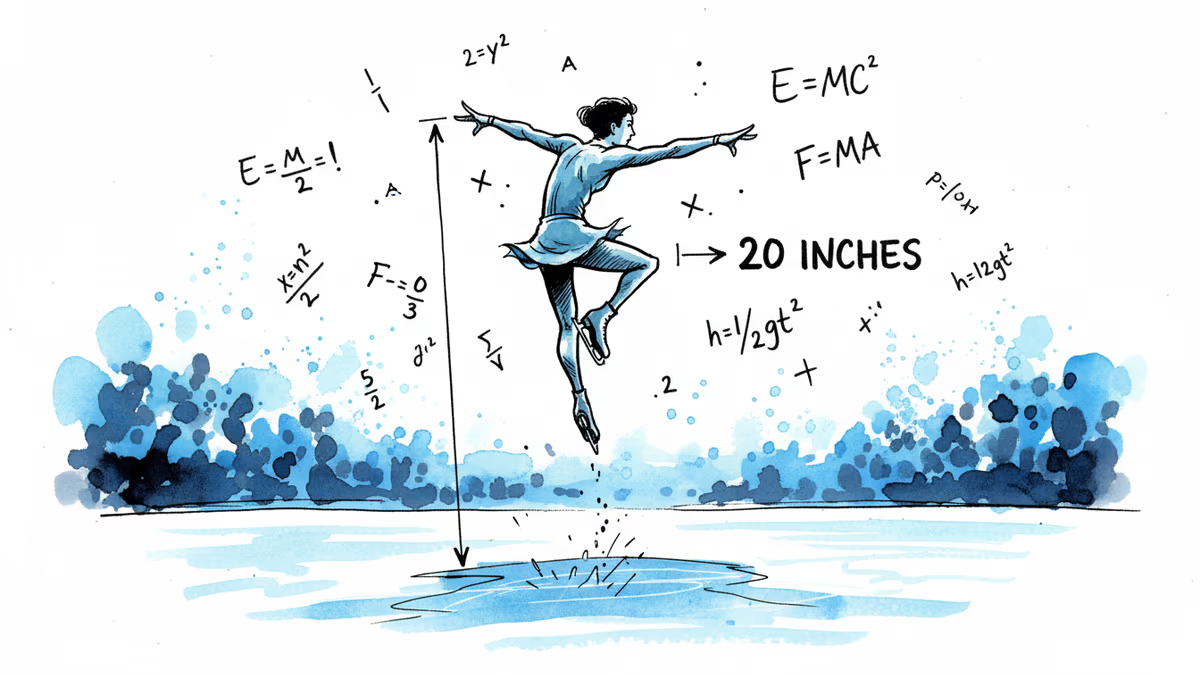
Scientists reveal the biomechanical secret behind the quadruple axel - it's all about getting 20 inches off the ice. New research challenges decades of figure skating theory.
20 Inches Changed Everything We Knew About 'Impossible'
Until 2022, the quadruple axel was figure skating's white whale. Then Ilia Malinin landed one, and suddenly the "Quad God" was rewriting Olympic records. But what separates generational talent from everyone else? Japanese researchers found the answer hiding in plain sight: get 20 inches off the ice.
Seiji Hirosawa's 2024 study in Sports Biomechanics didn't just analyze jumps—it shattered decades of conventional wisdom. While previous research dismissed jump height as relatively unimportant, the quadruple axel told a completely different story.
The Physics of 4.5 Rotations
The axel is figure skating's most technically demanding jump, and here's why: it's the only one starting forward, forcing skaters to complete an extra half-rotation. A single axel requires 1.5 turns; a quadruple axel demands 4.5 rotations in mid-air.
Using Ice Scope tracking technology, Hirosawa's team analyzed two elite skaters attempting quads in competition. They measured vertical height, horizontal distance, and skating speeds before takeoff and after landing. The results were striking: both skaters achieved significantly greater vertical heights during quad attempts compared to their triple axels.
"This suggests a strategic shift toward increasing vertical height to master 4A jumps," the study concluded. The math is elegantly simple: jump higher, spin more. Increased height provides crucial flight time for those extra rotations around the body's longitudinal axis.

Rethinking Athletic Development
This research forces us to reconsider how we develop elite athletes. For decades, figure skating focused on technique refinement and artistic expression. Now we know that raw jumping power might be just as crucial for breakthrough performances.
The implications extend beyond skating rinks. In an era where sports science increasingly drives performance gains, this study exemplifies how data can decode seemingly impossible feats. What other "impossible" athletic achievements are simply waiting for the right biomechanical insight?
Consider the broader athletic landscape: swimmers chasing hundredths of seconds, gymnasts pushing rotational limits, track athletes redefining human speed. Each sport has its own version of the quadruple axel—a barrier that seems insurmountable until science reveals the key.
The Talent vs. Technology Paradox
Here's what makes this discovery fascinating: Malinin didn't need scientific analysis to master the quad axel. His body intuitively found the solution. But now that researchers have codified his approach, other skaters can theoretically follow a blueprint.
Yet questions remain. If the formula is simply "jump 20 inches high," why do so few skaters succeed? The answer lies in the complexity beyond raw height: mid-air body control, landing stability, psychological pressure management, and split-second timing adjustments that no study can fully capture.
This creates an intriguing paradox in modern athletics. We can measure and analyze elite performance with unprecedented precision, but execution still requires something unmeasurable—call it instinct, talent, or that indefinable "it factor."
Perhaps the real breakthrough isn't in the measurement—it's in proving that "impossible" is often just "not yet understood." What other athletic barriers are we calling impossible when we simply haven't found the right angle of analysis?In your own field, what "impossible" challenge might just be waiting for a fresh perspective?
Authors
Related Articles
Scientists say quintuple jumps are impossible. But Ilia Malinin, who shocked the world with a quad axel at 17, is preparing to challenge that assumption once again.

Samsung Electronics' union branch revealed that 84% of survey respondents oppose the government's roughly $290 billion (₩400 trillion) semiconductor megaproject in Gwangju. Government, management, the union and shareholders are all reading the same national project in sharply different ways.

Nvidia shipped roughly a billion RISC-V cores in 2024, then announced it would run CUDA on the open standard. We break down how royalty-free instruction sets and open software stacks are trying to route around CUDA's lock-in. Part 2 of the Semiconductor Sovereignty series.

US AI-chip export controls split into three layers in the first half of 2026 — January easing, a May crackdown on circumvention, and a pending bill. Nvidia erased China from its guidance and still posted a record $81.6 billion quarter. A look at the export policy that both shields and cages it.
Scientists say quintuple jumps are impossible. But Ilia Malinin, who shocked the world with a quad axel at 17, is preparing to challenge that assumption once again.
Samsung Electronics' union branch revealed that 84% of survey respondents oppose the government's roughly $290 billion (₩400 trillion) semiconductor megaproject in Gwangju. Government, management, the union and shareholders are all reading the same national project in sharply different ways.
Nvidia shipped roughly a billion RISC-V cores in 2024, then announced it would run CUDA on the open standard. We break down how royalty-free instruction sets and open software stacks are trying to route around CUDA's lock-in. Part 2 of the Semiconductor Sovereignty series.
US AI-chip export controls split into three layers in the first half of 2026 — January easing, a May crackdown on circumvention, and a pending bill. Nvidia erased China from its guidance and still posted a record $81.6 billion quarter. A look at the export policy that both shields and cages it.
Thoughts
Share your thoughts on this article
Sign in to join the conversation