

The Physics-Defying Teen Who Might Just Land Figure Skating's Impossible Jump
Scientists say quintuple jumps are impossible. But Ilia Malinin, who shocked the world with a quad axel at 17, is preparing to challenge that assumption once again.
In 2021, legendary Russian figure skating coach Alexei Mishin declared that no skater would ever successfully perform a quad axel in his lifetime. The following year, a 17-year-old American named Ilia Malinin made those words irrelevant.
Now sports scientists have drawn another line in the ice: quintuple jumps are physically impossible. But the same teenager who shattered decades of conventional wisdom is eyeing that barrier too, and the skating world is starting to wonder if "impossible" means anything anymore.
The Jump That Broke Physics
Malinin's quad axel wasn't just a new record—it was a 26-year impossibility finally conquered. Since Kurt Browning landed the first ratified quadruple jump in 1988, figure skating had gradually embraced the quad era. Every type of quad had been mastered except one: the axel.
"I thought I would see a quintuple toe before I would see a quad axel," admits Timothy Goebel, the 2002 Olympic bronze medalist known as the "Quad King." The axel's forward takeoff makes it exponentially more difficult than other jumps, requiring skaters to generate rotation while launching in the most unstable direction possible.
Yet Malinin, who had already dubbed himself the "Quad God" online, made it look routine. Since that breakthrough, he's won two world titles and become the overwhelming favorite for 2026 Olympic gold based purely on technical ability.
The Science of the Impossible
Lindsay Slater Hannigan, assistant professor of physical therapy at University of Illinois Chicago, has analyzed what makes Malinin different. Her findings challenge assumptions about human limits.
"His quad axel looks like everyone else's triple axel," she explains. While most skaters need to rotate at 1,900 to 2,100 degrees per second for quads, Malinin accomplishes his quad axel at just 1,800 degrees per second—the same speed others use for triple axels.
The secret lies in what Hannigan calls "the snap"—how quickly a skater transitions into rotational position mid-air. Elite male skaters typically reach about 20 inches of height, so maximizing rotation speed within that limited airtime becomes crucial. Malinin enters his rotational position faster than anyone else and maintains it longer, extracting more revolutions from the same physics.

"For him, the idea of doing a quint and taking it to the next level is very reasonable," Hannigan concludes.
When Rules Rewrite Reality
Here's where it gets interesting: a "quintuple" jump doesn't necessarily require five full rotations in the air. George Rossano, a physicist and figure skating judge, points out that the International Skating Union (ISU) allows significant pre-rotation on takeoff and up to a quarter rotation under-rotation on landing.
"You could actually do a jump that's four and a quarter in the air, and it would be called a quint by the ISU," Rossano explains. Malinin has already demonstrated 4.25 rotations on his quad axel attempts. By ISU standards, he's tantalizingly close to quint territory.
This isn't about bending rules—it's about how human achievement intersects with institutional definitions of possibility.
The Scoreboard Paradox
Yet even if Malinin lands a quint, the scoring system won't reward him proportionally. His revolutionary quad axel carries a base value just one point higher than a quad lutz—a jump several male skaters have mastered over the past decade.
"Yes, [the quad axel] is significantly undervalued in terms of its intrinsic difficulty," Rossano noted in 2022. "But if you gave it its true, intrinsic difficulty, then the one person now who has a quad axel wins every time."
The ISU only added quintuple jumps to their scoring table in July 2024, assigning identical values to all five types despite obvious difficulty differences. Malinin's motivation for attempting a quint mirrors his quad axel journey: bragging rights over points.
Beyond the Impossible
Coaches who've worked with quad specialists see the progression as natural. Tom Zakrajsek, who coached world medalist Vincent Zhou, says he immediately thought Malinin could upgrade to a quint after witnessing the quad axel. The biomechanical similarities between certain jumps create pathways for advancement that pure physics calculations might miss.
Malinin's dominance stems not from a single groundbreaking element but from complete mastery of the entire quad repertoire. He regularly performs seven quads per program, accumulating points through volume and execution quality rather than relying on one impossible jump.
The 2026 Winter Olympics may answer that question definitively.
Authors
Related Articles
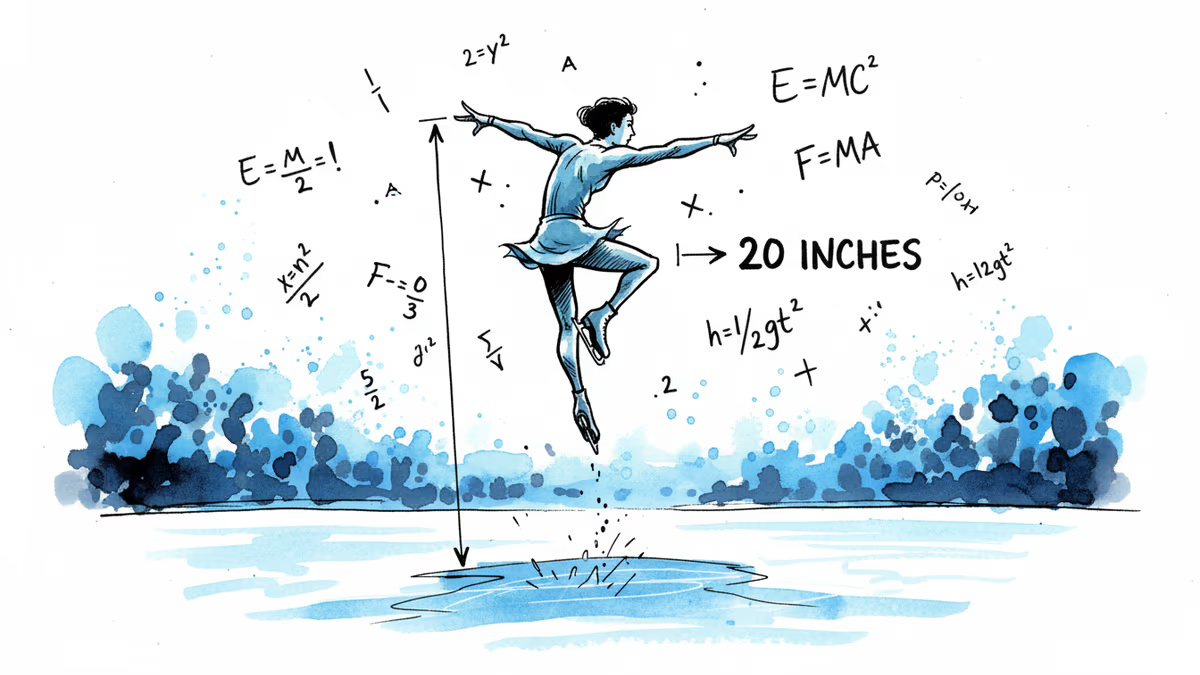
Scientists reveal the biomechanical secret behind the quadruple axel - it's all about getting 20 inches off the ice. New research challenges decades of figure skating theory.

Samsung Electronics' union branch revealed that 84% of survey respondents oppose the government's roughly $290 billion (₩400 trillion) semiconductor megaproject in Gwangju. Government, management, the union and shareholders are all reading the same national project in sharply different ways.

Nvidia shipped roughly a billion RISC-V cores in 2024, then announced it would run CUDA on the open standard. We break down how royalty-free instruction sets and open software stacks are trying to route around CUDA's lock-in. Part 2 of the Semiconductor Sovereignty series.

US AI-chip export controls split into three layers in the first half of 2026 — January easing, a May crackdown on circumvention, and a pending bill. Nvidia erased China from its guidance and still posted a record $81.6 billion quarter. A look at the export policy that both shields and cages it.
Scientists reveal the biomechanical secret behind the quadruple axel - it's all about getting 20 inches off the ice. New research challenges decades of figure skating theory.
Samsung Electronics' union branch revealed that 84% of survey respondents oppose the government's roughly $290 billion (₩400 trillion) semiconductor megaproject in Gwangju. Government, management, the union and shareholders are all reading the same national project in sharply different ways.
Nvidia shipped roughly a billion RISC-V cores in 2024, then announced it would run CUDA on the open standard. We break down how royalty-free instruction sets and open software stacks are trying to route around CUDA's lock-in. Part 2 of the Semiconductor Sovereignty series.
US AI-chip export controls split into three layers in the first half of 2026 — January easing, a May crackdown on circumvention, and a pending bill. Nvidia erased China from its guidance and still posted a record $81.6 billion quarter. A look at the export policy that both shields and cages it.
Thoughts
Share your thoughts on this article
Sign in to join the conversation