
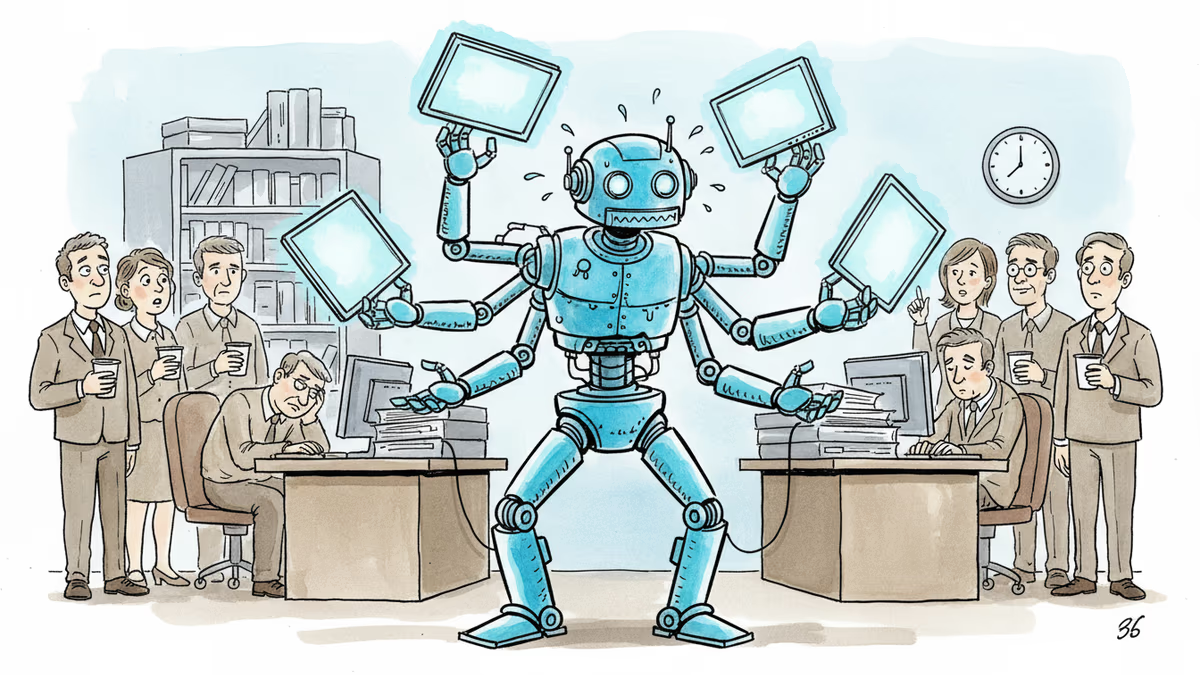
The $200 AI Agent That Does Your Job
Perplexity launches an AI agent for $200/month that handles complex workflows independently. Is this the future of work automation or an expensive experiment?
The $200 AI Agent That Does Your Job
Perplexity just added a powerful new tool to its $200-per-month subscription tier. Called 'Perplexity Computer,' this AI agent promises to "unify every current AI capability into a single system." It can execute complex workflows independently using 19 different AI models, even creating sub-agents to tackle specific problems.
But here's what caught our attention: The company had to cancel a press demonstration hours before the event because they found flaws in the product. If an AI agent isn't ready for a controlled demo, what does that say about its readiness for real-world work?
From Search to Agents: The Perplexity Evolution
Perplexity made its mark early in the AI boom by wrapping frontier models in familiar interfaces—particularly its search-engine-like answer service. Then came the Comet web browser last summer. Now, with this agent tool, the company is betting on a different future.
"You don't hear us talk about MAUs ever, because we're not actually on a mission to get as many users as possible," one executive said during a background briefing. Instead, they're targeting users making "GDP-moving decisions." It's a stark contrast to OpenAI's 800 million weekly users.
The Multi-Model Strategy
Here's where it gets interesting. Perplexity's data shows users naturally gravitate toward different models for different tasks:
- Visual outputs: Gemini Flash
- Software engineering: Claude Sonnet 4.5
- Medical research: GPT-5.1

"Multi-model is the future," argues one Perplexity executive. "Models are specializing, not commoditizing." If one LLM excels at coding and another at marketing copy, their software automatically chooses the optimal one.
The company even offers a "Model Council" feature, letting users query multiple models simultaneously. But the unit economics of offering multiple queries at flat subscription rates remain unclear.
The Trust Problem
Perplexity abandoned its advertising business late last year, admitting it "undermined users' trust in their answers' accuracy." This decision reflects a broader challenge facing AI companies: How do you monetize without compromising credibility?
The shift to enterprise subscriptions and premium tiers suggests one answer. But it also raises questions about accessibility. At $200 per month, this level of AI assistance becomes a luxury good.
What Enterprises Are Really Buying
Beyond the flashy agent capabilities, Perplexity is positioning itself as a research powerhouse. They've released a new benchmark called Draco for complex research tasks (where, unsurprisingly, their own offering beats competitors like Gemini).
The company claims it's no longer reliant on other companies' APIs for its web index and now has its own AI-optimized search API. One executive noted he's now checking revenue metrics each morning instead of query counts—a telling shift in priorities.
The Real Competition
While Perplexity talks about boutique services, the reality is that Google and others have already adapted their products to be more like what Perplexity built. The company faces the classic innovator's dilemma: How do you stay ahead when giants copy your innovations?
Their answer seems to be doubling down on orchestrating multiple third-party LLMs for cost-effective, accurate results. But this strategy has risks—especially if model providers change their terms or pricing.
Authors
Related Articles

Samsung and SK unveiled a chip and AI investment package worth thousands of trillions of won on June 29. The headline number swings wildly by outlet, but the real contest isn't capital — it's water and power.

Viral videos show 2026 graduates jeering executives who praise AI at commencement ceremonies. It's not just rudeness — it's a signal about who pays for technological optimism.

Filipino virtual assistants using AI to ghost-manage LinkedIn profiles for executives is now a structured industry. 30 comments a day, fake engagement rings, and a platform struggling to tell real from fabricated.
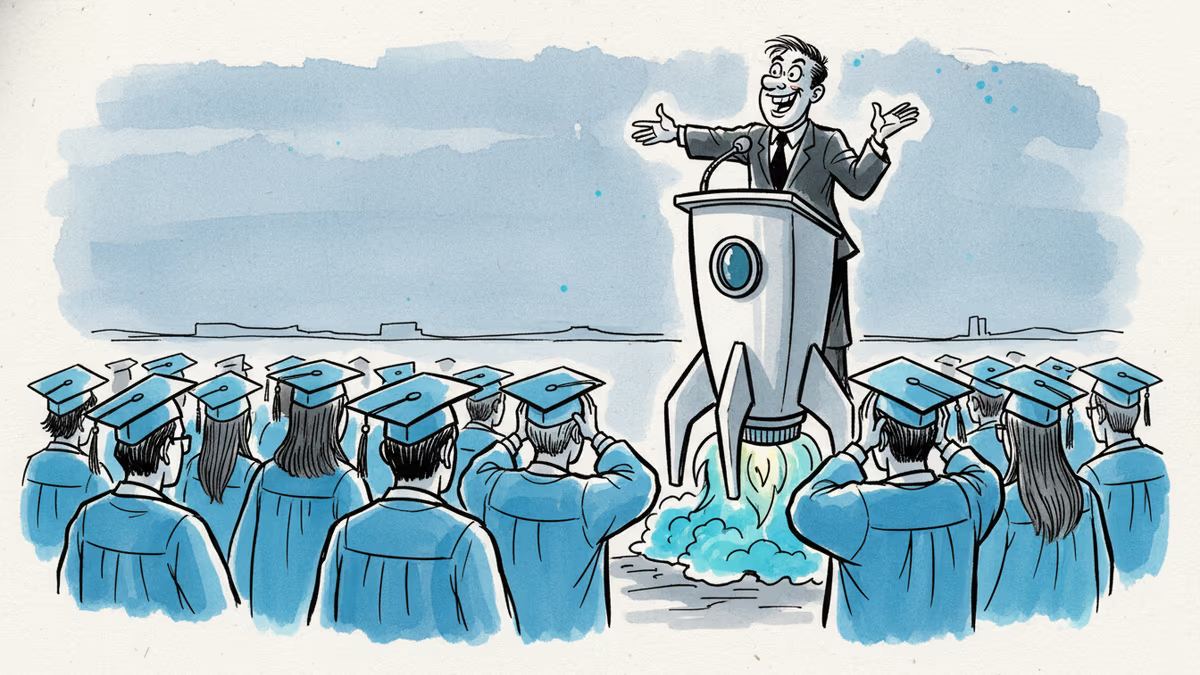
Two commencement speakers learned the hard way that AI enthusiasm doesn't land well with today's graduates. The backlash reveals a widening gap between tech optimism and Gen Z's economic reality.
Samsung and SK unveiled a chip and AI investment package worth thousands of trillions of won on June 29. The headline number swings wildly by outlet, but the real contest isn't capital — it's water and power.
Viral videos show 2026 graduates jeering executives who praise AI at commencement ceremonies. It's not just rudeness — it's a signal about who pays for technological optimism.
Filipino virtual assistants using AI to ghost-manage LinkedIn profiles for executives is now a structured industry. 30 comments a day, fake engagement rings, and a platform struggling to tell real from fabricated.
Two commencement speakers learned the hard way that AI enthusiasm doesn't land well with today's graduates. The backlash reveals a widening gap between tech optimism and Gen Z's economic reality.
Thoughts
Share your thoughts on this article
Sign in to join the conversation