
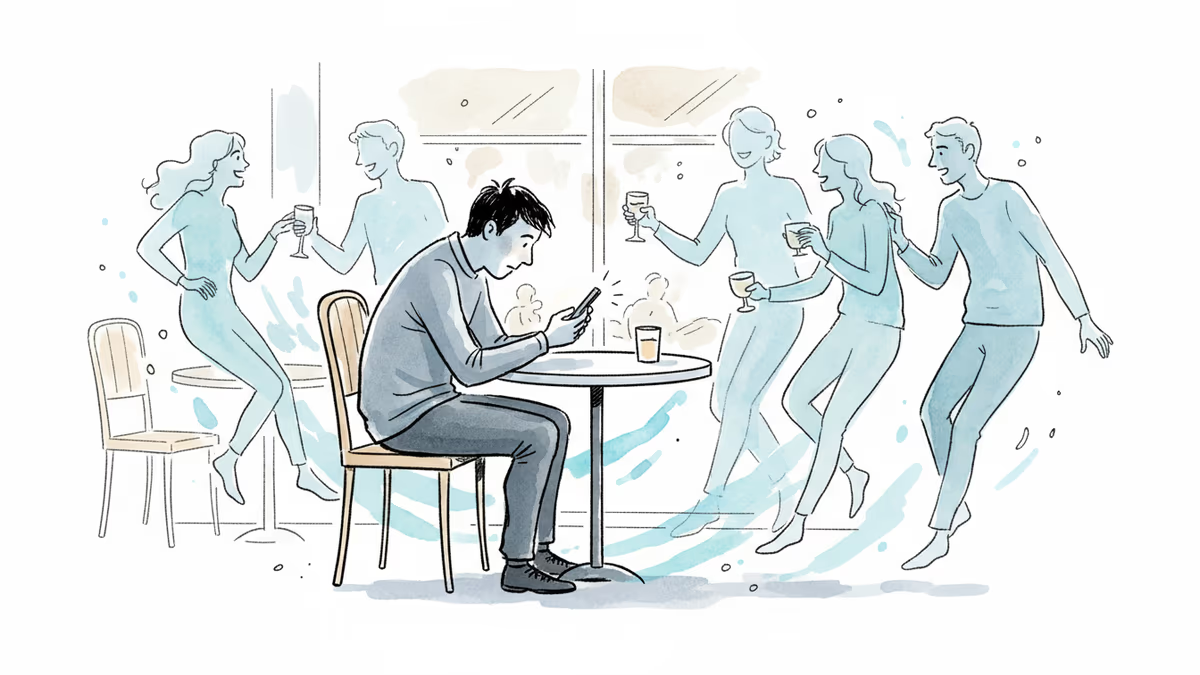
Can an App Actually Make You Friends?
Friendship apps generated $16M and 4.3M downloads in the US in 2025. As loneliness becomes a public health crisis, a new app category is betting that algorithms can do what organic adult life can't.
The Last Taboo in the App Store
You'd swipe right on a stranger for a date. But would you do the same for a friend? For most people, that still feels a little strange — and a growing number of entrepreneurs are betting that's exactly the gap worth closing.
In 2023, the U.S. Surgeon General declared loneliness a public health crisis, putting it on the same policy shelf as obesity and smoking. Two years later, the market has responded. According to Appfigures estimates, friendship and local community apps collectively pulled in roughly $16 million in U.S. consumer spending and 4.3 million downloads in 2025 alone. That's not Tinder money — but it's a category that, technically, didn't exist a decade ago.
Who's Actually Downloading These
The demand isn't coming from one demographic — it's coming from several at once, and that's what makes this interesting.
Remote workers who miss the low-stakes hallway conversations of office life. People who've moved to a new city in their 30s and found that making friends as an adult is, frankly, harder than anyone warned them. Empty nesters in their 40s and 50s whose social lives quietly hollowed out as kids left home. What unites them is a structural problem: most adult social infrastructure — school, college, early-career offices — disappears just when people stop being naturally thrown together.
The apps attack this awkwardness head-on. The whole premise is that everyone on the platform wants the same thing. No ambiguity, no mixed signals. Just people who've explicitly said: I want new friends.

The approaches vary widely. Timeleft drops five strangers into a restaurant every Wednesday at 7 p.m. — participants only learn each other's jobs and star signs the night before. 222 runs personality tests and invites matched groups to wine bars or comedy clubs, charging a $22.22 curation fee. Les Amís uses AI matching for women, trans, and LGBTQ+ users, connecting them through pottery classes and book clubs. Meet5, targeting users over 40, crossed from Europe to the U.S. and has already clocked 777,000 downloads stateside. Bumble's BFF, spun out from the dating giant in 2023, recently overhauled its design to push group meetups over one-on-one connections.
The Dating App Parallel — and Where It Breaks Down
It's tempting to map this onto the arc of online dating. Stigmatized, then normalized, then ubiquitous. The logic tracks: once Tinder made swiping on strangers socially acceptable, the psychological barrier to finding friends online dropped with it.
But there's a meaningful difference. Romantic chemistry has a clearer signal — you either feel it or you don't. Friendship is slower, more contextual, more dependent on repeated exposure over time. An algorithm can put two compatible people in the same room. It cannot make them show up a second time, or a third. The apps seem aware of this: almost all of them are built around recurring, structured events rather than one-off matches, precisely because frequency is what turns acquaintances into actual friends.
There's also a business model problem. Dating apps monetize urgency — users pay to find someone faster, then churn when they do. Friendship apps need their users to stay engaged even after they've made friends. That's a harder loop to design.
The Skeptic's Corner
Not everyone is convinced the category has legs. Critics point out that $16 million across a dozen apps is thin — that's less than a mid-tier mobile game makes in a month. Many of these apps are geographically limited: Mmotion is New York only, Washed Up is Los Angeles only, Clyx operates in just Miami and London. Scaling a hyperlocal social product is notoriously difficult, and the graveyard of failed local social apps — Google Nearby, Facebook Local, Nextdoor's various pivots — is long.
There's also the question of whether the problem is really a product problem at all. Some researchers argue that adult loneliness is structural — driven by car-dependent urban design, long working hours, and the erosion of third places like pubs, community centers, and religious institutions. If that's true, no app fixes it. The app just makes the symptom more manageable.
Authors
Related Articles
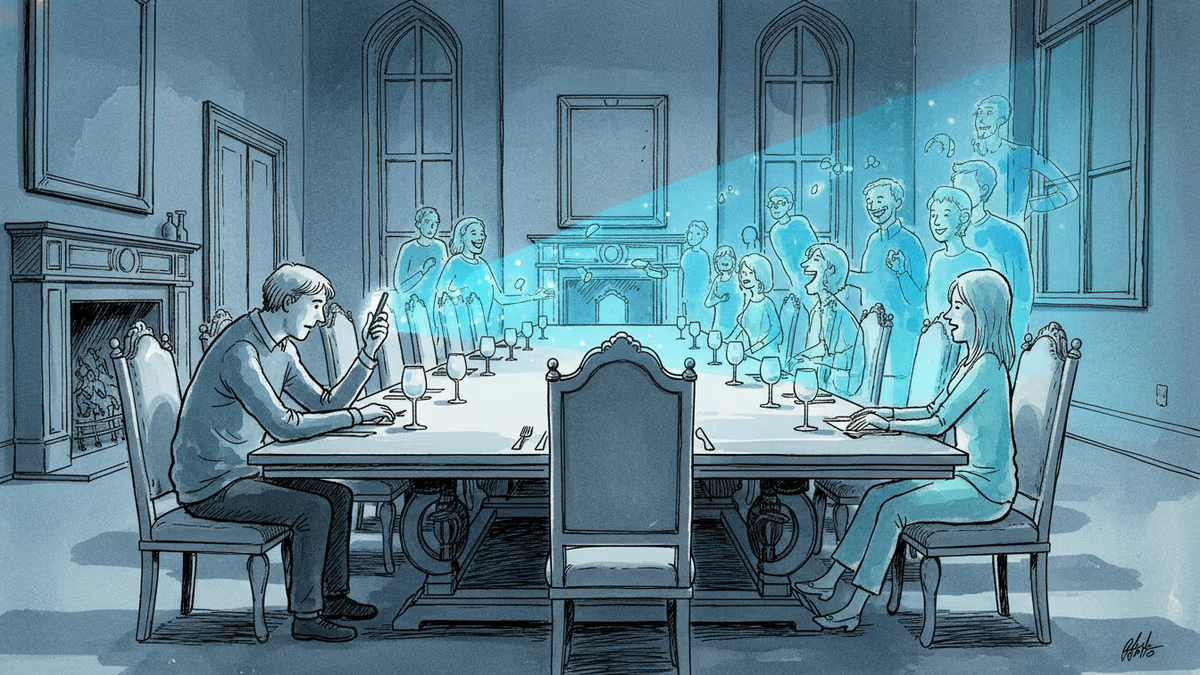
As loneliness hits crisis levels, a new wave of friendship apps is pulling in $16M and 4.3M downloads in the US alone. But can technology actually solve a human problem?

Five stories from late September, traced to where the paper trail stops: Korea's export record, Nvidia's Hugging Face 8-K, a US-China AI channel, the UN on AI, and rising births.

Huawei's CANN is open source under a license barring software for non-Ascend chips. Inside China's second CUDA, and the two links still outside it: pre-training compute and 5nm capacity.
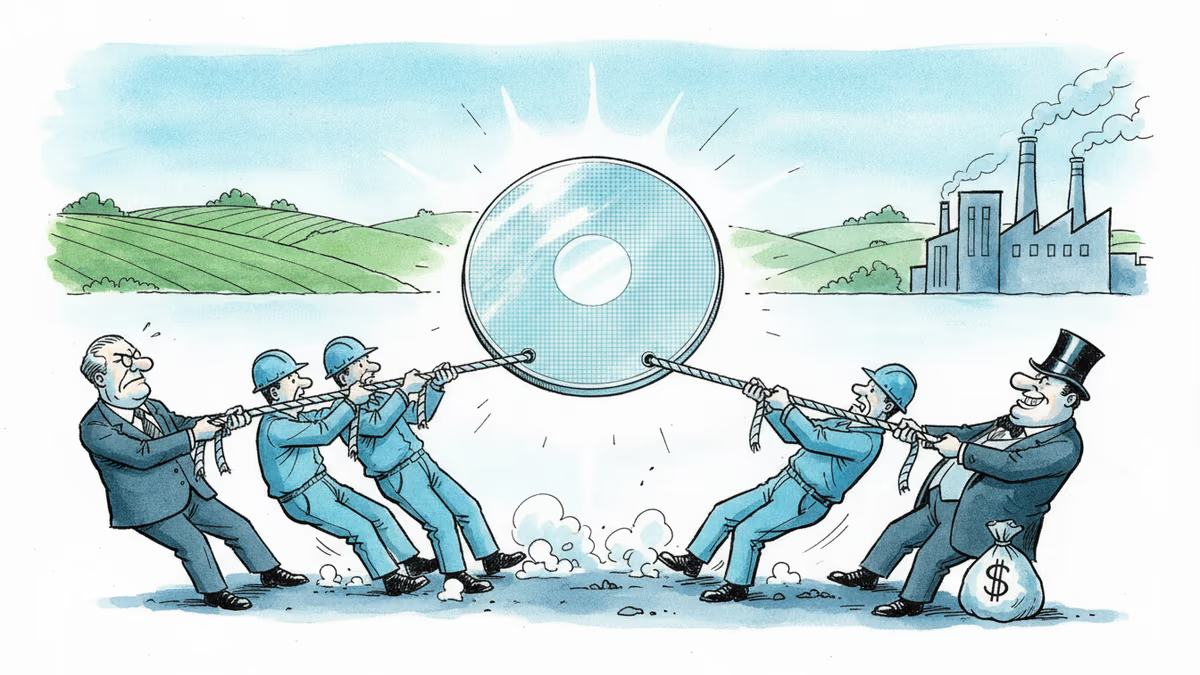
Samsung Electronics' union branch revealed that 84% of survey respondents oppose the government's roughly $290 billion (₩400 trillion) semiconductor megaproject in Gwangju. Government, management, the union and shareholders are all reading the same national project in sharply different ways.
As loneliness hits crisis levels, a new wave of friendship apps is pulling in $16M and 4.3M downloads in the US alone. But can technology actually solve a human problem?
Five stories from late September, traced to where the paper trail stops: Korea's export record, Nvidia's Hugging Face 8-K, a US-China AI channel, the UN on AI, and rising births.
Huawei's CANN is open source under a license barring software for non-Ascend chips. Inside China's second CUDA, and the two links still outside it: pre-training compute and 5nm capacity.
Samsung Electronics' union branch revealed that 84% of survey respondents oppose the government's roughly $290 billion (₩400 trillion) semiconductor megaproject in Gwangju. Government, management, the union and shareholders are all reading the same national project in sharply different ways.
Thoughts
Share your thoughts on this article
Sign in to join the conversation