
The Amputee Olympian Whose Competitors Use His Prosthetics
Snow cross racer Mike Schultz lost his leg in a crash, engineered his own high-performance prosthetics, and now even his competitors rely on his BioDapt technology to compete at elite levels
At 27, snow cross racer Mike Schultz earned the nickname "Monster Mike" for his legendary fearlessness. But one drift off course changed everything. Flying off his snowmobile, he obliterated his knee, spent days in a coma, and ultimately lost his leg to amputation.
Most people would've hung up their racing gear. Schultz engineered his own prosthetic knee instead.
Today, the founder of BioDapt doesn't just compete at the highest levels—he wins multiple Winter Paralympics and World Championships. More remarkably, his competitors use his prosthetics too. And sometimes, he fixes their gear right before races.
When Your Rival Builds Your Equipment
"You never get the temptation to 'fix' a competitor's Moto Knee?" I asked Schultz over Zoom from his 2026 Paralympic training camp, making a little wrenching gesture.
"I just tell them, 'Yeah, I'm sorry, there's actually a recall on this one. I'll get it back to you in April,'" he laughed. "Make sure you put the 'just kidding' part in when you write that!"
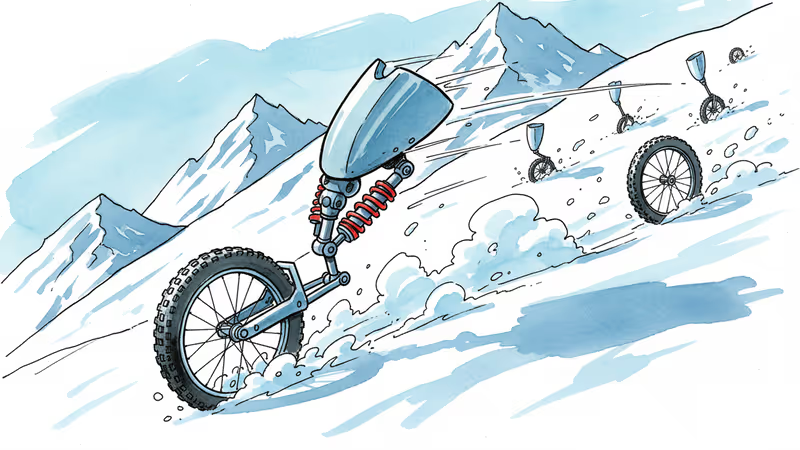
This isn't your typical prosthetic. Schultz's Moto Knee 2 uses mountain bike shocks and a patented linkage system designed for snowboard cross—a sport where you fly over jumps and take hairpin turns at 60+ mph. Regular prosthetics work fine for grocery shopping. They don't work for extreme sports where a quarter-turn adjustment on a set screw makes the difference between gold and crashing.
"The alignment is crucial, otherwise you're not going to be able to roll over to your toe edge or heel edge to make a turn," Schultz explains. "Changes in an angle by half or a quarter turn on a set screw are noticeable."
The Paradox of Competitive Advantage

Here's where it gets interesting: Schultz's prosthetics work so well that he now rides standard racing boards built to his dimensions. Early on, BioDapt experimented with custom boards to accommodate reduced ankle control. Not anymore.
"Right now, I'm running all the standard flex patterns," he says.
This creates a fascinating competitive dynamic. Schultz has essentially eliminated his own disadvantage so completely that his "adaptive" equipment performs at par with able-bodied athletes' gear. Meanwhile, other adaptive athletes—including his direct competitors—rely on his technology to compete.
Extreme athletes, amputees, and veterans all use BioDapt prosthetics. The company has carved out a niche that didn't exist before: high-performance prosthetics for people who refuse to slow down.
The Toolkit That Defines Elite Competition
Schultz travels with a complete toolkit and spare parts for both prostheses. "As an amputee athlete, my toolkit is extremely important," he says. He can rebuild his entire prosthetic system in five minutes if needed.
This isn't just preparation—it's survival strategy. When your competitive edge depends on precision engineering, equipment failure isn't just disappointing; it's potentially dangerous at racing speeds.
His gear bag also contains his Giro helmet with MIPS technology, a Gerber multi-tool for quick adjustments, and six Donek B-1 racing boards. But the most important item? A teddy bear.
Lucky Bear and the Psychology of Performance
When his daughter Lauren was 4 or 5 (she's 12 now), she snuck "Lucky Bear" into his competition bag. "I was like, man, he's this big!" Schultz gestures. "I don't have room for Lucky Bear! I gotta bring spare legs and stuff!"
Lauren's instinct proved right. Since Lucky Bear joined the team, Schultz has dominated adaptive snow bike, snow cross, snowboard cross, and motocross. Now Lauren, a competitive gymnast, carries her own mini Lucky Bear to competitions.
"The coolest part about Lucky Bear is now Lauren is competing in gymnastics, so she has her own mini Lucky Bear that goes into her backpack every time she competes," Schultz says. "And of course, they match. He has a big one, and she has a small one."
Authors
Related Articles
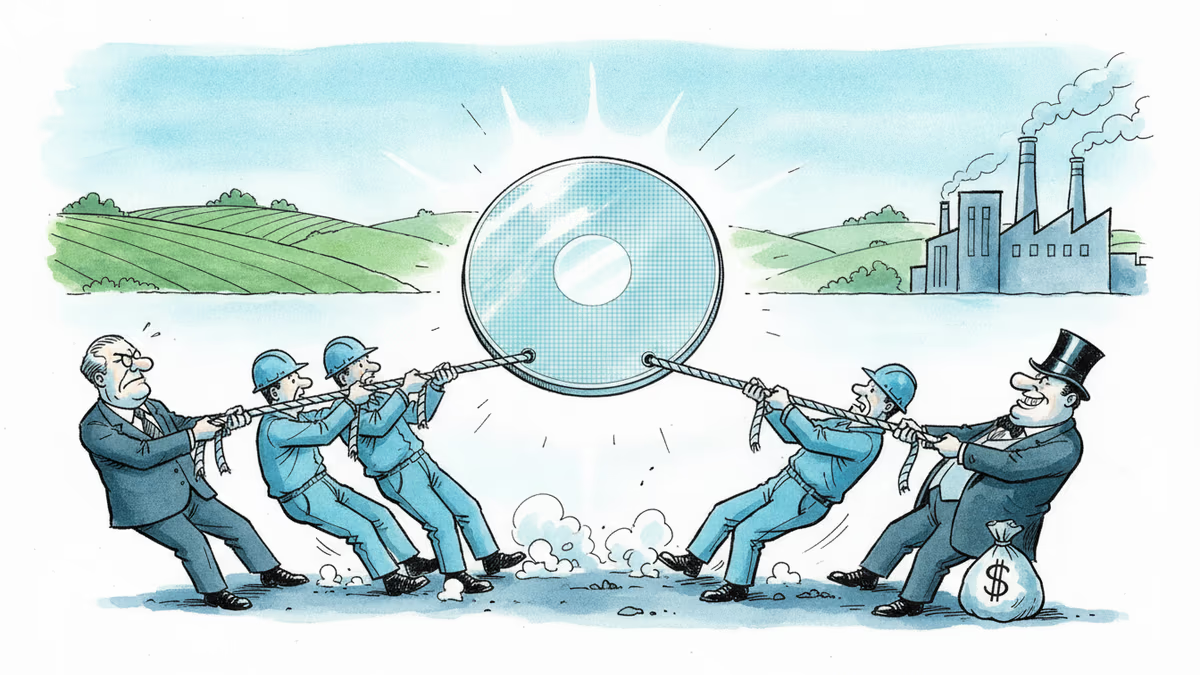
Samsung Electronics' union branch revealed that 84% of survey respondents oppose the government's roughly $290 billion (₩400 trillion) semiconductor megaproject in Gwangju. Government, management, the union and shareholders are all reading the same national project in sharply different ways.

Nvidia shipped roughly a billion RISC-V cores in 2024, then announced it would run CUDA on the open standard. We break down how royalty-free instruction sets and open software stacks are trying to route around CUDA's lock-in. Part 2 of the Semiconductor Sovereignty series.
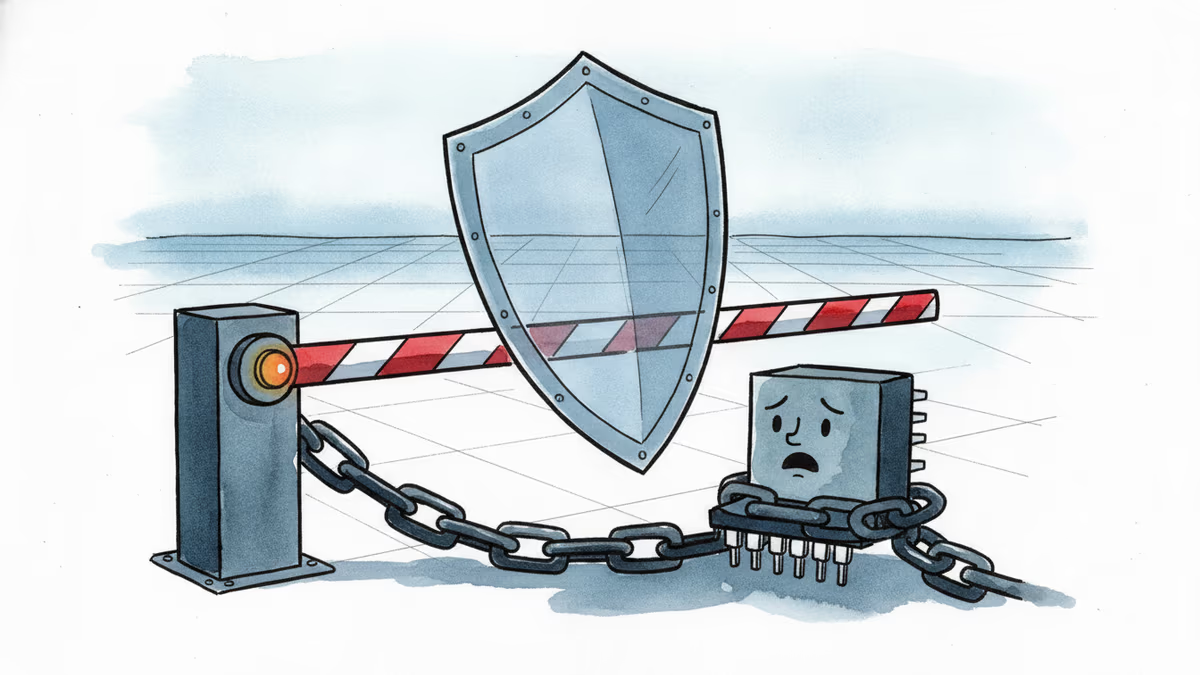
US AI-chip export controls split into three layers in the first half of 2026 — January easing, a May crackdown on circumvention, and a pending bill. Nvidia erased China from its guidance and still posted a record $81.6 billion quarter. A look at the export policy that both shields and cages it.

AMD's MI325X matches or beats Nvidia on memory and bandwidth — yet Nvidia's 86-92% share holds. The real moat is CUDA, 20 years in the making. Part 1 of 4.
Samsung Electronics' union branch revealed that 84% of survey respondents oppose the government's roughly $290 billion (₩400 trillion) semiconductor megaproject in Gwangju. Government, management, the union and shareholders are all reading the same national project in sharply different ways.
Nvidia shipped roughly a billion RISC-V cores in 2024, then announced it would run CUDA on the open standard. We break down how royalty-free instruction sets and open software stacks are trying to route around CUDA's lock-in. Part 2 of the Semiconductor Sovereignty series.
US AI-chip export controls split into three layers in the first half of 2026 — January easing, a May crackdown on circumvention, and a pending bill. Nvidia erased China from its guidance and still posted a record $81.6 billion quarter. A look at the export policy that both shields and cages it.
AMD's MI325X matches or beats Nvidia on memory and bandwidth — yet Nvidia's 86-92% share holds. The real moat is CUDA, 20 years in the making. Part 1 of 4.
Thoughts
Share your thoughts on this article
Sign in to join the conversation