
Aronofsky's AI History Series Sparks Creative Revolution Debate
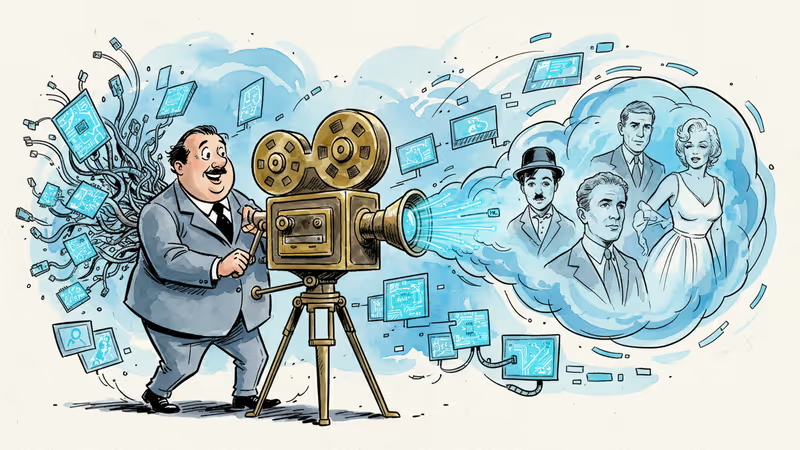
Darren Aronofsky's AI-generated Revolutionary War documentary divides critics and audiences. Is this the future of filmmaking or a cautionary tale about artificial creativity?
The acclaimed director behind Black Swan and The Wrestler just became the poster child for AI filmmaking's most contentious debate. Last week, Darren Aronofsky's AI studio Primordial Soup and Time magazine released the first episodes of "On This Day... 1776," a year-long series recreating moments from the American Revolution using artificial intelligence.
When Algorithms Meet History
The project promises 365 episodes documenting daily events from 250 years ago, featuring photorealistic avatars of George Washington, Thomas Paine, and Benjamin Franklin. Using what Time Studios describes as "a variety of AI tools," the series aims to bring Revolutionary War history to life in ways traditional filmmaking couldn't achieve.
Time Studios President Ben Bitonti positioned this as a glimpse into "thoughtful, creative, artist-led use of AI"—not replacing human craft but "expanding what's possible and allowing storytellers to go places they simply couldn't before." The ambition is clear: democratize historical storytelling by removing traditional production barriers.
Critics Draw Battle Lines
The response was swift and brutal. The AV Club slammed the "repetitive camera movements [and] waxen characters" that create "an ugly look at American history." CNET didn't mince words, calling it "AI slop" that's "ruining American history"—a "hellish broth of machine-driven AI slop and bad human choices."
The Guardian delivered perhaps the harshest verdict: "The once-lauded director of Black Swan and The Wrestler has drowned himself in AI slop," describing the series as "embarrassing," "terrible," and "ugly as sin."

The Uncanny Valley Problem
The criticism reveals a fundamental challenge facing AI-generated content: the uncanny valley effect. When technology creates something almost—but not quite—human, audiences often react with revulsion rather than wonder. The "waxen" quality critics describe suggests current AI tools still struggle with the subtle nuances that make characters feel authentically alive.
This isn't just an aesthetic problem—it's a storytelling one. Historical figures like Washington and Franklin carry enormous cultural weight. When AI renders them as unconvincing avatars, it risks trivializing the very history the project aims to illuminate.
Beyond the Hype Cycle
Yet dismissing this experiment entirely might miss its broader significance. Aronofsky's reputation as a serious filmmaker lends credibility to AI tools that are often associated with low-effort content creation. His involvement signals that established artists are taking these technologies seriously, even if early results disappoint.
The project also highlights AI's potential to tackle previously impossible creative challenges. Recreating 18th-century scenes with period-accurate detail would typically require massive budgets and extensive historical research. If AI tools can eventually deliver convincing results at a fraction of the cost, they could revolutionize documentary filmmaking and educational content.
The Creative Industries' Crossroads
This controversy reflects deeper tensions within creative industries grappling with AI adoption. Traditional craftspeople worry about job displacement, while tech enthusiasts promise democratized creativity. Aronofsky's series sits uncomfortably between these positions—created by an established filmmaker but producing results that critics find artistically bankrupt.
The timing is significant too. As Hollywood continues recovering from strikes partly triggered by AI concerns, high-profile projects like this become lightning rods for broader industry anxieties. Every AI-generated Washington or Franklin becomes a proxy for debates about human creativity's future.
Authors
Related Articles

Samsung and SK unveiled a chip and AI investment package worth thousands of trillions of won on June 29. The headline number swings wildly by outlet, but the real contest isn't capital — it's water and power.

Viral videos show 2026 graduates jeering executives who praise AI at commencement ceremonies. It's not just rudeness — it's a signal about who pays for technological optimism.

Filipino virtual assistants using AI to ghost-manage LinkedIn profiles for executives is now a structured industry. 30 comments a day, fake engagement rings, and a platform struggling to tell real from fabricated.
Two commencement speakers learned the hard way that AI enthusiasm doesn't land well with today's graduates. The backlash reveals a widening gap between tech optimism and Gen Z's economic reality.
Samsung and SK unveiled a chip and AI investment package worth thousands of trillions of won on June 29. The headline number swings wildly by outlet, but the real contest isn't capital — it's water and power.
Viral videos show 2026 graduates jeering executives who praise AI at commencement ceremonies. It's not just rudeness — it's a signal about who pays for technological optimism.
Filipino virtual assistants using AI to ghost-manage LinkedIn profiles for executives is now a structured industry. 30 comments a day, fake engagement rings, and a platform struggling to tell real from fabricated.
Two commencement speakers learned the hard way that AI enthusiasm doesn't land well with today's graduates. The backlash reveals a widening gap between tech optimism and Gen Z's economic reality.
Thoughts
Share your thoughts on this article
Sign in to join the conversation