
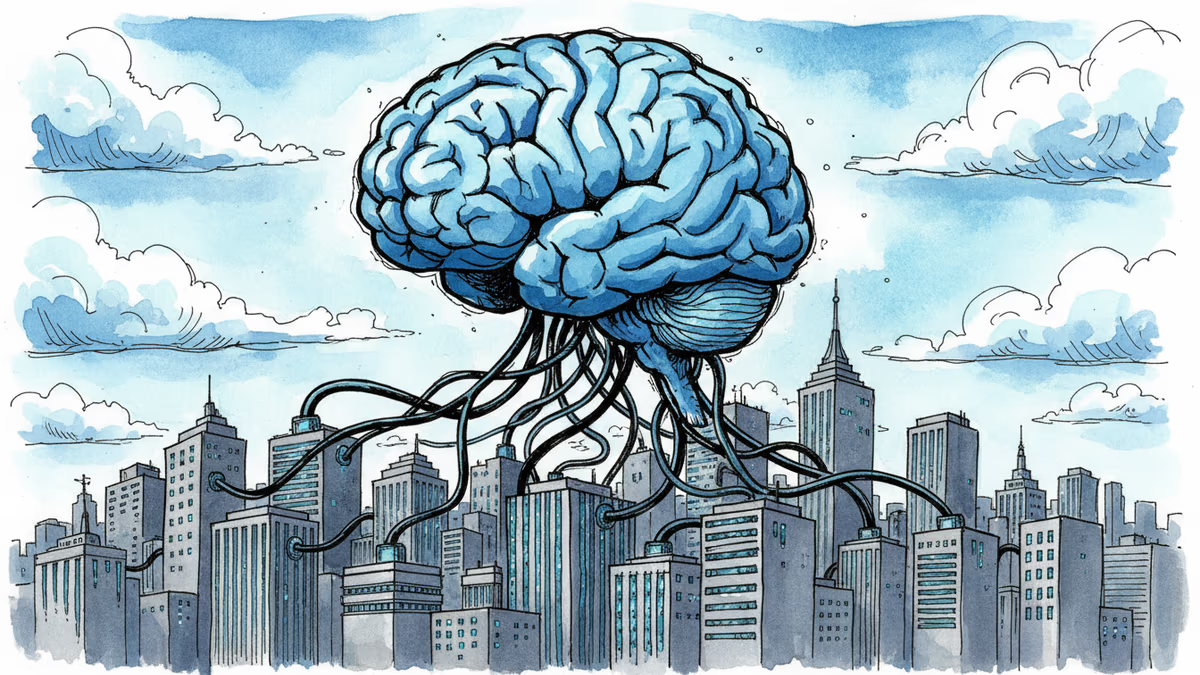
Who Will Own the AI Brain That Runs Your Company?
Glean's $7.2B valuation reveals the hidden battle for enterprise AI infrastructure. As AI agents replace chatbots, the real question isn't which AI is best—it's whose ecosystem you'll join.
$7.2 billion. That's what investors think Glean is worth—a company that started as enterprise search. How does a search startup command such a valuation? Because we're witnessing a fundamental shift: AI is moving from answering questions to actually doing the work, and someone needs to be the brain that powers it all.
From Search to Work: The AI Evolution
Glean CEO Arvind Jain recently outlined this transformation at Web Summit Qatar. "Enterprise AI is shifting fast from chatbots that answer questions to systems that actually do the work across an organization," he explained. This isn't just incremental improvement—it's a complete reimagining of how businesses operate.
Consider the difference: Instead of asking "Where's that email from last month?" employees now say "Prepare the board presentation for next week." The AI doesn't just find information; it synthesizes data, creates documents, coordinates with team members, and manages the entire workflow. But here's the catch: for this to work, something needs to connect all the dots.
The Invisible War for AI Infrastructure
This is where the real battle lies. Glean positions itself as an "AI work assistant" that sits underneath other AI experiences—connecting to internal systems, managing permissions, and delivering intelligence wherever employees work. It's the plumbing that nobody sees but everyone depends on.
Microsoft, Google, and Amazon are aggressively bundling AI into their existing enterprise suites. They already have deep hooks into corporate data through cloud services, email systems, and productivity tools. Their pitch is simple: why complicate things with another vendor?

But specialized players like Glean counter with neutrality. "We're not trying to lock you into our word processor or email system," they argue. "We just want to make your existing tools smarter." The $150 million funding round suggests investors see merit in this approach.
The Consolidation Question
What's driving this intense competition? The stakes are enormous. Whoever controls the AI infrastructure layer doesn't just win a software contract—they become integral to how organizations think, decide, and execute. It's the difference between selling a tool and becoming the nervous system.
The enterprise software market has always favored consolidation. CIOs prefer fewer vendors, simpler contracts, and integrated experiences. But AI introduces new variables: data privacy, algorithmic transparency, and vendor lock-in concerns that weren't as critical in the pre-AI era.
Salesforce learned this lesson when it acquired Slack and integrated AI across both platforms. ServiceNow is doing something similar with workflow automation. The message is clear: in the AI age, point solutions may not survive.
Hype vs. Reality in the Agent Space
Jain acknowledges the elephant in the room: agent hype. "There's definitely excitement about AI agents, but we need to separate what's real from what's marketing," he notes. The reality is messier than the demos suggest.
Current AI agents excel at well-defined tasks with clear parameters. They struggle with ambiguity, context switching, and the kind of nuanced judgment that defines knowledge work. The most successful implementations aren't replacing humans—they're augmenting specific workflows where the AI can operate within guardrails.
This creates an interesting dynamic. Companies that promise too much too soon risk customer backlash. Those that under-promise might miss the window entirely. The winners will likely be those who nail the "boring" infrastructure work while others chase flashy demos.
Authors
Related Articles

Across America, data centers face fierce opposition while the factories that supply them sail through approvals. This selective resistance reveals a strategic blind spot.

Five stories from late September, traced to where the paper trail stops: Korea's export record, Nvidia's Hugging Face 8-K, a US-China AI channel, the UN on AI, and rising births.

Huawei's CANN is open source under a license barring software for non-Ascend chips. Inside China's second CUDA, and the two links still outside it: pre-training compute and 5nm capacity.
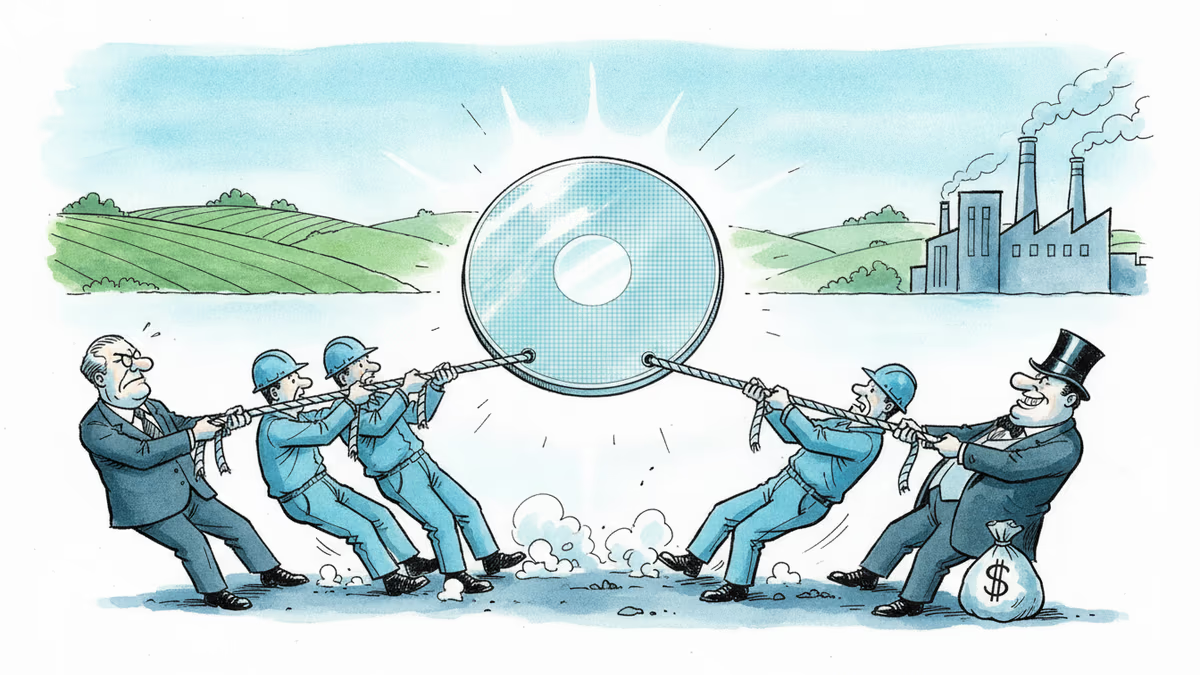
Samsung Electronics' union branch revealed that 84% of survey respondents oppose the government's roughly $290 billion (₩400 trillion) semiconductor megaproject in Gwangju. Government, management, the union and shareholders are all reading the same national project in sharply different ways.
Across America, data centers face fierce opposition while the factories that supply them sail through approvals. This selective resistance reveals a strategic blind spot.
Five stories from late September, traced to where the paper trail stops: Korea's export record, Nvidia's Hugging Face 8-K, a US-China AI channel, the UN on AI, and rising births.
Huawei's CANN is open source under a license barring software for non-Ascend chips. Inside China's second CUDA, and the two links still outside it: pre-training compute and 5nm capacity.
Samsung Electronics' union branch revealed that 84% of survey respondents oppose the government's roughly $290 billion (₩400 trillion) semiconductor megaproject in Gwangju. Government, management, the union and shareholders are all reading the same national project in sharply different ways.
Thoughts
Share your thoughts on this article
Sign in to join the conversation