
OpenAI's GPT-5.2 Isn't About Better Chat—It's About Replacing Your Workflow
OpenAI's GPT-5.2 is more than a model upgrade. Our expert analysis reveals why its focus on 'reliable agentic workflows' is a direct threat to the SaaS market.
The Lede: The Agentic Shift is Here
OpenAI's announcement of GPT-5.2 is not another incremental chatbot upgrade. The key phrase in the release—"faster, more reliable agentic workflows"—is a strategic declaration. It signals a deliberate pivot from conversational AI to autonomous systems, a move designed to transform AI from a tool you consult into a workforce you deploy. For executives and investors, this isn't about better prose; it's about the dawn of a new operational paradigm that could dismantle the existing enterprise software market.
Why It Matters: Beyond the Hype
The significance of GPT-5.2 lies not in its raw intelligence, but in its purported reliability for autonomous tasks. For years, AI's unpredictability—its tendency to "hallucinate" or fail on multi-step processes—has been the primary barrier to enterprise-level automation. By explicitly targeting "reliable agentic workflows," OpenAI is aiming to solve the billion-dollar bottleneck holding back true AI integration in business.
The second-order effects are profound:
- The SaaS Threat: If a reliable AI agent can manage a sales pipeline, process customer service tickets, or orchestrate cloud infrastructure via natural language prompts, what is the long-term value proposition for specialized SaaS platforms like Salesforce, Zendesk, or even ServiceNow? GPT-5.2 positions the AI model as the platform, not just an integration.
- Redefining Productivity: The focus shifts from human-computer interaction to human-agent delegation. Professionals will evolve from being 'doers' to 'directors' of AI agents, managing a fleet of digital workers to execute complex tasks.
- The Talent Arms Race: The demand for developers will not be just for those who can call an API, but for those who can architect, manage, and debug complex, multi-agent systems. This creates a new, more advanced tier of AI engineering.
The Analysis: From Prompt-and-Response to Autonomous Action

"Reliability": The Only Word That Matters
Historically, large language models have been masters of probabilistic generation, not deterministic execution. GPT-3 was a creative marvel; GPT-4 brought advanced reasoning. But both struggled with the consistency required for mission-critical business processes. A model that is 95% accurate is impressive for drafting emails but catastrophic for processing financial transactions. OpenAI's emphasis on "reliability" suggests a focus on architectural changes that reduce randomness and improve procedural accuracy, a necessary precondition for building trust with enterprise clients.
The Competitive Landscape Realigns
This move is a direct challenge to competitors like Google and Anthropic. The race is no longer just about token count, context windows, or benchmark scores. The new competitive frontier is the agentic layer—the framework for making models act. While Google has its powerful Gemini model and deep enterprise roots with Google Cloud, and Anthropic has focused on safety and steerability, OpenAI is attempting to frame the narrative around a new category: the AI-native workflow. Rivals will be forced to respond not just with better models, but with their own robust agent-building platforms and a credible story on reliability.
Investment Thesis: The Platform vs. The Application
The announcement of GPT-5.2 should trigger a re-evaluation of investment theses across the tech landscape. The value is likely to accrue to the foundational model providers who can successfully build an agentic ecosystem (like an 'App Store' for AI agents). Companies building thin wrappers or single-function AI tools are at high risk of being commoditized. The defensible businesses will be those that either own the foundational model or use AI agents to create a defensible, real-world service that is difficult to replicate (e.g., logistics, robotics, complex physical services).
Guidance for CTOs and Developers
Stop thinking in API calls; start thinking in workflows. The advent of reliable agents means the fundamental unit of work is shifting. Instead of building applications that make discrete calls for text generation or data analysis, the new task is to architect systems that can hand off an entire business objective to an AI agent. CTOs should be sanctioning pilot projects now to identify which internal workflows (e.g., lead qualification, bug report triage, market research synthesis) are prime candidates for agentic automation. The question is no longer "How can AI help this task?" but "Can an AI agent own this entire process?"
PRISM's Take
GPT-5.2, as presented, is the clearest signal yet that the AI industry is graduating from its experimental phase into its industrial-scale deployment phase. The shift from conversational partner to autonomous worker is not a futuristic concept; it is the stated product direction of the market leader. This model isn't an upgrade—it's an economic catalyst. Businesses that treat it as a better chatbot will be left behind by competitors who recognize it as the foundation for a new, automated, and far more efficient operational workforce.
This content is AI-generated based on source articles. While we strive for accuracy, errors may occur. We recommend verifying with the original source.
Related Articles
OpenAI is closing its Sora video generation app less than two years after its splashy debut. The move raises hard questions about AI product longevity, creator trust, and where the video AI race is really headed.
Anthropic's Claude Code and Cowork can now directly control your Mac desktop—clicking, scrolling, and navigating files. As AI agents race to take over local computers, what are the real implications?
Sam Altman thanked developers for writing code the hard way. The same week, Amazon cut 16,000 jobs. What does gratitude mean when the grateful party built the replacement?
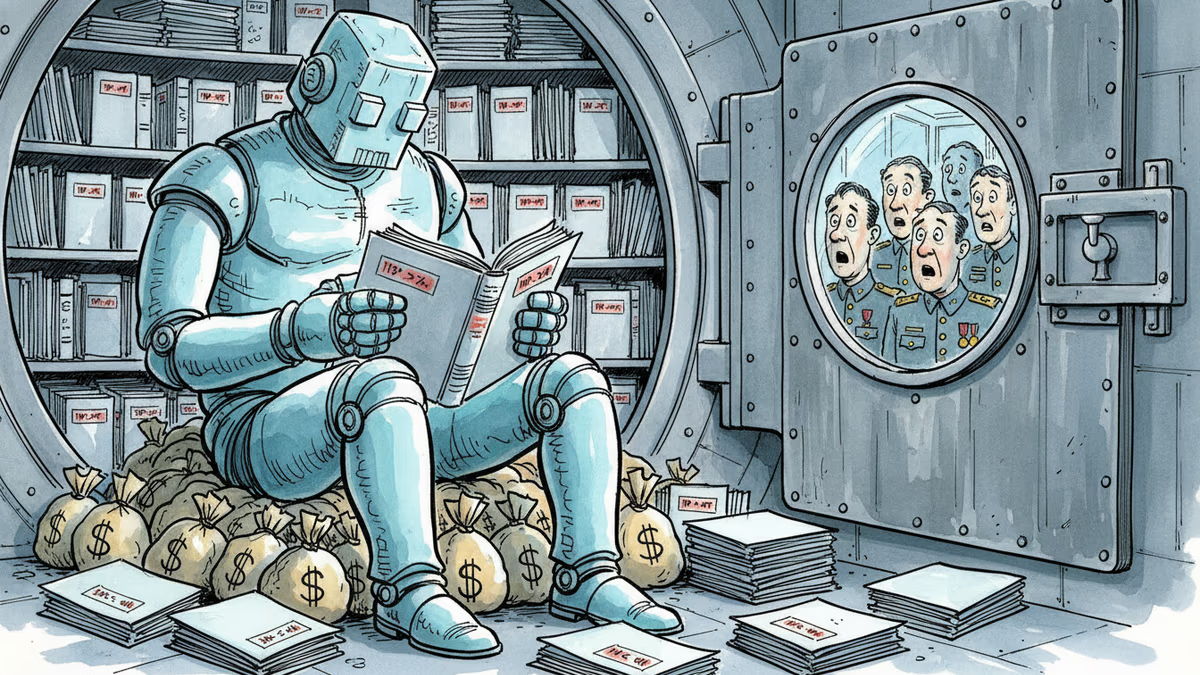
The Pentagon is exploring training AI models like OpenAI and xAI on classified military data. As tensions with Iran escalate, the plan raises urgent questions about security, accountability, and the future of AI in warfare.
OpenAI is closing its Sora video generation app less than two years after its splashy debut. The move raises hard questions about AI product longevity, creator trust, and where the video AI race is really headed.
Anthropic's Claude Code and Cowork can now directly control your Mac desktop—clicking, scrolling, and navigating files. As AI agents race to take over local computers, what are the real implications?
Sam Altman thanked developers for writing code the hard way. The same week, Amazon cut 16,000 jobs. What does gratitude mean when the grateful party built the replacement?
The Pentagon is exploring training AI models like OpenAI and xAI on classified military data. As tensions with Iran escalate, the plan raises urgent questions about security, accountability, and the future of AI in warfare.
Thoughts
Share your thoughts on this article
Sign in to join the conversation