
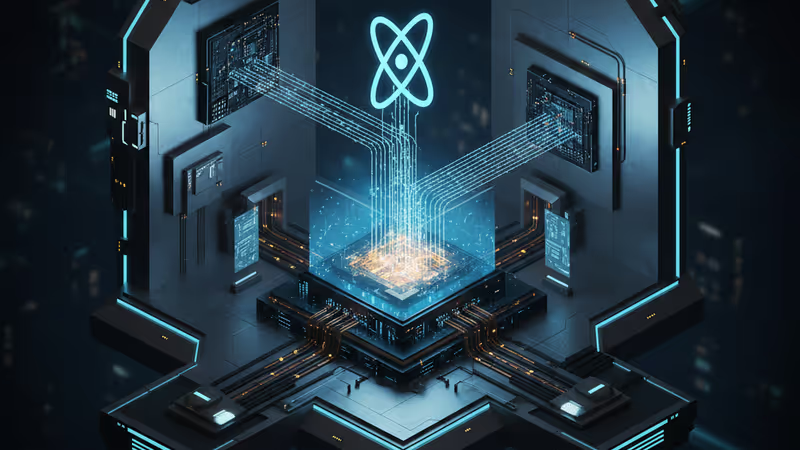
OpenAI’s Federal Gambit: Why the DOE Pact is AI's 'National Lab' Moment
OpenAI's partnership with the US Department of Energy isn't just a deal. It's a strategic move that recasts AI as national infrastructure. PRISM analyzes the impact.
The Lede: Beyond the Press Release
OpenAI's new partnership with the U.S. Department of Energy (DOE) is far more than a standard public-private collaboration. For the busy executive, this signals the formal anointing of a leading AI company as a strategic national asset. This isn't about running Office 365 on government servers; it's about embedding the world's most advanced AI deep within America's scientific and national security apparatus. This memorandum is a foundational brick in building a 21st-century techno-industrial complex, directly linking Silicon Valley's AI frontier to the nation's highest-stakes research.
Why It Matters: The Second-Order Effects
The immediate goal is to apply AI to grand challenges like climate science, fusion energy, and materials discovery. But the strategic implications ripple much further:
- A New Pace for Science: The DOE's national labs possess some of the world's most powerful supercomputers and unique, massive datasets—from particle physics to grid modeling. Coupling this with OpenAI's models creates a feedback loop that could fundamentally accelerate the pace of scientific discovery, turning research cycles that took years into months.
- The Geopolitical Chessboard: This is a direct response to state-driven AI initiatives in China and elsewhere. By integrating a private-sector champion like OpenAI, the U.S. is creating a powerful, agile alternative to a purely state-controlled model, betting that this hybrid approach will out-innovate rivals in critical domains like energy independence and next-gen computing.
- Setting the Governance Blueprint: How this partnership handles data security, intellectual property, and ethical oversight for powerful AI will create the de facto standard for all future collaborations between Big Tech and sensitive government agencies. It’s a test case with national security implications.
The Analysis: Historical Echoes and Competitive Moats

This isn't the first time the U.S. government has partnered with private industry to secure a technological edge. The collaboration echoes the public-private synergy of the 20th century—think Bell Labs working on defense communications or the aerospace industry's role in the space race. What's different now is the nature of the asset: not just hardware or manufacturing, but a self-improving intelligence layer.
For OpenAI, this is a profound competitive advantage. While rivals like Google DeepMind and Anthropic also pursue scientific applications, this DOE pact grants OpenAI privileged access to:
- Unique, High-Stakes Problems: Working on grid resilience or nuclear stockpile stewardship provides training challenges far beyond commercial applications.
- Unrivaled Datasets: The sheer volume and quality of data generated by national labs is a moat that cannot be easily replicated.
- Institutional Legitimacy: Being a trusted partner of the DOE elevates OpenAI's status, making it the default choice for other sensitive government and industrial applications.
- AI-Native Simulation: Companies creating platforms that replace or augment traditional scientific simulation software with faster, AI-driven models.
- Specialized Application Layers: Startups building tools that fine-tune models like GPT-4 for specific scientific domains, from drug discovery to materials science.
- Secure Infrastructure: The need for secure, verifiable, and auditable AI infrastructure for government use will become a multi-billion dollar market in itself.
This move signals a shift from AI's first act (consumer apps and business automation) to its second, more profound act: AI as a tool for fundamental discovery.
PRISM's Take: The Blurring Line
This alliance between OpenAI and the DOE marks a critical juncture. It's the moment the line between a commercial technology company and critical national infrastructure becomes irrevocably blurred. While the potential for scientific breakthroughs is immense, it also concentrates enormous power and influence within a single corporate entity. The key challenge for policymakers will be to harness this innovative power without sacrificing public oversight. This isn't just a technology story; it’s a story about the evolving relationship between private innovation and the public good in an age of intense technological competition. We are witnessing the playbook for 21st-century industrial strategy being written in real-time.
Authors
Related Articles

OpenAI has reorganized for the second time in a month, merging ChatGPT and Codex into a single agentic platform under president Greg Brockman's unified product leadership.
After two weeks of witnesses calling him a liar, OpenAI CEO Sam Altman testified in his own defense, claiming Elon Musk tried to kill the company twice.

Sam Nelson, 19, died after following ChatGPT's advice to mix Kratom and Xanax. His parents are suing OpenAI for wrongful death, raising urgent questions about AI trust, liability, and design.
OpenAI's new Daybreak initiative uses the Codex AI agent to find and patch security vulnerabilities before attackers do—putting it in direct competition with Anthropic's secretive Claude Mythos.
OpenAI has reorganized for the second time in a month, merging ChatGPT and Codex into a single agentic platform under president Greg Brockman's unified product leadership.
After two weeks of witnesses calling him a liar, OpenAI CEO Sam Altman testified in his own defense, claiming Elon Musk tried to kill the company twice.
Sam Nelson, 19, died after following ChatGPT's advice to mix Kratom and Xanax. His parents are suing OpenAI for wrongful death, raising urgent questions about AI trust, liability, and design.
OpenAI's new Daybreak initiative uses the Codex AI agent to find and patch security vulnerabilities before attackers do—putting it in direct competition with Anthropic's secretive Claude Mythos.
Thoughts
Share your thoughts on this article
Sign in to join the conversation