
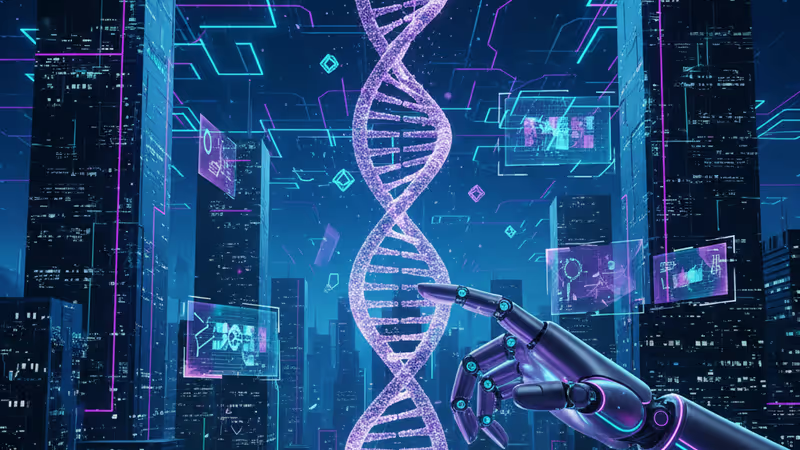
Chai Discovery Eli Lilly AI drug discovery: A $1.3 billion leap for biotech
Chai Discovery lands a $1.3B valuation and partners with Eli Lilly for AI-powered drug discovery. Explore the OpenAI-backed startup's journey and its Chai-2 algorithm.
In just over 12 months, Chai Discovery has gone from a stealthy startup to a $1.3 billion heavyweight. By securing $130 million in Series B funding this December, the company is positioning itself as the "CAD suite" for molecular design, aiming to replace expensive trial-and-error with precision AI.
The Chai Discovery Eli Lilly AI drug discovery deal
Last Friday, the startup announced a milestone partnership with pharmaceutical giant Eli Lilly. Lilly will utilize Chai’s flagship algorithm, Chai-2, to design therapeutic antibodies—the specialized proteins used to combat complex diseases. This collaboration isn't just a pilot; it's a strategic move to push the frontier of how generative AI can build better molecules from scratch.

Born from the OpenAI inner circle
Chai’s rapid ascent is no accident. Co-founders Josh Meier and Jack Dent have deep ties to OpenAI and its CEO, Sam Altman. Meier, a former OpenAI researcher, was encouraged by Altman years ago to start a proteomics firm. OpenAI eventually became an early investor, even providing office space in San Francisco during the company's infancy. Meier’s previous work at Facebook on the ESM1 protein-language model serves as the technological precursor to Chai’s current innovations.
| Entity | Partnership Role | Value/Focus |
|---|---|---|
| Eli Lilly | Strategic Partner | Antibody Design |
| Nvidia | Co-innovation Lab | $1 Billion investment |
| OpenAI | Seed Investor | Early support & space |
Authors
Related Articles
CAR T cell therapy, proven in blood cancers, is now in hundreds of clinical trials for MS, lupus, and other autoimmune conditions. What the science shows—and what it doesn't yet.
R3 Bio wants to grow human bodies without brains as biological backups. The science is speculative. The ethics are explosive. And the legal framework doesn't exist yet.
Colossal Biosciences raised hundreds of millions to resurrect woolly mammoths and dire wolves. What they're actually doing is more complicated—and more interesting.
Elon Musk and Sam Altman head to trial this week in a case that could determine whether OpenAI survives as a for-profit company—and who leads it. Here's what's really at stake.
CAR T cell therapy, proven in blood cancers, is now in hundreds of clinical trials for MS, lupus, and other autoimmune conditions. What the science shows—and what it doesn't yet.
R3 Bio wants to grow human bodies without brains as biological backups. The science is speculative. The ethics are explosive. And the legal framework doesn't exist yet.
Colossal Biosciences raised hundreds of millions to resurrect woolly mammoths and dire wolves. What they're actually doing is more complicated—and more interesting.
Elon Musk and Sam Altman head to trial this week in a case that could determine whether OpenAI survives as a for-profit company—and who leads it. Here's what's really at stake.
Thoughts
Share your thoughts on this article
Sign in to join the conversation