
The $400 Billion AI Market Just Got Its First Real Challenger
Current AI's open-source device challenges Big Tech's AI monopoly with offline capabilities and 22 Indian languages. Could this spark a new era of decentralized AI?
A $400 Million David Faces Goliath
A small black device picked its favorite candy bar at the India AI Impact Summit last month. "Twix," it declared after scanning the table. This wasn't just another AI demo—it was a declaration of war against Big Tech's AI monopoly.
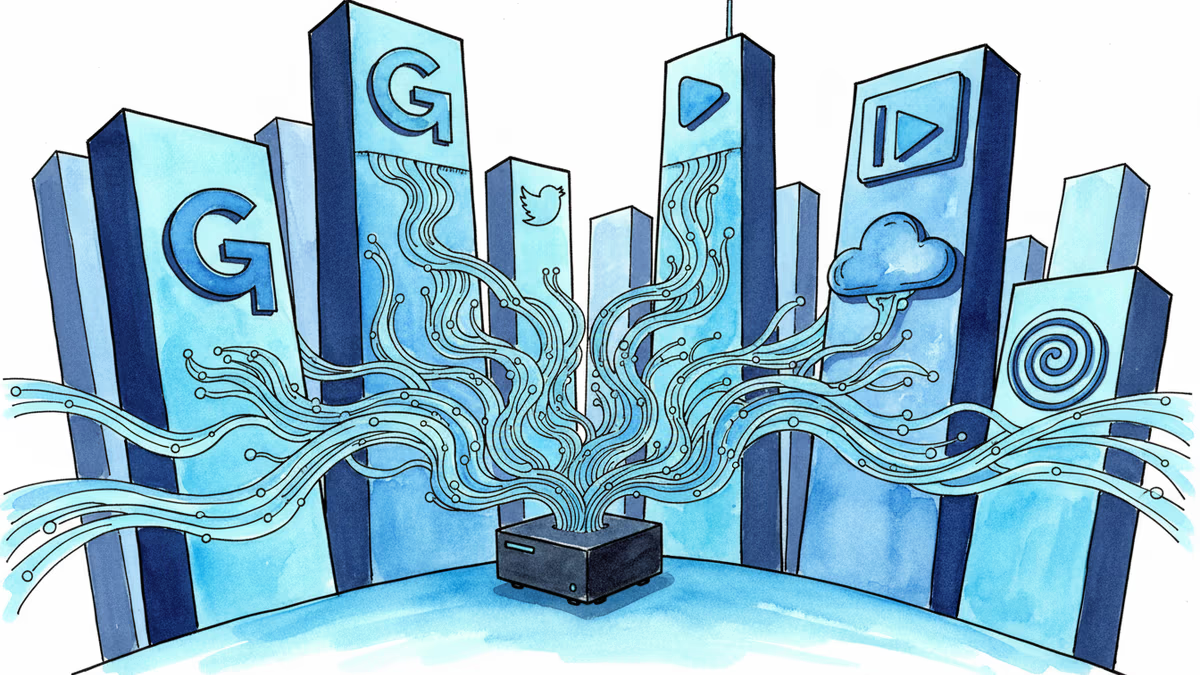
The device, built by Current AI (a $400 million public-interest partnership), does something radical: it works completely offline while supporting 22 Indian languages. No cloud dependency. No data harvesting. No Silicon Valley gatekeepers.
Why does this matter? Because every AI device entering your home today—from smart glasses to butler robots—is recording you constantly and sending your data to corporate clouds. Current AI CEO Ayah Bdeir calls this the end of "abstract AI" and the beginning of something far more personal and potentially invasive.
The Internet's Cautionary Tale
"The internet, when first conceived, was open and free," Bdeir reflects. "Anyone could develop their own website, start their business, create their own community. Gradually, it became a walled garden."
That transformation took 20 years. AI's consolidation is happening faster. Google, Amazon, Microsoft, and Meta already control the infrastructure, data, and distribution channels. Current AI's response? Build an alternative before it's too late.
The demonstration was deliberately targeted at the visually impaired—a community often overlooked by mainstream tech. Users asked questions like "What do you see in front of me?" in Hindi and English, receiving detailed answers despite running on limited hardware with no internet connection. Shailendra Pal Singh from the Indian government's Bhashini project confirmed zero accuracy loss compared to cloud-based systems.
Three Strategies for AI Democracy

Current AI operates on three fronts: funding public-interest AI research, building in areas too unprofitable for private investment, and creating infrastructure to coordinate decentralized innovation.
The third point is crucial. "There's already a lot of interesting public-interest AI work," Bdeir explains. "It's just decentralized and not coordinated." Think of it as the difference between scattered resistance movements and an organized revolution.
The organization plans to release full open-source designs on GitHub. Andrew Tergis, the engineer who led the project, envisions anyone being able to "connect to this device, write their own application, pull any number of models onto it, and run inference locally in their hand."
The Frugal AI Revolution
Current AI champions what Bdeir calls "frugal AI"—a direct challenge to Big Tech's "bigger is better" philosophy. While companies race to build the largest data centers and most powerful models, Current AI asks: what about the 3.8 billion people in low-connectivity areas?
This isn't just about technical specs. It's about who gets to participate in the AI future. When AI requires massive cloud infrastructure, only the wealthiest companies and countries can play. When AI runs on a handheld device, the game changes entirely.
The timing isn't coincidental. Political instability and Big Tech overreach have created what Bdeir calls "disenchantment" with current AI development. People want alternatives in ways they "perhaps weren't before."
Beyond Language: Culture Preservation
Current AI's focus extends beyond linguistic diversity to "culture preservation." This matters because AI training data predominantly reflects Western perspectives and values. When AI systems make decisions about content moderation, hiring, or healthcare, whose cultural norms are they applying?
The collaboration with India's Bhashini project—supporting 22 Indian languages—demonstrates this philosophy in action. It's not just about translation; it's about ensuring AI understands context, nuance, and cultural meaning across different communities.
Authors
Related Articles

Samsung and SK unveiled a chip and AI investment package worth thousands of trillions of won on June 29. The headline number swings wildly by outlet, but the real contest isn't capital — it's water and power.

Viral videos show 2026 graduates jeering executives who praise AI at commencement ceremonies. It's not just rudeness — it's a signal about who pays for technological optimism.

Filipino virtual assistants using AI to ghost-manage LinkedIn profiles for executives is now a structured industry. 30 comments a day, fake engagement rings, and a platform struggling to tell real from fabricated.
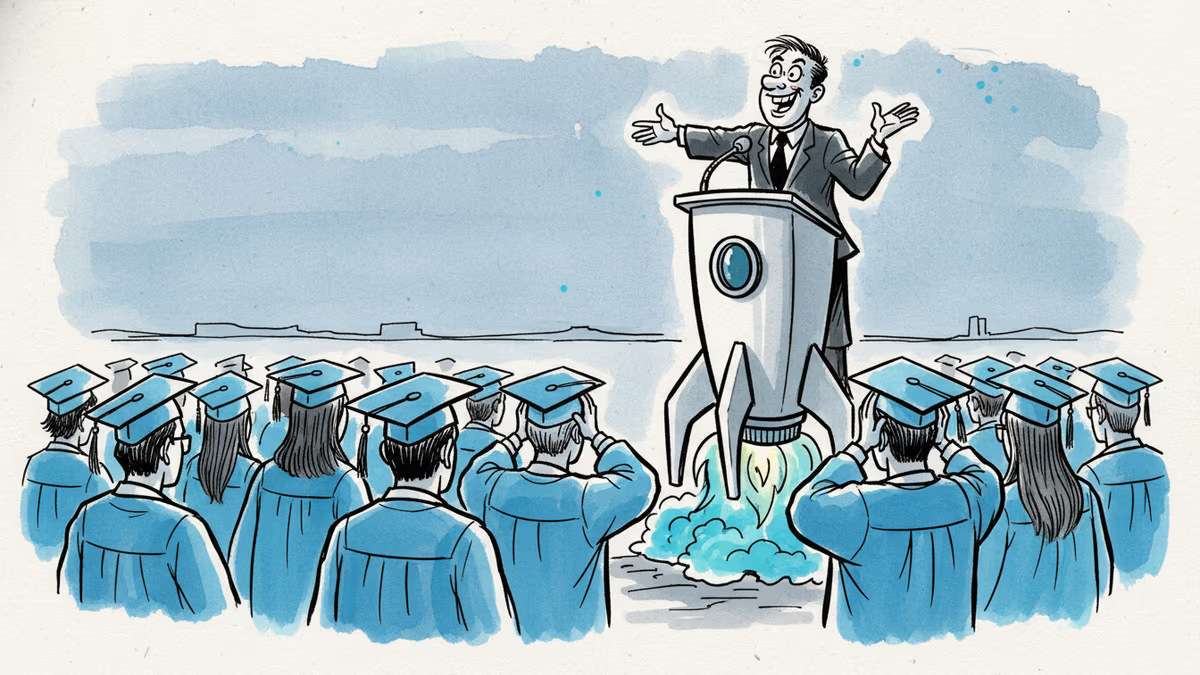
Two commencement speakers learned the hard way that AI enthusiasm doesn't land well with today's graduates. The backlash reveals a widening gap between tech optimism and Gen Z's economic reality.
Samsung and SK unveiled a chip and AI investment package worth thousands of trillions of won on June 29. The headline number swings wildly by outlet, but the real contest isn't capital — it's water and power.
Viral videos show 2026 graduates jeering executives who praise AI at commencement ceremonies. It's not just rudeness — it's a signal about who pays for technological optimism.
Filipino virtual assistants using AI to ghost-manage LinkedIn profiles for executives is now a structured industry. 30 comments a day, fake engagement rings, and a platform struggling to tell real from fabricated.
Two commencement speakers learned the hard way that AI enthusiasm doesn't land well with today's graduates. The backlash reveals a widening gap between tech optimism and Gen Z's economic reality.
Thoughts
Share your thoughts on this article
Sign in to join the conversation