
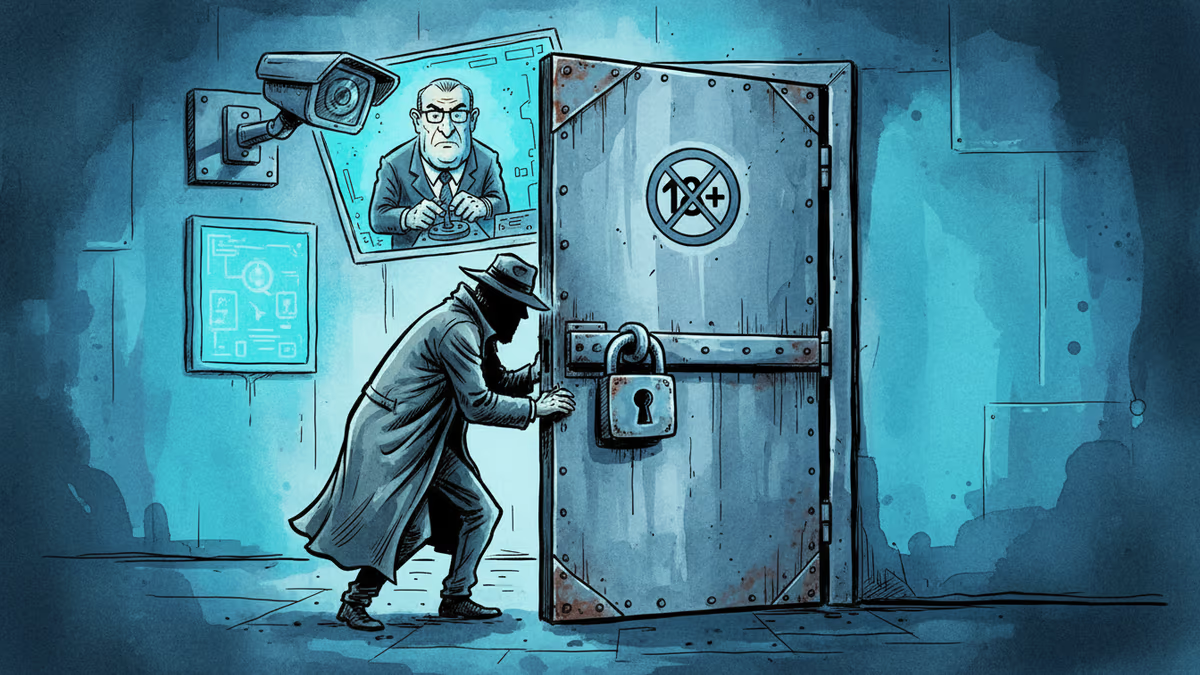
VPNs Are Now a Political Act
Age verification laws are turning VPNs from a niche privacy tool into everyday infrastructure. What happens when governments decide to shut the door?
VPN app downloads spike every time a government passes a new internet restriction law. That's not a coincidence — it's a pattern.
The latest trigger: a wave of online age verification mandates sweeping across the US, UK, and Australia, requiring websites — particularly adult content platforms — to confirm users are over 18 before granting access. On the surface, it sounds like reasonable child protection policy. But the side effect nobody planned for is turning VPNs from a niche cybersecurity tool into something closer to everyday household infrastructure.
From Corporate Tunnels to Everyday Workarounds
VPNs weren't born in the consumer market. The technology emerged in the mid-1990s as a way for corporations to let remote employees securely access internal networks — think of it as a private, encrypted tunnel bored through the public internet. For most of their early life, VPNs lived in IT departments, not on personal smartphones.
The shift came in waves. First, travelers and expats used them to access home-country streaming libraries. Then, citizens in countries with heavy censorship — China, Iran, Russia — adopted them to reach blocked websites. Then came the privacy-conscious crowd, wary of ISPs selling browsing data after the US Congress rolled back net neutrality protections in 2017. Each wave brought a new class of users who had never thought twice about VPNs before.
Now comes another wave, and this one is different. It's not driven by corporate policy, authoritarian censorship, or abstract privacy concerns. It's driven by law-abiding citizens in liberal democracies who simply want to access legal content without handing over a government-issued ID to a private website.
The Age Verification Dilemma
The mechanics of online age verification create an uncomfortable trade-off. To prove you're an adult, platforms typically ask for one of three things: a credit card number, a government ID scan, or biometric data processed by a third-party verification service. Each option carries its own risk profile.
Credit card checks are easily bypassed by minors with access to a parent's wallet. ID scans create centralized databases of sensitive documents that are, historically, breached with alarming regularity. Biometric verification — facial age estimation — raises questions that privacy advocates say remain largely unanswered: Who stores the data? For how long? Can it be subpoenaed?

Faced with these options, a growing number of adults are choosing a fourth path: VPNs that route their connection through a server in a jurisdiction without such requirements, making the website believe the user is connecting from somewhere else entirely. In states like Louisiana and Texas, which passed some of the earliest US age verification laws, VPN downloads reportedly surged in the weeks following enforcement deadlines.
The irony is sharp. Laws designed to protect privacy — by keeping minors away from adult content — are pushing adults toward privacy tools precisely because the verification process itself feels like a privacy violation.
Who's Winning, Who's Worried
The clearest winner so far is the VPN industry. Companies like ExpressVPN, NordVPN, and Mullvad have watched their user bases grow without spending a dollar on the political campaigns that created this environment. Every new restriction law is, functionally, a free marketing event.
Regulators and lawmakers are in a harder position. The goal — keeping harmful content away from children — is broadly popular. But enforcement is proving difficult when the technology to circumvent the rules is legal, cheap, and takes about four minutes to set up. Some legislators have floated the idea of requiring ISPs to block VPN traffic, a proposal that would put the US and UK in uncomfortable company alongside the governments they typically criticize for internet censorship.
For civil liberties organizations like the Electronic Frontier Foundation and the Open Rights Group, the situation presents a familiar paradox: defending the right of adults to access legal content means defending tools that authoritarian regimes also use to suppress dissent — and that bad actors use for less defensible purposes. The argument for VPNs doesn't get simpler just because the cause is sympathetic.
Platform operators — the websites actually subject to these laws — are caught between compliance costs and user abandonment. Pornhub famously chose to geo-block entire US states rather than implement verification, which tells you something about how the industry weighs the cost of compliance against the cost of lost traffic.
The Bigger Pattern
Zoom out and the age verification debate is one node in a much larger argument about who controls the architecture of the internet. For most of its public life, the internet operated on a presumption of anonymity — you could browse without identifying yourself, and that was considered a feature, not a bug.
That presumption is eroding from multiple directions simultaneously. Age verification laws push from the child safety angle. Anti-terrorism legislation pushes from the security angle. Data localization requirements push from the national sovereignty angle. Each individually sounds defensible. Together, they're quietly dismantling the infrastructure of anonymous access that VPNs were built to protect.
The question isn't whether any single law is reasonable. It's whether the cumulative effect of reasonable-sounding laws adds up to something that looked unreasonable when described plainly: an internet where your identity is always known, always logged, and always one subpoena away from exposure.
VPNs are the current pressure valve. But pressure valves don't fix the underlying pressure.
Authors
Related Articles
The FTC fined Cox Media and two ad firms $930,000 — not for actually eavesdropping on users, but for falsely claiming they could. The case raises uncomfortable questions about surveillance capitalism.
A Utah woman was sentenced to life in prison partly because of her Google searches and deleted texts. The Kouri Richins case reveals how digital footprints have become the courtroom's most reliable witness.
After 15 years of fragmented mobile messaging, Apple and Google are rolling out end-to-end encrypted RCS messaging between iPhones and Android devices. Here's what changed, why it took so long, and what it means for your privacy.
New Mexico already won $375 million from Meta. Now it wants something harder to give: a court order forcing Facebook, Instagram, and WhatsApp to redesign themselves. A three-week trial starts Monday.
The FTC fined Cox Media and two ad firms $930,000 — not for actually eavesdropping on users, but for falsely claiming they could. The case raises uncomfortable questions about surveillance capitalism.
A Utah woman was sentenced to life in prison partly because of her Google searches and deleted texts. The Kouri Richins case reveals how digital footprints have become the courtroom's most reliable witness.
After 15 years of fragmented mobile messaging, Apple and Google are rolling out end-to-end encrypted RCS messaging between iPhones and Android devices. Here's what changed, why it took so long, and what it means for your privacy.
New Mexico already won $375 million from Meta. Now it wants something harder to give: a court order forcing Facebook, Instagram, and WhatsApp to redesign themselves. A three-week trial starts Monday.
Thoughts
Share your thoughts on this article
Sign in to join the conversation