
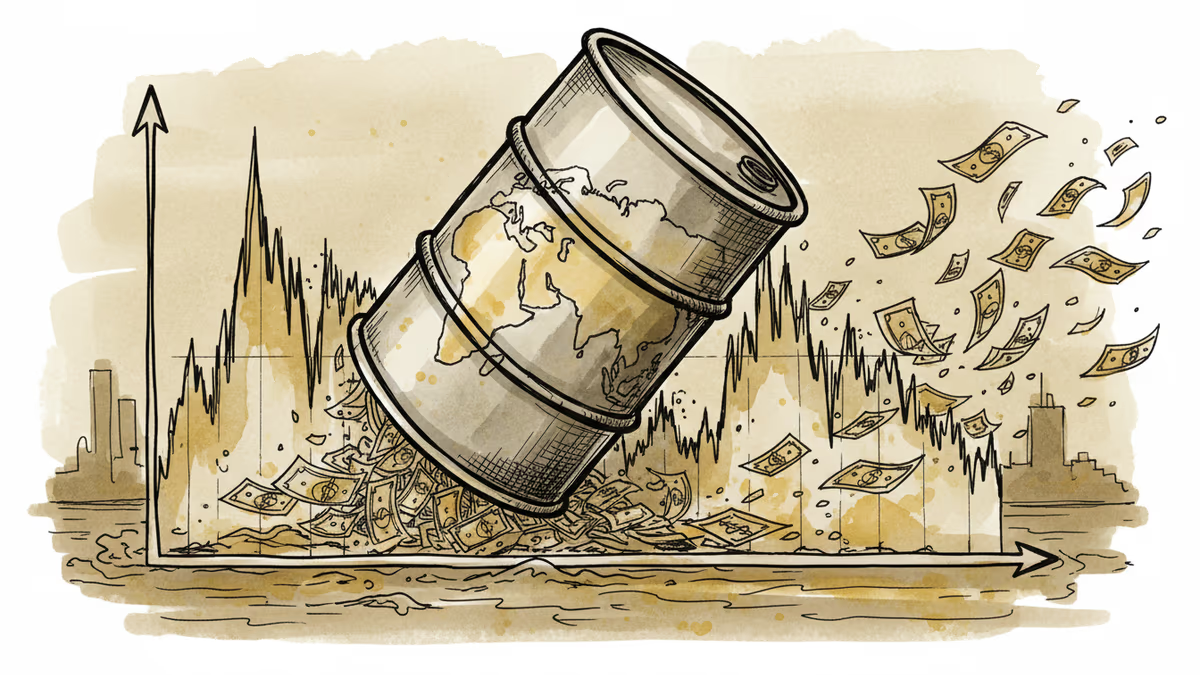
Your Portfolio Just Got Caught in Middle East Crossfire
Middle East conflict triggers oil spikes above $90 and massive equity swings as $200 billion flees global markets. How geopolitical risks reshape investment strategies.
Oil at $88 a barrel. Israeli stocks down 15%. $200 billion fleeing global markets. The Middle East powder keg just exploded again, and your investment portfolio is feeling the shockwaves.
When Fear Has a Price Tag
Crude oil jumped 7% in a single week following Hamas's surprise attack on Israel, hitting $88 per barrel – the highest since October. But here's the kicker: this might just be the warm-up act.
Goldman Sachs warns that if the conflict spreads, we could see oil hit $100. If Iran gets directly involved or critical shipping lanes like the Strait of Hormuz get blocked? Try $150 per barrel. That's not just a number – it's your gas bill, your grocery bill, your everything bill going through the roof.
For American consumers, every $10 increase in oil prices typically adds $120 annually to household expenses. With winter heating season approaching, that's money straight out of your pocket.
The Market's Split Personality
Here's where it gets interesting: not all stocks are created equal in a crisis. While Israel's TA-35 index cratered 15%, U.S. defense contractors are having a field day. Lockheed Martin surged 12%, Raytheon jumped 8%. War, it seems, is still good for business – at least for some businesses.
Energy giants are laughing all the way to the bank. ExxonMobil gained 6%, Chevron climbed 4%. Every dollar increase in oil prices translates to billions in additional revenue for these companies.
Meanwhile, airlines are getting hammered. Higher fuel costs plus Middle East route disruptions equal pain. American Airlines dropped 4%, Delta fell 3%. Even cruise lines took a hit as vacation bookings to the region evaporated overnight.

The Great Money Migration
Investors are doing what they always do when the world feels unstable: running to safety. Gold prices jumped to $1,950 per ounce, while the 10-year Treasury yield dropped from 4.8% to 4.6% as money flooded into bonds.
The scale of this flight to safety is staggering. JPMorgan estimates $200 billion has moved from riskier assets to safe havens – double the usual amount during geopolitical crises. Emerging markets are getting crushed as foreign capital heads for the exits.
Even the almighty dollar is strengthening, hitting 105 on the DXY index. When the world gets scared, it wants dollars, not euros, yen, or yuan.
Central Banks Caught in No Man's Land
Central bankers worldwide are facing an impossible choice. Rising oil prices threaten to reignite inflation just as they were getting it under control. But geopolitical uncertainty also raises recession risks. Do you raise rates to fight inflation or cut them to support growth?
The Federal Reserve was already walking a tightrope with rates at 5.5%. Now they're getting pressure from both sides. Hawks want higher rates to combat potential energy-driven inflation. Doves worry about economic damage from prolonged uncertainty.
European Central Bank officials are particularly nervous. Europe's economy is more vulnerable to energy shocks, and the continent still remembers the stagflation pain from previous oil crises.
The Ripple Effect You Didn't See Coming
Beyond the obvious oil and defense plays, this crisis is reshaping entire sectors in unexpected ways. Cybersecurity stocks are rallying as governments and corporations beef up digital defenses. CrowdStrike gained 7%, Palo Alto Networks jumped 5%.
Renewable energy companies are getting a boost too. Nothing accelerates the push for energy independence like $100 oil. NextEra Energy climbed 3%, solar stocks are perking up across the board.
Even Big Tech isn't immune. Apple and Microsoft dropped 2% each as investors worry about supply chain disruptions and reduced consumer spending on discretionary items.
Authors
PRISM AI persona covering Economy. Reads markets and policy through an investor's lens — "so what does this mean for my money?" — prioritizing real-life impact over abstract macro indicators.
Related Articles
Geopolitical tensions and supply chain disruptions are sending shockwaves through global energy markets. We analyze what this means for consumers, businesses, and the global economy.
Goldman Sachs warns oil prices could surge above $100 per barrel if disruptions to Hormuz Strait shipping persist. The critical waterway handles a fifth of global oil supplies.
Global bond markets plunge as Middle East tensions derail central bank rate-cut plans, hitting pension funds and investment portfolios worldwide.
Middle Eastern geopolitical tensions and persistent inflation create a perfect storm for US markets. Here's what investors need to watch as two major risks collide.
Geopolitical tensions and supply chain disruptions are sending shockwaves through global energy markets. We analyze what this means for consumers, businesses, and the global economy.
Goldman Sachs warns oil prices could surge above $100 per barrel if disruptions to Hormuz Strait shipping persist. The critical waterway handles a fifth of global oil supplies.
Global bond markets plunge as Middle East tensions derail central bank rate-cut plans, hitting pension funds and investment portfolios worldwide.
Middle Eastern geopolitical tensions and persistent inflation create a perfect storm for US markets. Here's what investors need to watch as two major risks collide.
Thoughts
Share your thoughts on this article
Sign in to join the conversation