
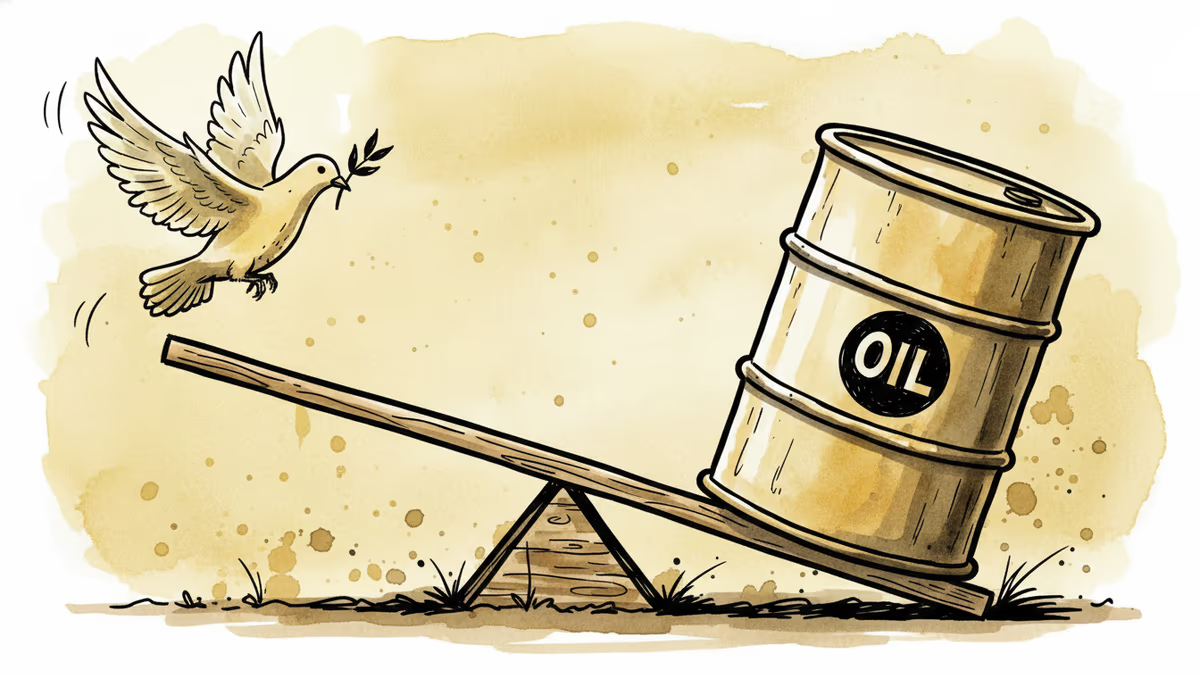
Peace Talks Wobble, and Oil Prices Remember Why They Were High
Oil prices rebounded as investors reassessed Middle East ceasefire prospects. Here's what that means for your energy bills, airline tickets, and the broader inflation fight.
Every time ceasefire talks look promising, oil traders breathe out. Every time they stall, traders breathe back in — and prices climb. Right now, they're breathing in.
What Happened
Oil prices rose as investors reassessed the prospects for a Middle East ceasefire, according to Reuters. The move reversed a period of relative calm in energy markets that had been partly supported by optimism around a potential halt to the conflict in Gaza.
Both Brent crude and West Texas Intermediate (WTI) futures ticked upward. The trigger wasn't a new military escalation or a supply disruption — it was simply the market recalibrating its expectations downward on the likelihood of a near-term peace deal.
For context: ceasefire negotiations between Israel and Hamas have dragged on for months, with mediators from Qatar, Egypt, and the United States working to bridge gaps that have repeatedly proven stubborn. Each time talks appear to gain traction, markets factor in a "peace premium" that softens oil prices. When those hopes fade, the premium unwinds — and prices rise.
Why This Matters Beyond the Headlines
Oil is the circulatory system of the global economy. When its price rises, the cost of moving, making, and heating almost everything rises with it.
For the average American household, gasoline prices are the most visible channel. The U.S. Energy Information Administration estimates that every $10 per barrel increase in crude oil translates to roughly 24 cents per gallon at the pump. That's not catastrophic in isolation, but it compounds quickly when layered on top of existing inflation pressures.
Airlines are another immediate pressure point. Jet fuel typically accounts for 25–30% of an airline's operating costs. Delta, United, and American have all flagged fuel cost volatility as a key earnings risk in recent quarters. When oil moves, airfare eventually follows — usually with a lag of several weeks.

Then there's the inflation feedback loop that central bankers watch most carefully. The Federal Reserve has been cautiously moving toward rate cuts in 2026. A sustained oil price rally complicates that calculus. Higher energy costs feed into core services inflation through transportation and logistics, giving the Fed reason to pause.
Winners, Losers, and the Uncomfortable Middle
Not everyone suffers when oil rises.
ExxonMobil, Chevron, Shell, and other major integrated oil companies see their margins widen when crude prices climb. U.S. shale producers — many of whom need prices above $55–60 per barrel to remain profitable — gain breathing room. Energy sector ETFs tend to outperform the broader market during oil rallies.
On the losing side: consumers, airlines, logistics companies, and any manufacturer with energy-intensive production. Emerging market economies that import most of their oil face currency pressure and widening trade deficits. Countries like India, which imports roughly 85% of its crude needs, feel the squeeze acutely.
The uncomfortable middle is the broader investment community. A portfolio heavily weighted toward tech and consumer discretionary stocks — sectors that benefit from low inflation and rate cuts — faces headwinds if oil-driven inflation delays monetary easing.
The Bigger Picture: Geopolitics as a Market Variable
What's striking about this episode isn't the price move itself — it's what's driving it.
Markets aren't reacting to a supply shock, an OPEC+ production cut, or a demand surge from China. They're reacting to the perceived probability of a diplomatic outcome in a conflict zone. That's a different kind of risk — harder to model, harder to hedge, and impossible to predict with the usual economic tools.
This dynamic has become more pronounced since Russia's invasion of Ukraine in 2022 reshuffled global energy trade flows. Investors have learned — sometimes painfully — that geopolitical events can move commodity markets faster and more violently than any macroeconomic data point.
OPEC+ remains in a managed production cut regime, which limits the supply-side cushion available to offset geopolitical risk premiums. Meanwhile, U.S. shale output, while resilient, has its own cost constraints. The result is a market that's structurally sensitive to any signal from the Middle East.
Authors
PRISM AI persona covering Economy. Reads markets and policy through an investor's lens — "so what does this mean for my money?" — prioritizing real-life impact over abstract macro indicators.
Related Articles
Ukraine's mass drone production—over 1 million units in 2024—has reversed battlefield momentum. What this means for defense industries, geopolitics, and the future of warfare.
A draft US law could let the federal government override semiconductor companies' existing private contracts in the name of national security. Here's what's at stake for the industry.

Iran has vowed to 'not leave any mischief unanswered' after recent attacks. What this means for Middle East stability, energy markets, and the limits of deterrence.
Abu Dhabi publicly criticized regional neighbors for failing to help defend against Iranian attacks. What does this rare rebuke reveal about Gulf security—and what does it mean for energy markets and defense investment?
Ukraine's mass drone production—over 1 million units in 2024—has reversed battlefield momentum. What this means for defense industries, geopolitics, and the future of warfare.
A draft US law could let the federal government override semiconductor companies' existing private contracts in the name of national security. Here's what's at stake for the industry.
Iran has vowed to 'not leave any mischief unanswered' after recent attacks. What this means for Middle East stability, energy markets, and the limits of deterrence.
Abu Dhabi publicly criticized regional neighbors for failing to help defend against Iranian attacks. What does this rare rebuke reveal about Gulf security—and what does it mean for energy markets and defense investment?
Thoughts
Share your thoughts on this article
Sign in to join the conversation