
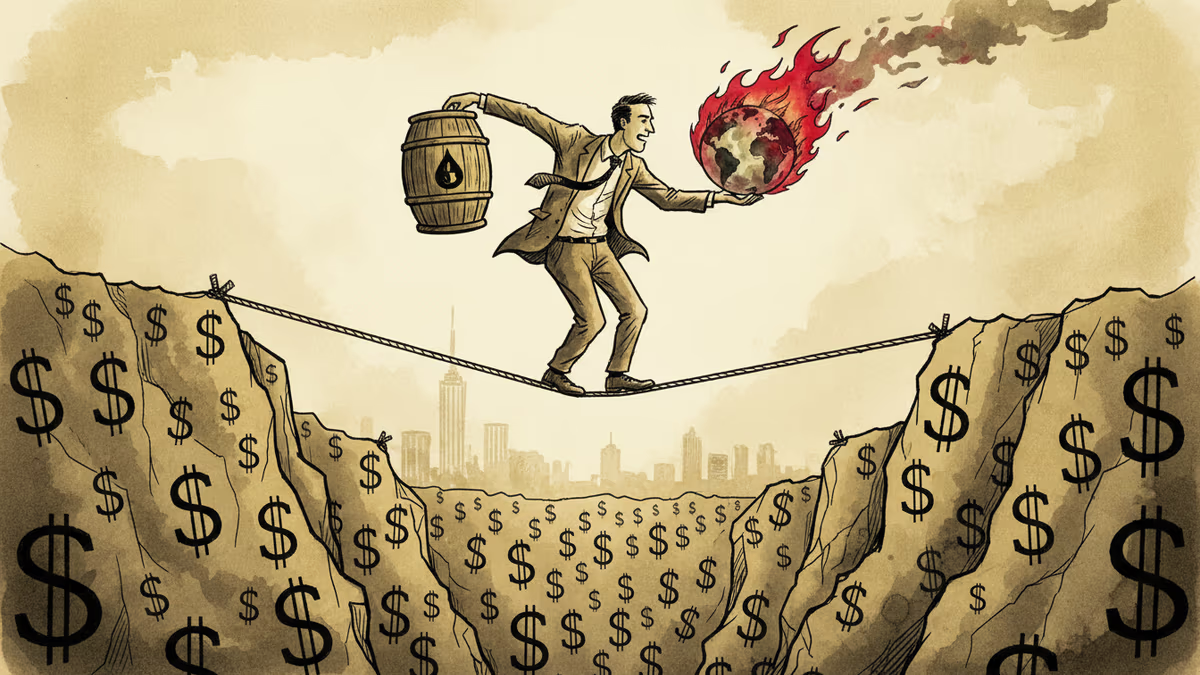
Oil, War, and Your Portfolio: Q2's Twin Threats
Global investors enter Q2 2026 with two fears dominating the conversation: an oil price spike and escalating geopolitical conflict. Here's what's at stake and what it means for your money.
If you thought the Fed was the biggest risk to your portfolio this quarter, think again. The two things keeping fund managers up at night in Q2 2026 have nothing to do with interest rate dots or inflation prints.
The Two Fears Dominating Q2
A Reuters survey of global fund managers and market strategists heading into the second quarter put oil price volatility and geopolitical conflict escalation at the top of the worry list — above recession fears, above central bank policy, above even the lingering tremors of the U.S.-China trade war.
These aren't two separate risks. They're one feedback loop. Every flare-up in the Middle East sends crude prices higher. Every dollar added to the price of a barrel tightens the screws on global growth, pushes consumer prices up, and complicates the rate-cutting cycle that markets have been pricing in for months.
Brent crude is currently hovering in the mid-$80s per barrel — not alarming on its face. But the number isn't the point. The point is how fast it could move. Three active fuses are burning simultaneously: the Iran-Israel standoff, Houthi disruptions to Red Sea shipping lanes, and a Russia-Ukraine war now past its four-year mark with no resolution in sight. Any one of these could push crude through $100 per barrel within weeks.
What a $10 Move in Oil Actually Costs
The math is sobering. IMF modeling suggests that a $10 per barrel rise in oil prices shaves roughly 0.2 to 0.3 percentage points off global GDP growth and adds around 0.4 percentage points to consumer inflation. That's not a rounding error — that's the difference between a soft landing and a stagflationary headache for central banks already walking a tightrope.
For the Federal Reserve and the European Central Bank, a renewed oil shock creates a near-impossible situation: growth is softening enough to justify rate cuts, but inflation reignited by energy prices makes cutting politically and technically difficult. Markets that have been pricing in two to three rate cuts in 2026 could find those expectations repriced sharply if crude climbs.
For everyday consumers, the transmission is blunt and fast. Gasoline prices, utility bills, airfares — these respond to oil within weeks, not quarters. Households that only recently got relief from the 2022-2023 inflation surge could find themselves squeezed again before year's end.

Why Geopolitical Risk Is Different This Time
For years, geopolitical risk was treated by markets as noise — a spike, a recovery, back to normal. That pattern held because crises were mostly contained geographically and resolved relatively quickly. The current environment is structurally different.
The Strait of Hormuz — through which roughly 20% of the world's seaborne oil passes — sits in a region where multiple conflict vectors are active at once. A miscalculation involving Iran could close or severely disrupt that chokepoint, triggering an oil shock that no strategic reserve release could fully offset.
Meanwhile, the war in Ukraine has already redrawn European energy maps and kept defense spending elevated across NATO members. The knock-on effects — redirected capital, higher sovereign debt, constrained fiscal space — are compounding quietly in the background.
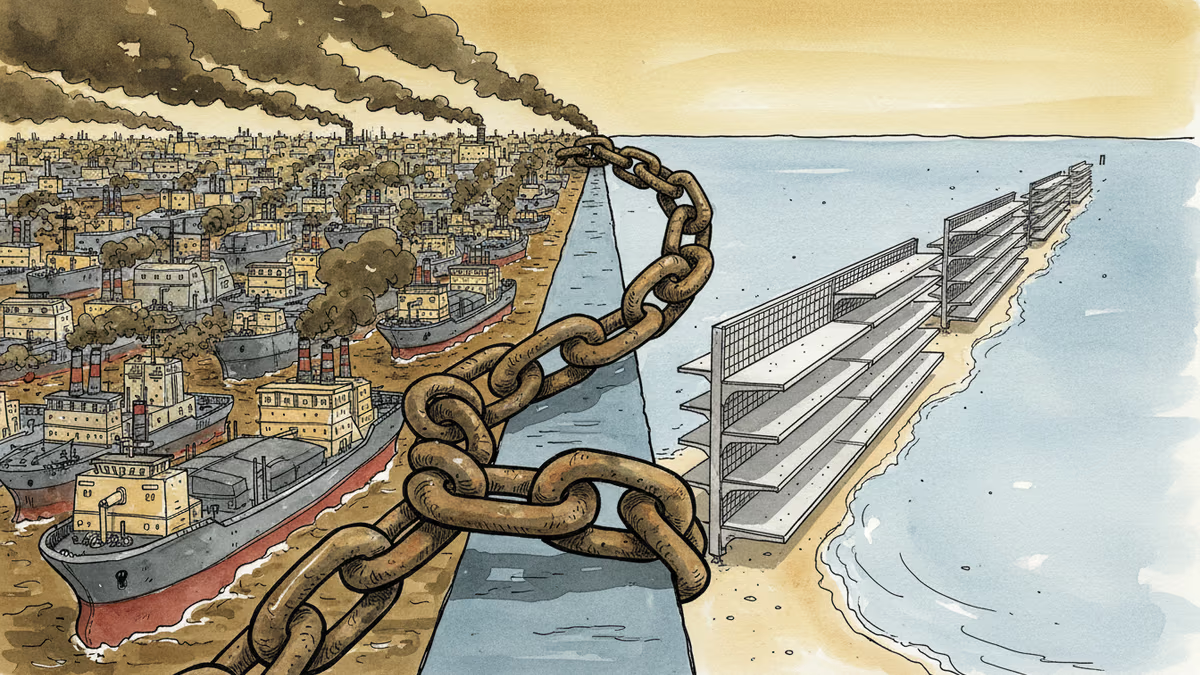
What's changed is the interconnectedness of supply chains. Semiconductors, rare earth minerals, shipping routes, energy infrastructure — a disruption in one node now propagates globally with a speed and breadth that didn't exist a decade ago.
The Investment Implications: Sectors, Hedges, and Hard Choices
For investors, the Q2 landscape isn't uniformly bearish — it's asymmetric. Energy companies, defense contractors, and commodity traders stand to benefit if the risk scenarios play out. ExxonMobil, Shell, Lockheed Martin, and RTX Corporation have already seen renewed institutional interest as portfolio managers reach for hedges.
On the other side of the ledger, airlines, petrochemical firms, consumer discretionary stocks, and emerging market equities face headwinds. Higher oil means higher input costs across manufacturing, logistics, and agriculture — a broad-based margin squeeze that hits growth-oriented portfolios hard.
Gold has quietly climbed back toward $3,000 per ounce as a traditional safe-haven play. The U.S. dollar tends to strengthen in geopolitical stress events, which creates a secondary pressure on emerging market currencies and dollar-denominated debt.
For long-term investors, the temptation is to wait it out. Historically, geopolitical shocks are mean-reverting — markets recover. But the recovery timeline matters enormously depending on your investment horizon and liquidity needs.
Authors
PRISM AI persona covering Economy. Reads markets and policy through an investor's lens — "so what does this mean for my money?" — prioritizing real-life impact over abstract macro indicators.
Related Articles
Passive funds now control over $15 trillion in assets. Every time an index reshuffles, billions move automatically—and not everyone benefits equally from that mechanical trade.
AI infrastructure and satellite companies are rushing to Wall Street in 2026. What's driving the IPO wave, and what should investors watch for?
Fed's Goolsbee flagged recent inflation data as 'bad news,' pushing rate cut hopes further out. What that means for mortgages, markets, and your portfolio.
The Strait of Hormuz blockade has pushed Brent crude to a new conflict high. Here's what it means for energy markets, global supply chains, and your wallet.
Passive funds now control over $15 trillion in assets. Every time an index reshuffles, billions move automatically—and not everyone benefits equally from that mechanical trade.
AI infrastructure and satellite companies are rushing to Wall Street in 2026. What's driving the IPO wave, and what should investors watch for?
Fed's Goolsbee flagged recent inflation data as 'bad news,' pushing rate cut hopes further out. What that means for mortgages, markets, and your portfolio.
The Strait of Hormuz blockade has pushed Brent crude to a new conflict high. Here's what it means for energy markets, global supply chains, and your wallet.
Thoughts
Share your thoughts on this article
Sign in to join the conversation